
by Emma Riva
If a fine art conservator’s good, you’ll never know they were there, so it’s rare to get to see one in action. But conservators Ana Alba, Patricia Buss, Cindy Fiorini, Cricket Harbeck, Jessica Keister, Patty Huss West, Rhonda Wozniak, Kate Pirilla, and Aaron Regal were hard at work at the Maxo Vanka murals at the September Paint the Town Maxo fundraiser.
For those unfamiliar, the Vanka murals are a series of 25 frescoes inside of St. Nicholas Croatian Church in Millvale, PA. Vanka, a Jewish immigrant from Zagreb, arrived in Millvale in 1937 and completed the frescoes across a period of 1941-1951. Vanka’s murals, though they are inside of a church, are powerful testaments to social justice and immigration history. Vanka is quoted as saying: “I painted so that Divinity in becoming human, would make humanity divine.”
Save Maxo Vanka is an nonprofit organization dedicated to the physical conservation of the murals and the educational legacy of their message. This mission, however, takes what all of us in the arts seem to be looking for: cash. “Paint the Town Maxo” was the second fundraiser of its kind for Save Maxo Vanka. But its meaning is far more than fundraising itself.
Conservator Naomi Ruiz pointed me to Joanne and Paul Billig, a couple from Youngstown, OH who had chosen to celebrate their 65th wedding anniversary at Paint the Town Maxo. “My grandparents were married here in 1915 here and my father was the first child, baptized here in 1916,” Joanne Billig said to me. The pair were kind enough to let me bother them for a few minutes during their anniversary dinner, but their story is a shining example of the murals’ enduring power. “About twelve years ago, we brought our kids to the murals and they still remember that—one of our daughter-in-laws saw this event on Facebook and bought us tickets for our anniversary,” she explained.
Jessica Keister and I later gossiped about a well-known conservator (something of an oxymoron) who I won’t name because of his famous penchant for suing anyone who he sees as tarnishing his character. But she noted that in Pittsburgh, the community of conservators she works with is supportive and kind. “It’s only in the last decade that conservation has focused on outreach and education,” Keister said. Paint the Town Maxo allowed for some recognition of the work they do, which is no joke. “When the Canadian wildfire air was here, that was the kind of air that was around during painting the murals. That’s the dirt we’re cleaning off.”
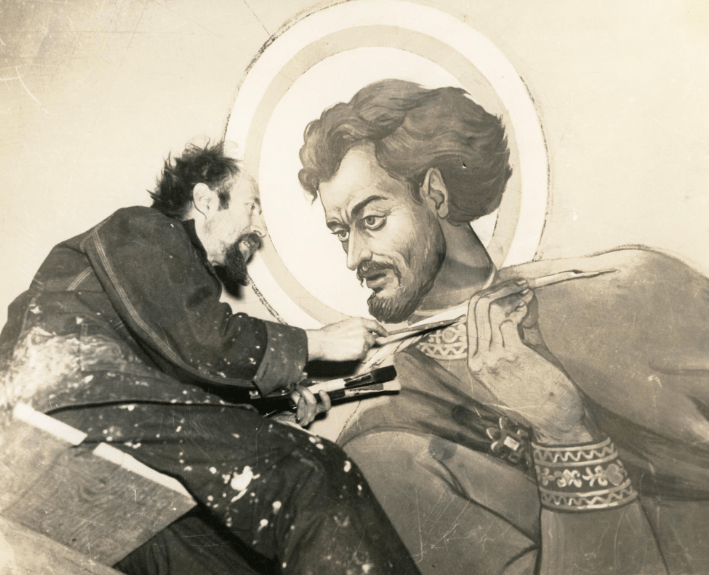
When I asked Kate Pirilla about her experience conserving the murals, she said: “I can’t help but think of the photos of Vanka painting, the rickety sparks and scaffolding. There was no safety at all and he did it so fast.” In those photos of Vanka, you can see the fervor in his eyes and the precarity of the whole setup. Vanka knew he was not just painting the inside of a church, but rather making a political statement. “I like the labor aspect of the murals,” Pirilla expanded. “There’s this common thread throughout Pittsburgh history of advancing workers’ rights. The only reason these paintings survived was because of immigrant labor.”
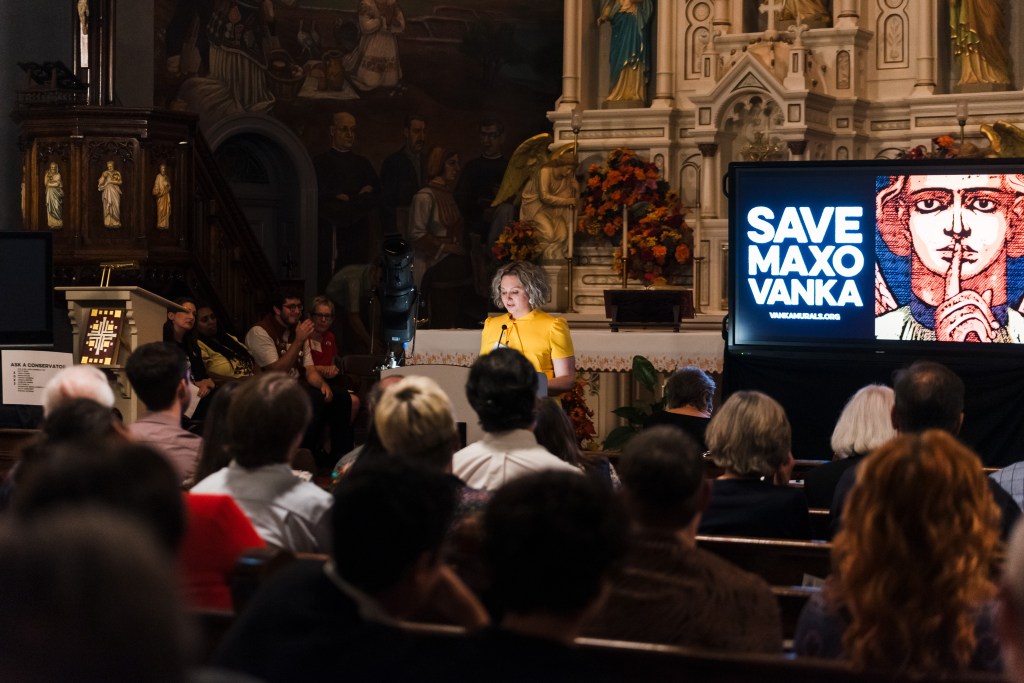
One of the most affecting images in the Vanka murals is Justice: an angel in the corner in teal and crimson. Something about its eyes and the space between them draw me in. Its eyes are a little too far apart, rendering it uncanny. That same face shows up on the “save Maxo Vanka” flier on the conservators’ scaffolding. There is something haunting about Vanka’s figures, but not in a scary or threatening sense. The whole chapel glows as if light emanates from Vanka’s paint itself. As I walked around, I heard murmurs of “Every time I come I see something I haven’t seen before.” The counterpart to Justice is Injustice, or as one guest called it, “scary gas mask nun.” Injustice dials up the uncanny element of Vanka’s figuration to eleven, with piercing brown eyes behind a military gas mask and a bleeding sword gripped in its glove. One of the artists on staff later remarked to me that there’s an in-joke that the murals are “straight up psychedelic” and that microdosing while looking at them would be a worthwhile experience.
Though there were no psychedelics, Paint the Town Maxo did a solid job of including a lot of different media for people to access the murals and the experience through, including live music by Mary Mack, portraits by Sophia Pappas, and a scavenger hunt for the murals by artist Maggie Negrete with an easy and a hard mode. If you’d like to know which aspect she thinks is the hardest to find, here it is—if you go visit as I hope you are convinced to do by the end of reading this piece, good luck:

When we sat down in the main chapel to hear remarks from the education team, Roman Benty threw the audience into the deep end by having everyone unfold their programs to reveal a blank space asking: “What is your definition of love?”
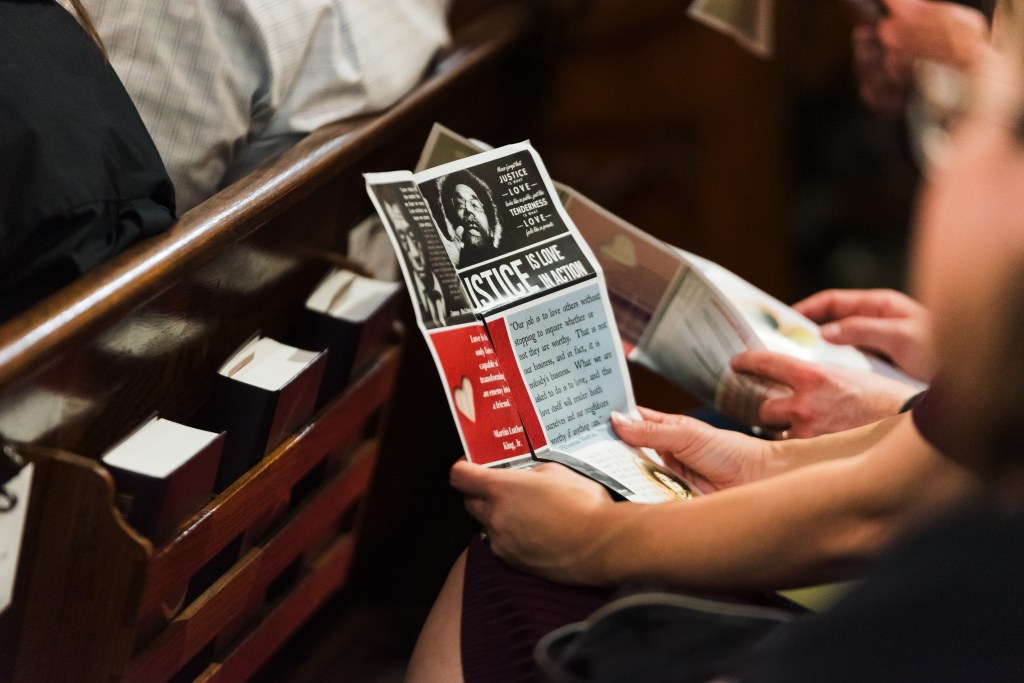
The person sitting next to me whispered: “I thought about that and panicked.”
This question seems to existentially follow me wherever I go, even when I try not to think about it. I stared down at the blank space and borrowed a pen from my pew-neighbor to write. Love is the delicate work of conservation, I attempted. What does this mean beyond a platitude? I don’t know, What I do know is that at Paint the Town Maxo, we saw an example of James Baldwin’s definition on the flier—“as a state of being, or a state of grace – not in the infantile American sense of being made happy but in the tough and universal sense of quest and daring and growth.”
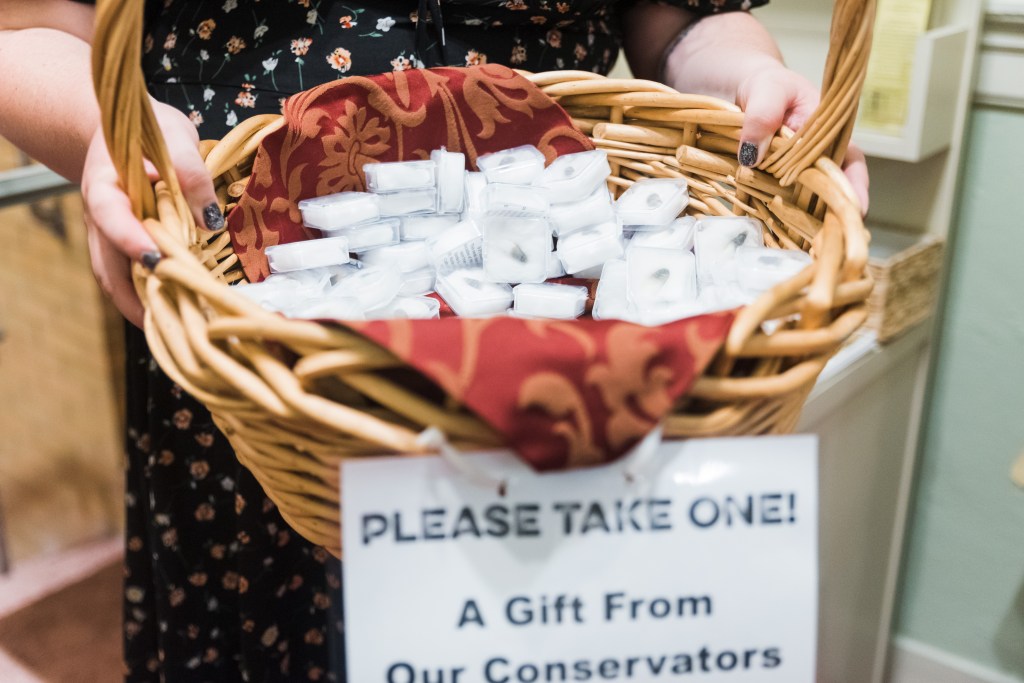
That love is not only the nuclear family or a couple, but a community recognizing the ways we collectively need each other. One of the gifts attendees received was a swab of grime from the conservation efforts. Yes, Paint the Town Maxo was a fundraiser, but it hardly felt corporate. What other fundraiser gives you a literal piece of dirt from the walls of a historic preservation relic to take home?
Whatever love is, whether it makes you panic or fills you with joy, I think we can agree that it helps reveal the glow underneath the grime. But the grime is part of it, too. Maybe it’s decades of Pittsburgh soot. Or maybe it’s the swab. Either way, it was in the chapel of St. Nicholas Croatian Church with me.
The Maxo Vanka murals will be open for tours starting 10/31 with brand new conservation works on display.

 PETRICHOR
Leave a comment