
“What song do you want played at your funeral?” Usher Olivia LeSuero asked at the door of Katie Mack’s one-woman show, #UglyCry. This was not something I thought about often. I picked “There Is A Light That Never Goes Out” by The Smiths. (“And I want people to dance,” I added). I had just been at the downtown gallery crawl, where when I mentioned I was heading to see #UglyCry my friend who was an attendant at one of the galleries said that that Mack had come in with her flier for #UglyCry. “We aren’t allowed to do that, but her concept was so funny I wanted to let her,” she said. Mack’s mixture of confidence and self-effacing humor endear people to her in this way.
I met Mack, fittingly, on Instagram and was immediately drawn to her engagement with uncomfortable conversations and her no-holds-barred vulnerability. #UglyCry isn’t a traditional one-woman show, and it isn’t exactly what you’d expect from immersive theatre, either. It invites people to bring their phones in with them. The basic premise is this: “After the death of her ex-boyfriend, this grieving, social media-obsessed millennial brings him back to life with her phone. Based on a true story.” Mack’s deceased ex, Eric Anthamatten, was a philosopher who studied self-actualization, so Mack uses his own philosophy papers to try and figure out if he can self-actualize from beyond the grave on the internet.
In line, LeSuero said to one passer-by “I like your Margaritaville shirt. Is Jimmy Buffett your funeral song?” Someone else picked Kansas’s “Carry on My Wayward Son.” These were then compiled into a playlist that made the backdrop of the intro of the show. As soon as we entered the black box, Mack friends someone on Facebook. There’s an intimacy to swapping socials I had never really considered, even though I do it all the time. You’re exchanging a tiny morsel of yourself with someone.
Once I entered the black box, I was met with QR Codes surrounded by neon signs that director Susanna McDonald said they had lifted from Facebook Marketplace to make the outskirts of the theatre look like a photoshoot set. One QR led me to a Google Drive link asking me what was my dream date, with example of a meal cooked by Jeremy Allen White of The Bear. In hindsight, does Jeremy Allen White actually know how to cook like his character on The Bear? I suppose it’s a dream date, so he could, since it’s only what we can piece together of his presence from our imagination, much like the ephemera of Eric Anthamatten scattered across the internet. Regardless, only God and Katie Mack’s management team know my answer to the question, but I punctuated it with an all-caps LMAO for good measure. Others led to Instagram filters including “crying<3” and “old to young.” In an early monologue, Mack describes the Internet as like elementary school, “little, entitled humans showing each other body parts, mathematics, and lunches,” but professes that she loves it. She does much of this while on a treadmill, by the way, with an impressive amount of breath control and charisma.

It’s painful to watch Mack cycle through self-blame through her own old videos and photos—at one point, she rewinds through her own memory to the night she and Anthamatten met, and wonders if she had done one thing differently, if he would still be alive. Through the use of deepfakes, she plastered Anthamatten’s face onto various video and photos. A recurring digital character is Dalton, a guy she’s dating-but-not-dating who keeps calling her and at one point declares that he loves her over text. She “like” reacts to the message, then they barely speak for six months until she needs someone to pick her up from a colonoscopy.
Needs. As much as we’d like to admit that we don’t have them, we all do. What is a lover, anyways? Someone to pick you up from your colonoscopy? To booty-call you? To confide in? Something that drew me to Mack and her work is that she has dedicated much of it to the ways modern life complicates these questions about relating to each other. Much of our emotional lives exists in this random ephemera, in e-mails, texts, and if you’re a public figure, others’ interpretations of your suffering. One of the play’s most jarring moments is when Mack pulls up a true crime video about Anthamatten’s murder, which features the commentator putting on makeup as they discuss the grisly details of his death and characterize Mack’s own behavior as crazy. Though, okay, in all fairness, the deepfakes she makes are kind of unsettling.
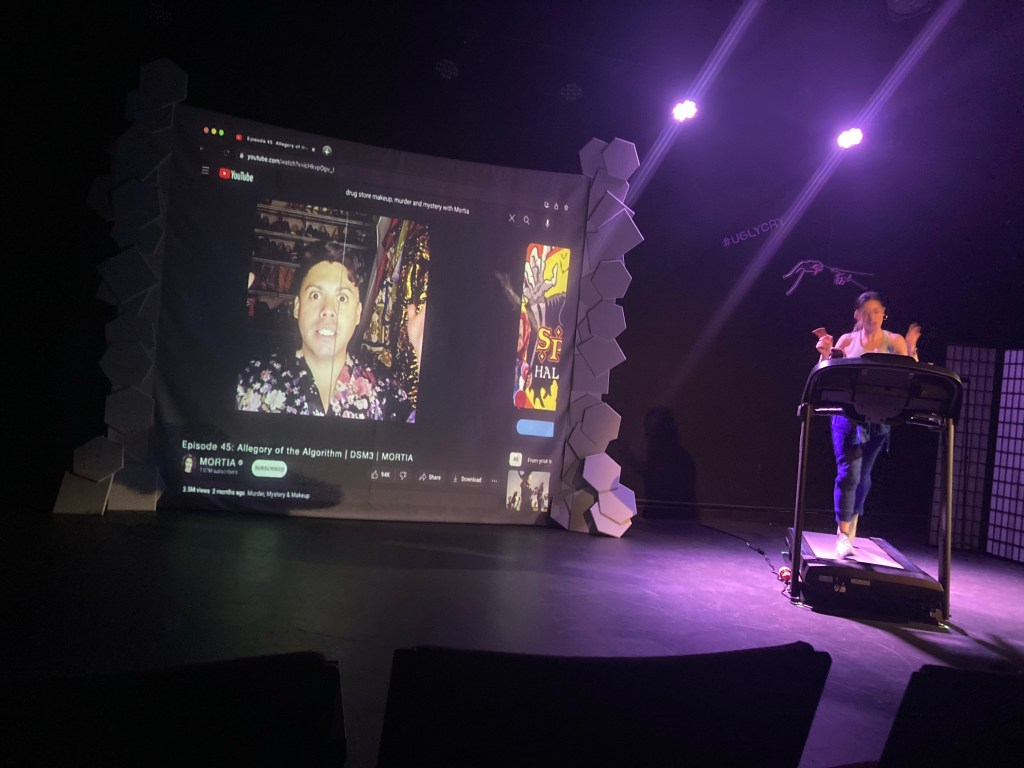
#UglyCry is a messy experience about a messy experience. It’s chaotically earnest. Mack is the glue that holds it together. She puts on a layered performance that pokes fun at the performative nature of even vulnerability itself. The narrative meanders at a few of the interactive portions in the show’s beginning, but when Mack gets going, she really gets going. Though we had our phones, Mack commanded attention.
The show’s emotional core comes from her facing her own mortality through the physical illness she experienced alongside grieving—There’s a tenderness to watching a TikTok about how to prepare for a colonoscopy alongside her or seeing her in a bejeweled hospital gown and heels. And the show’s eventual crescendo is her realization that though Eric’s death is a traumatic event for her, there is a much deeper, unprocessed pain that’s exacerbating it. What made that earlier trauma of a close friend’s death during her childhood much more difficult, she realizes, is that it wasn’t discussed. #UglyCry creates a conversation around death and grieving that Mack herself did not have.
What the play ultimately comes down to is that there is no way to avoid pain. The play shows that when we do face deep, visceral pain it reveals how much of our lives revolve around coping with that inevitable truth. We post to fill time, get beauty treatments or primp and bathe to look younger or nicer, exercise to feel productive or strong or powerful, have sex or spend time with loved ones to co-regulate our fragile, frazzled nervous systems, but at the end of the day, people we care for can still hurt us or be hurt. Or die. We ourselves could die.

#UglyCry deals with a particular kind of grief, not of an illness decaying a loved one’s body but of a death by violence. As I write this, I have other windows on my laptop open with the faces of friends of friends in Israel slaughtered in the gruesome violence of war, and I saw #UglyCry the day before Yom Kippur, a day when we face the horror and powerlessness we feel in the face of death. Illness allows for some sort of process, at the very least, but we as viewers see Mack receive a phone call with news that shatters her in a split second. The senseless randomness of Anthamatten’s murder comes through in the scattered chaos of #UglyCry.
“People say grief is love with nowhere to go,” Mack says near the show’s conclusion. “But I want to tell you: Put it somewhere.” Through its use of immersion and interaction, #UglyCry creates a place for that. It functioned, to me, almost more as an art installation than a play, a physical space for those memories that have nowhere to go. It recognizes that theatre and art are the one thing the internet actually cannot replicate, no matter how hard we try: being in a room with others. It’s gutting to know you can never again share physical space with someone you love. But a funeral, too, is a sort of performance, with its own music, customs, and etiquette. I won’t spoil some of the ways Mack creates a connection through shared space and experience. But she succeeds in finding a place to put her grief that is not just cathartic but thought-provoking, too.
For any New York readers, Petrichor has one ticket to Mack’s New York performance run of #UglyCry—happy to send it to anyone interested, DM @petrichorpgh or email petrichorpgh@gmail.com. #UglyCry runs 10/14 and 10/15 in Pittsburgh at Carnegie Stage and 10/18 through 10/28 in New York.
 PETRICHOR
Leave a comment