by Emma Riva
Most artists live with a certain degree of existential dread. But it’s rare to find a show that faces its messiness head on—and Chaotic Structures at Sharpsburg gallery Ketchup City Creative does just that. The middle ground between a large group show and a solo exhibition is a collaborative show. Rather than working with a curator, a collaborative exhibition allows artists to take the reins and play off of each other’s visions. Ketchup City Creative sees itself as more of a non-profit and community space than a commercial gallery, but Brent Pheto, Corey Ochai, and Grant Catton’s Chaotic Structures is a show that could easily stand on its own in a commercial gallery space. In the name of good art writing, I do have to disclose that all three artists are people very dear to me, but that means that I’ve gotten the opportunity to work personally with them throughout different stages of their burgeoning careers and offer my own feedback—and my air conditioner unit as part of an installation in Grant Catton’s Happily Retired in 35 Years in Accounts Payable.

For those unfamiliar with the artists, Corey Ochai is a Braddock-born painter, videographer, and producer known as the “unofficial mayor of Sharpsburg” for his community activism in town. He’s beat cancer, addiction, incarceration, and much of his work draws from how these experiences made him question the nature of freedom, free will, and personal responsibility. Catton is an Ohio Valley native whose early career in finance gave him an instinctive handle on the language of capitalism and commerce that shows up in his dense, colorful multimedia works that interrogate how the systems around us deteriorate the sense of self. Pheto, originally from the D.C. metro area, moved to Pittsburgh from Austin and makes high-concept, narrative-based pieces inspired by his legal advocacy and experiences with systemic racism. Racism, mental illness, and capitalism are three themes that the art world as a whole loves to sprinkle in thematically, but Pheto, Ochai, and Catton tackle them head on in what’s one of the highest-concept shows I’ve seen in Sharpsburg.
Chaotic Structures isn’t just about showcasing some technical ability or broad theme but is almost literary in the way the works interact with each other. It has the same cohesive feeling that Eschaton, which I reviewed for my very first post in Petrichor, did. As a novelist as well as an art writer, I pick up on themes and symbolism and how they interact with each other in the art shows I see, and Chaotic Structures is interesting because of the collaborative. The three standouts from each artist’s catalogue in the show are Catton’s Special Counsel, Pheto’s The Making of Southern Greens and Northern Green, and Ochai’s Take 2.
Special Counsel is one of the first works of Catton’s I’ve encountered that uses a flowing, rounded shape as its centerpiece. The contrasting mixture of greens and oranges inside of the painting are almost nauseating. The way Catton mixes materials has always given his work a sort of motion sickness to it—constant motion, chaos to keep out structure, structure to keep out chaos, creating a sort of ouroboros of oversaturation. For the pieces in Chaotic Structures, he slashed blocks of color over the collage, a process he described as “heartbreaking” to go over, but the slashes of color add a new dimension to the paintings. The layers in Catton’s mixed media work are a neverending pile of potential directions the paintings could have gone, but the color blocks create a sense of finality.

The Making of Southern Greens and Northern Green leans into the sense of abject existential terror and anxiety that pervades Brent Pheto’s work. But the figure in the center, clinging to a watering can and a pot, shows the duality that even as chaos seems to grow uncontrollably around you, you’re trapped inside yourself, watering your own little plants, cooking your own little meal. The figure is faceless, and something about the gradient of blue and green in its outline stands out—that the figure isn’t simply starkly black on a white background but has some small force field around it. The piece is also just a technical achievement in the precision of the white leaves’ sharp edges. Pheto often worries he bums people out with his artwork, but his ability to balance the devastating emotions around systemic problems is what makes it really work.

In Ochai’s Take 2, the artist creates an uncanny valley with a three-eyed figure, two eyes on one side and one on the other. For Chaotic Structures, Ochai leaned into what he called a “creepy” aesthetic, and said he was inspired by Travis Trium Perfectum’s Technicolor Hellscape (earlier feature in Petrichor!) to contend with darker topics. The color white is one Ochai hasn’t played much with before, and one of his strengths has always been his ability to use complementary colors. The addition of negative space in white highlights that strength in Ochai’s work even more, like how Catton’s blocks of color showcase his strengths. Ochai paints faces that aren’t quite faces, that make you look at them twice to try and figure them out.

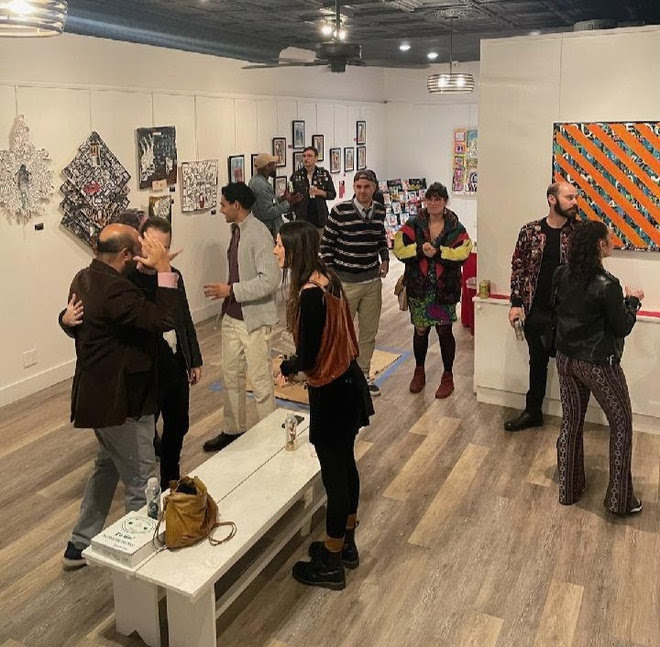
Chaotic Structures is a show that needs a long walk-through, with a plethora of surprises and subtleties within the paintings and curatorial decisions. Ochai’s section of the space is curated into the shape of a fish, making creative use of small canvases on a large wall. Ochai, Pheto, and Catton used the far wall of the gallery to showcase a collaborative piece between the three of them. But even within the individual paintings, there are commonalities. Pheto’s The Process of Finding an Advocate, Ochai’s 5th Ace in the Back Pocket, and Catton’s Algorithm / Go Ahead and Take 15% Off all contend with social media and the ways it feeds our egos and saturates us with mass information. The undercurrent of the show is this sense of depersonalization, that something is always wearing us down and disconnecting us from ourselves. And it proves, to me, that making art is the way to hold onto integrity, maintain your sense of self, and stay sane.
I will be conducting an artist talk tomorrow (10/26) at 6:30PM, and the show is open through 10/28 with a closing reception. I have a lot to say about these paintings and the secrets within them, so if you want to hear more, the artist talk tomorrow will be a great opportunity. If you’re not able to make it to either, I really encourage studio visits with each of these artists to discuss these works. It’s always exciting as a critic to see great artists working in new directions and expanding their practices. One of the joys of writing about art in Pittsburgh is getting to see and document those new directions, to be able to say “I saw the moment when that new aesthetic clicked.” So take risks. Be weird. Try chaos. Try structure. The balance is in there somewhere, waiting to be found.
 PETRICHOR
Leave a comment