by Adam Arthur
Editor’s Note: Yes, I know Halloween just ended, but Adam Arthur emailed me this piece right after the Pittsburgh Gothic piece went up and I thought it was amazing that that piece inspired someone else. I also think this adds a great perspective on how Garfield is one of the most aesthetically and culturally interesting neighborhoods of the city, with its looming hospitals, giant cemetery, and…art crawl? It’s interesting that a neighborhood full of unsettling structures is a center for nightlife and local art. Just a note: In this article, Adam references the mausoleum in Allegheny Cemetery–and I recently discovered that within it is one of Pittsburgh’s best kept art collection secrets. There are some gorgeous paintings including a few Hudson School master works inside of it, and it is free and open to the public. Thought this was worth mentioning, as Ron Donoughe told me about it and I was blown away by both the beauty of the space and the works inside of it. – ER
On October 5th of 2023, I had the honor of attending an art exhibit by Spaz, the nom de plume (or perhaps nom de guerre) of one of the Bloomfield-Garfield area’s oldhead punk rockers who has established himself as an artist specializing in the dark, the trippy, and the macabre.
Though I do not know him well beyond occasional sightings at local events, Spaz is one of the few artists in the neighborhood whose work I have been tempted to purchase on sight. Mainly in black-and-white and relying on heavy black pen, Spaz’s art reflected a grim, Boschian chaos, displaying the faces of various creatures (some more identifiably human than others) crowded together in a chaotic environment.
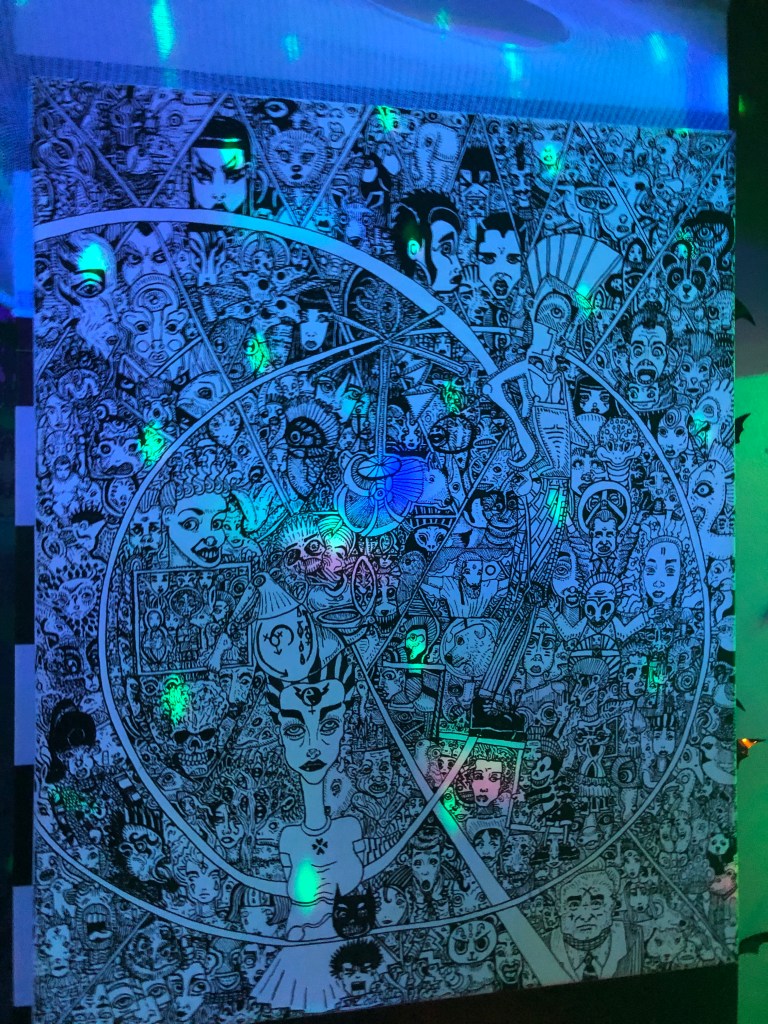
The imagery embodied the mysterious and grotesque, themes that run throughout the month of October. It was fitting that the exhibit took place at Mixtape, which has partnered with a performing arts organization called House of Burton to – for the month of October – style itself after the films of Tim Burton. This is not only seasonally appropriate, but also location appropriate.

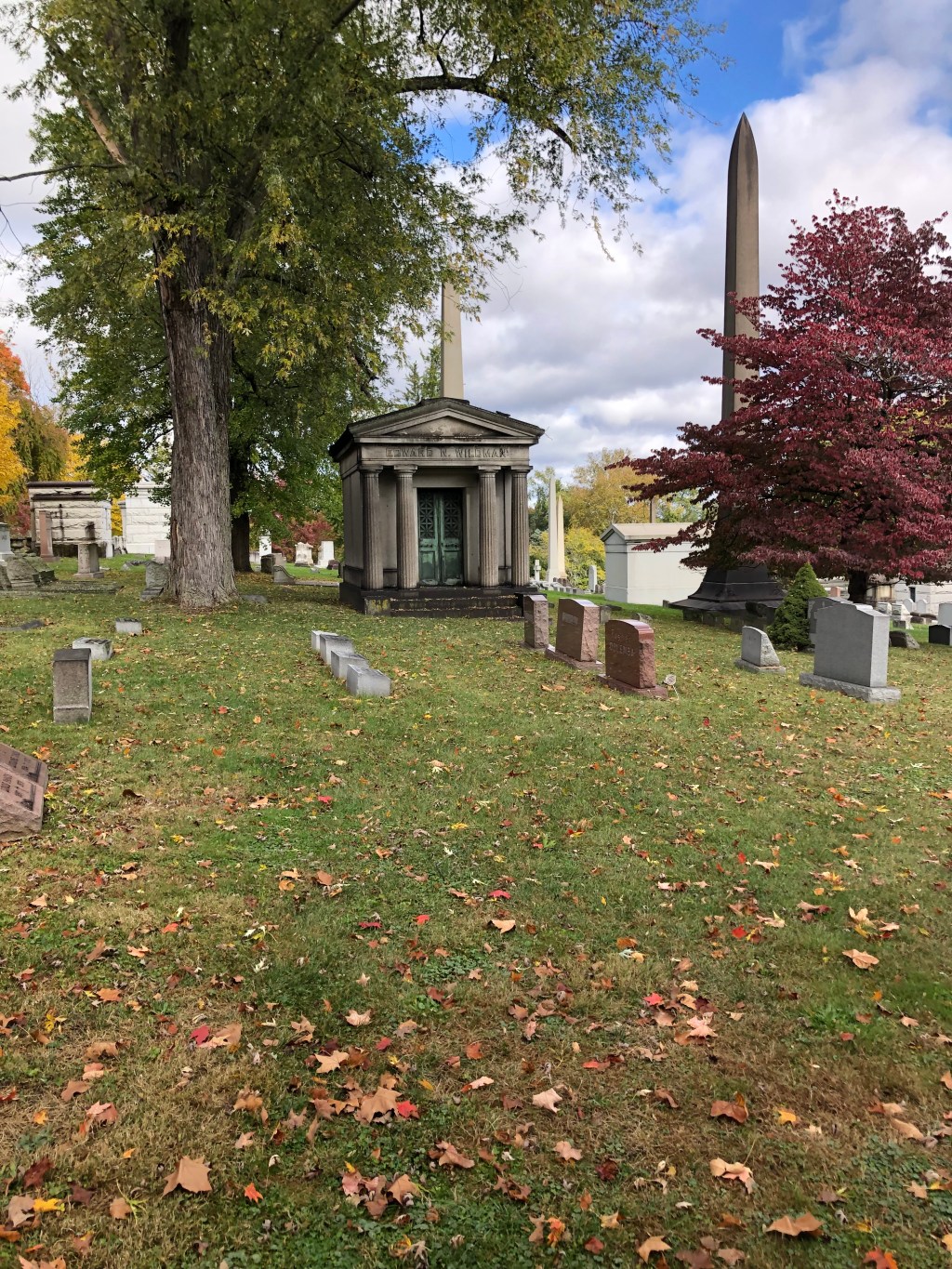
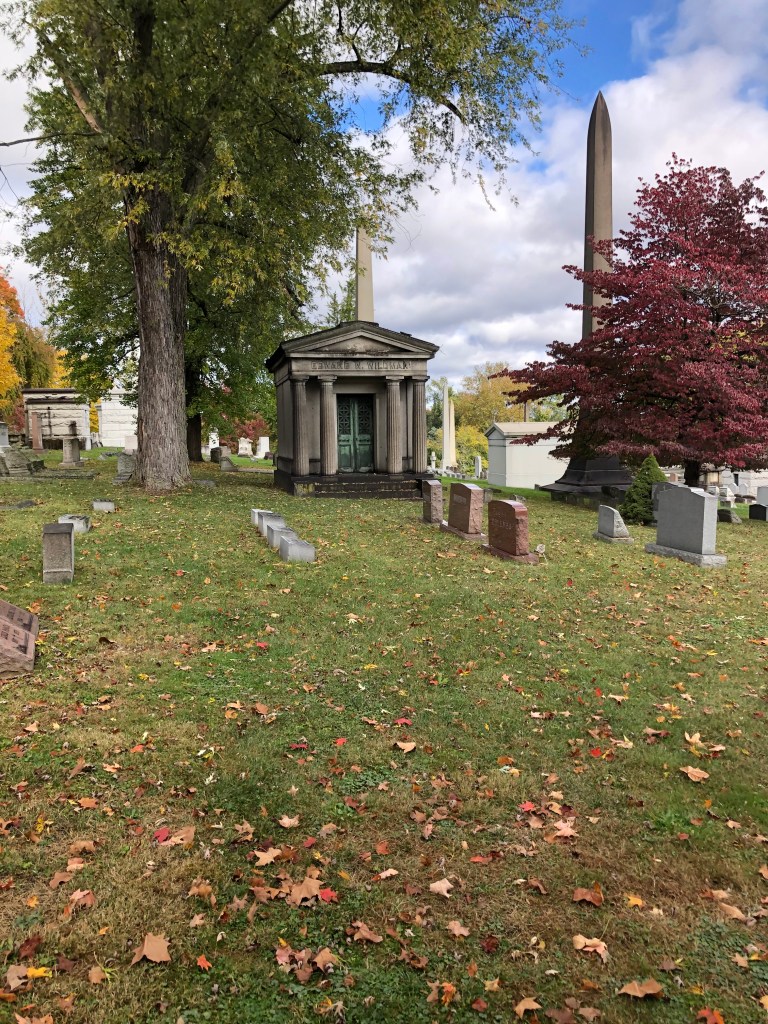
In Garfield, along Penn Avenue, one is sandwiched between two hospitals, places in which despite the best efforts of their staff, the last gasps of the dying are heard. So too does it fit that this exhibit took place within a stone’s throw from Allegheny Cemetery. While locals might mock the appearance of some of the monuments (such as the infamous “Titty Sphinx”), this serves only to diminish the grim awe with which one is faced jogging or bicycling among the mausoleums.
There is a certain level of intimidation and wonder crossing through the mock-gothic arches of the Allegheny Cemetery’s gates, finding oneself confronted with statues and structures that hint at the mysterious world beyond the veil. While the House of Burton pop-up relies on the comically exaggerated worlds of Tim Burton, that comical exaggeration also does a disservice to the majesty of the Allegheny Cemetery or other symbols of Pittsburgh’s past.
Also of note is the Center for Postnatural History, a locale that is not only macabre but “Gothic” in a classic, Frankensteinian sense. The Gothic novelists of the 18th century, such as Ann Radcliffe and Matthew Lewis, were concerned with the drama presented by the oppression of their surrounding world. Ann Radcliffe’s heroines are often, through cultural circumstances, entrapped and imprisoned by dangerous men enabled by the patriarchal society of Regency or Medieval Europe. Matthew Lewis wrote about religious corruption, entwined with the rapacious lust of his titular villain in The Monk. Carrying on this tradition was Mary Shelley, whose novel Frankenstein took aim at the twin evils of toxic masculinity (though the term as such was not used in her day) and humanity’s manipulation of the environment. The latter theme, unsurprisingly, is one that an individual will find in the confines of the Center for Postnatural History.
Visiting the Center is a dark, spiritual experience – one is surrounded by taxidermied animal corpses and skeletons, such as one might find in some ancient wizard’s lair. The content is at times frightening and depressing, as audio narration tells the visitor how human beings have used genetic manipulation to control and enslave not only animals, but each other. In a way, the flippant, sarcastic, and acerbic tone stereotypically attributed to Pittsburghers can be viewed as a reaction to the macabre.
What better way to keep the darkness at bay than to roll one’s eyes at it? Nowhere can this darkness be found more than in the heart of Pittsburgh, beneath the looming spires of Allegheny Cemetery’s gates, or in the dimly lit halls of the Center for Postnatural History. Even beyond the 31 days of October, of Autumn’s chosen “spooky month,” Garfield’s residents and visitors embrace the macabre.
Adam Arthur holds a graduate degree from Florida State University. He is the author of two poetry collections, Levers of Power and Sound and Substance. A transplant to Pittsburgh, he has lived in the area for three years and takes inspiration from his surroundings in his written work.
 PETRICHOR
Leave a comment