
by Emma Honcharski
Cover image by Jennifer Shin. Editor’s Note: The following is a curatorial statement from Emma Honcharski, a writer, artist, and curator who is a recipient of Brew House’s Prospectus fellowship for her exhibition BUTTERY SPREAD. I hope reading this makes you excited about the show! Please go! Details at the end of the piece. – ER
Consider the reciprocity of fungi delivering nutrients to soil and that soil becoming a home for plants to take root, or pollinators fertilizing flowers and those flowers bearing fruit and seeds. Consider what these relationships and systems make possible through their collaborations. Consider the many hands that our food passes through before it reaches us.
Now consider sharing a book with a friend, sharing a meal with a neighbor, sharing an experience with whomever is in this room with you right now.
Food can provide a sense of belonging, an entry point into new relationships, a connection to powers greater than us. Food is a way that I find narrative structure in my daily life, a way to see the threads that run through us all.
With food as a subject and a medium, less context is needed to make sense of what we’re seeing and sensing. The entry point of understanding shifts and questions of meaning-making can come from a shared place of knowing. For example, Sarah LaPonte’s Corn Boat is a boat that looks like an ear of corn. This playfulness and whimsy creates clarity that can lower apprehensions about engaging with a piece of art. With Corn Boat, LaPonte creates something that makes people stop and wonder, disrupting space the way performance art might, without requiring active engagement. (LaPonte has also created a baked potato boat and a lobster boat, but neither were seaworthy.)
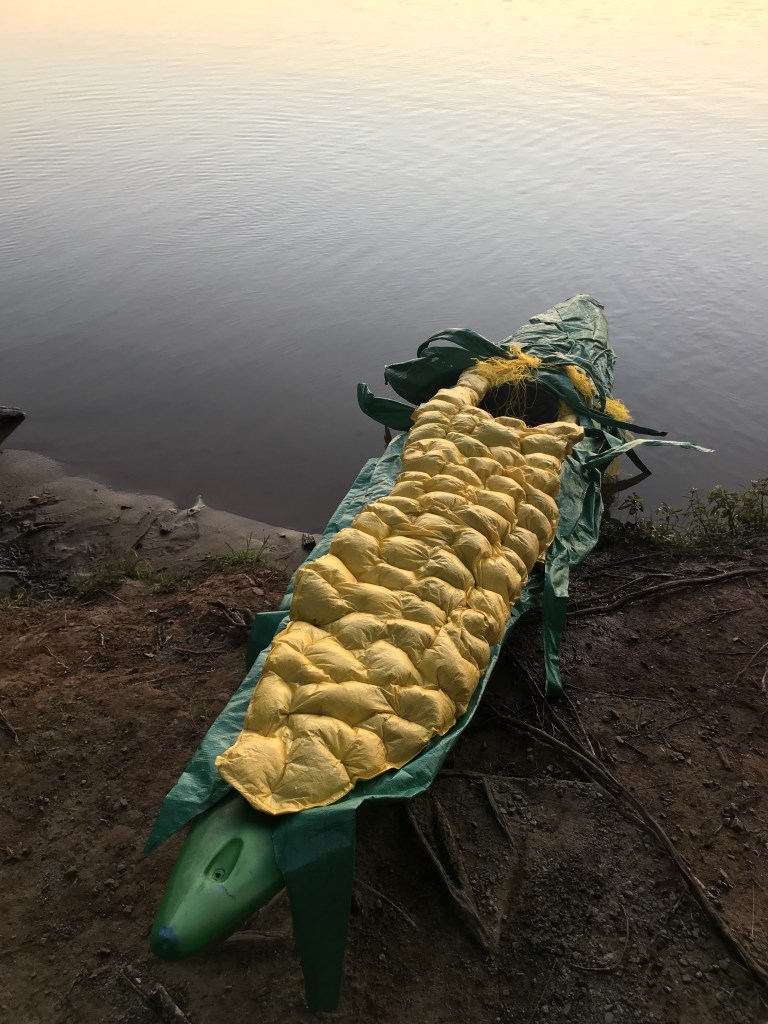
The romance, magic, and harsh realities of the restaurant industry come up in much of LaPonte’s work, offering outsiders new ways in and insiders new ways through. Her work in the reading room reminds me of how friendship manifests itself through writing, and how our practices are a part of our lived experiences.
All of our experiences of eating are possible because of a long chain of labor, almost always underpaid and incredibly skilled. May all of the time we spend engaging with art and media about food bring us closer to an understanding of the people who do this work, the immediacy of the climate crisis, the ways we are all harmed by late stage capitalism, and the ways we can eat with intention. May we be kind to all service workers and buy food from our neighbors instead of Jeff Bezos, whenever possible.
Labor is also present in Steph Neary’s work, which connects us through time and space to women’s work and crafts of the past. Her pieces bring folkloric magic to the space with storytelling through soft sculpture. Using reclaimed materials, she bridges fine art and craftwork to share a playful world with us.
Neary is the director of VaultArt Studio, a progressive art studio and project of Achieva, which advocates for, empowers, and supports people with disabilities and their families throughout their lives. Neary’s own art practice is separate from her work with VaultArt, as was the curatorial decision to include work from artists that use that studio. Still, this connectivity shows how systems of artists come together to create the show as we experience it.
Buttery Spread features a bounty of artists’ books and publications, objects that don’t always find a home in gallery shows. Believing in the power of printed material means creating space for artists’ books in galleries as a way to continue legitimizing this art form as its own medium. Accessible in function, form, and price, the artist book is a primary practice for many artists and a way for a greater number of people to engage with their work. I’m interested in engaging with galleries as third places, the way we spend time in public libraries or glorify European-style cafes. Who inhabits galleries comfortably, and how can we explore new ways to engage with artists’ many offerings? Incorporating books into gallery shows means seeing writers as artists and artists as writers, and recognizing the full range of ecosystems present in our practices.
A few months before the Pittsburgh Art Book Fair (which Chas and I co-directed, along with Caroline Kern, Mary Tremonte, and Jacquelyn Johnson), Pat McArdle, a local art collector, showed me one of his recent acquisitions: a book with the pages painted shut, which he had purchased from Lauren McCoy, also an artist at Pittsburgh’s VaultArt Studio. McCoy’s series of painted-shut books present a different mode of storytelling than the rest of the publications in the reading room. These works can shift our perspective on what books can be, asking us to think twice, but not too hard.
Just across the street from VaultArt Studio, in Pittsburgh’s Garfield neighborhood, JR Holtz’s mixed media works—which often include ladies in bikinis, athletes, and Pittsburgh cityscapes—have activated the walls at Spak Brothers for years. I became familiar with Holtz through this association with a food landmark in Garfield; Holtz’s paintings on glass feel like a living part of Pittsburgh. They resemble Howard Finster’s works, if Finster were a secular Steelers fan.
I am grateful to Josh Rievel for the work he does in sharing Holtz’s work with new audiences and making it possible for Holtz’s work to be in this show. Relationships that uplift and support others’ practices are as necessary as the balance of salt, acid, fat, and heat in any meal.
The Prospectus residency program has created an opportunity for me to reconsider a curator’s role, especially in a time when many people identify with the title. I believe that being a curator has to do with building relationships, creating connections, seeing threads of commonality, making meaning in patterns, valuing narratives, and finding ways to share with others the things that move us.
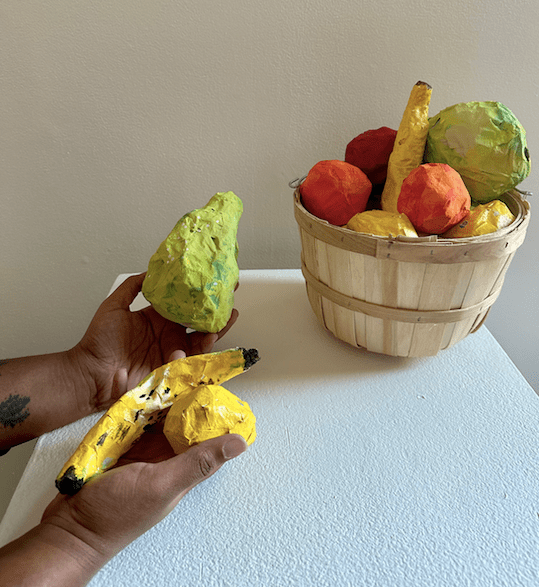
This sense of connection and understanding create ease that can be truly delightful. Familiarity comes in many forms, and Imin Yeh’s sculpture plays with this through a 1:1 ratio. How does it feel to see a triangular risograph-printed piece of paper and know that it is emulating a Cool Ranch Dorito? May we enjoy this creativity in form and materiality, this playful dance between edible and inedible, and this willingness to expand our horizons on what both food and art may be.
Isn’t it great not to worry if we’ve missed the point? May this food help us feel secure, tuned in, joyful.
Buttery Spread opens 11/9, 6PM-9PM at Brew House Association (711 S 21 St). Emma Honcharski (b. 1996, New York) is a media person, artist, writer and coordinator rooted in Pittsburgh, PA.
 PETRICHOR
Leave a comment