
by Adam Arthur
There is no better day than Veteran’s Day (or the day after it) to pay a visit to Soldiers and Soldiers Memorial Hall in Pittsburgh, PA. Established in 1910 by Pittsburgh-based military veterans, Soldiers and Sailors contains a significant collection not only of military paraphernalia but also local art pieces.
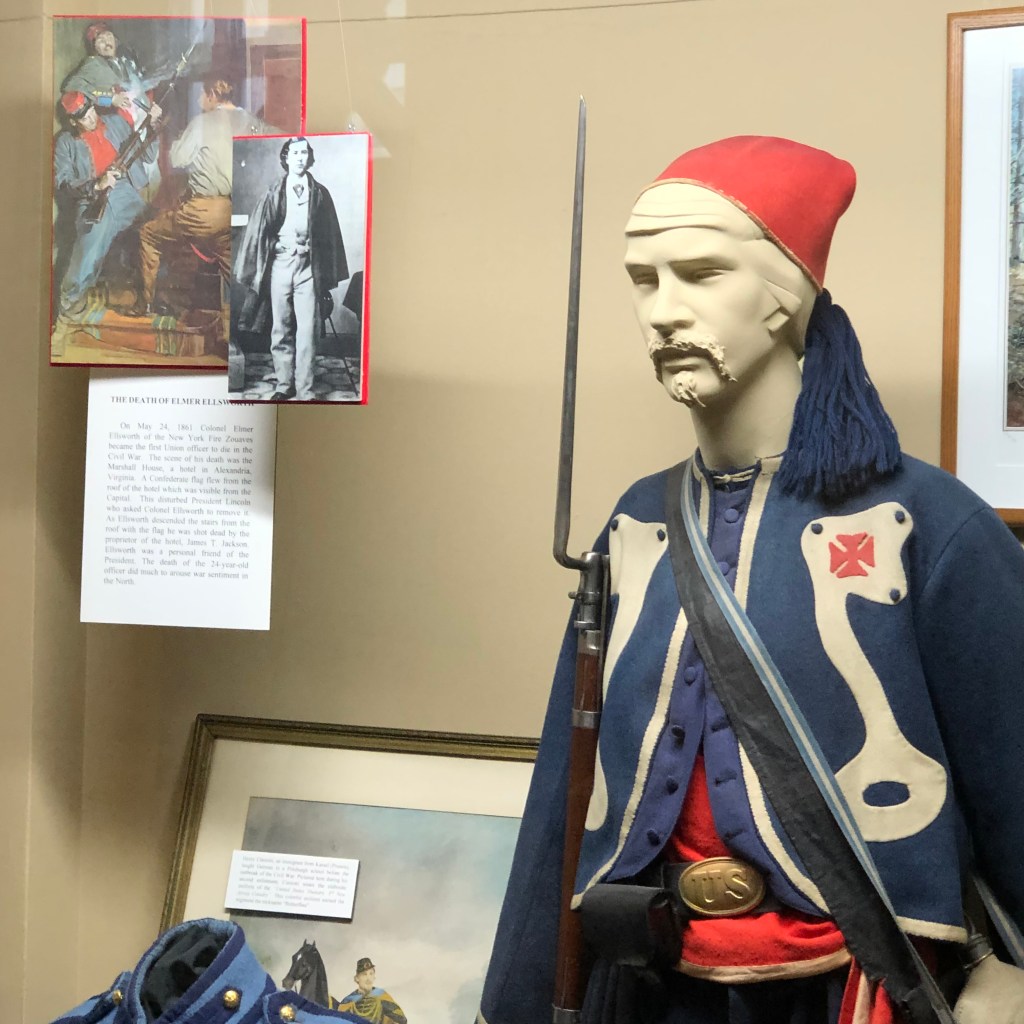
The local connection ought to be readily apparent. A significant portion of the museum’s displays are devoted, for example, to Colonel Elmer Ellsworth, whose name adorns one of the main commercial streets of Pittsburgh’s Shadyside neighborhood. Another exhibit discusses the service of Private Thomas Enright, a Pittsburgh native and one of the first soldiers to die in combat during World War I.
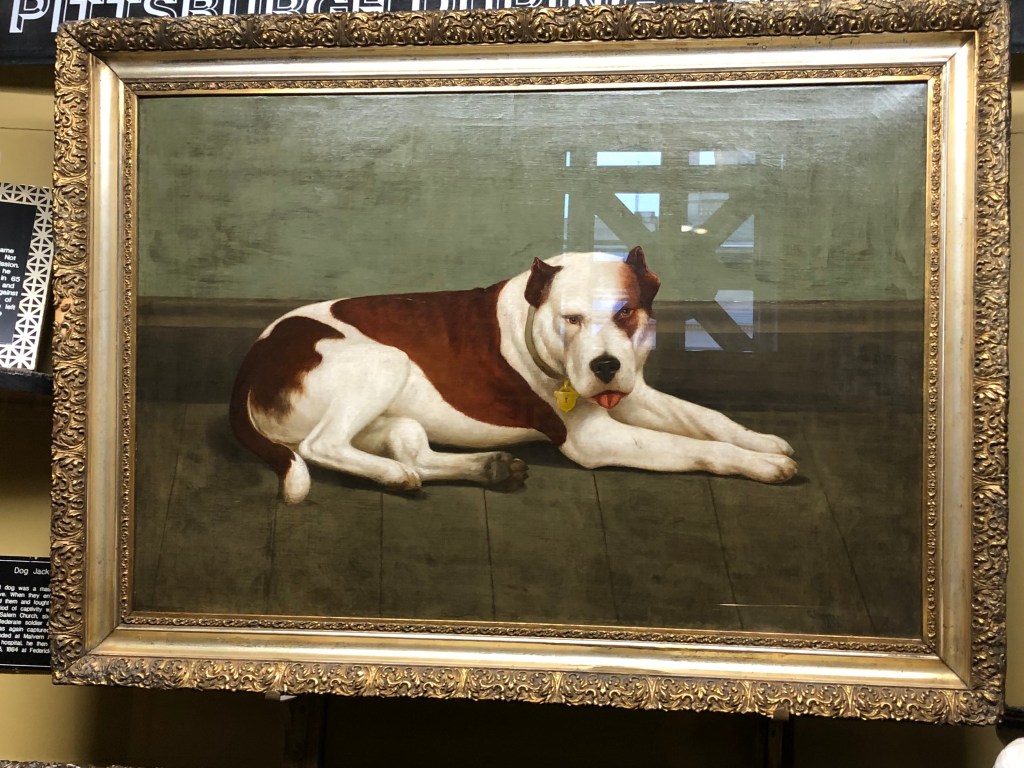
As far as art, the work of late Pittsburgh artist Ivo Zini can be found on display – specifically, a bust of the head of John F. Kennedy, the World War II veteran turned United States president. Other works of interest include a model of the U.S.S. Pittsburgh and Robert Taylor’s painting “The Bridge at Remagen”. One of the saddest tales portrayed in the art pieces at Soldiers and Sailors features in a portrait of “Dog Jack”, a canine fire mascot native to Pittsburgh’s Penn Avenue who was left missing in action. Another portrait, this one by Jasper Holman Lawman, depicts Schenley Park when it served as Camp Howe during the Civil War.

Visiting the Soldiers and Sailors Memorial Hall is an intellectually engaging experience not only for art buffs, but also politics and history buffs. I attempted to visit the museum with the mindset of the former, but found myself bringing my experience and passions as the latter to the experience.
Specifically, when visiting any museum related to politics and history, I have found it is important to pay attention not only to what is being stated (visually or otherwise), but also what is being omitted. This is the mindset, for example, that I brought to my visit to the Woodrow Wilson Presidential Library and Museum in Staunton, VA in 2019. That museum, at least at the time, stressed Wilson’s diplomatic accomplishments and progressive economic policies, while simultaneously downplaying the 28th United States president’s virulent racism and embrace of Confederate apologia that empowered the revived Ku Klux Klan.
A similar mindset must be brought to a visit to Soldiers and Sailors. In experiencing a visit to the Soldiers and Sailors Memorial, the visitor is inundated with the aesthetics of militarism with which we as Americans find ourselves surrounded by on a daily basis.
Art and militarism, of course, have a long and ambivalent relationship. Many great myths passed down through the ages are drawn from tales that glorify military exploits in the pursuit of some aim or other – Virgil’s Aeneid, for example, is a work that extols military virtues, as are the tales of King Arthur and his Knights of the Round Table. Soldiers and Sailors comes close to following in this vein of fetishizing militarism. This is a particularly important matter to think on critically during Veteran’s Day.
When I think of the veterans in my own life, I think not of American veterans such as my father – whose service in Germany he viewed as tantamount to a leisurely cultural exchange program – but my great-grandfather on the other side of my family, Fritz Solmitz.
Fritz Solmitz was a Jewish German and minor politician in the Social Democratic Party who had served in the Kaiser’s army, only to have his own country turn against him and end his life when it descended into the darkness of murderous Fascism some decades later. I bring up the example of my own family not to write my diary or engage in a work of auto-ethnographic “me-search,” but to provide an illustrative example that it can happen here.
The fetishization of militarism can lead, if unchecked, to grim places politically. This fetishization of military affairs and society’s ostensible worship of veterans combined with the neglect (in practice) of said veterans proves sadly demonstrative. One need only look at any major city’s (including Pittsburgh’s) Downtown area to see starving veterans begging for change (both literal and metaphorical). How are we to reconcile this with a site like Soldiers and Sailors Memorial Hall that exists as a monument to the country’s veterans (or, more accurately, to the masculine-coded violence of war), while veterans too often suffer?
If approached with a critical mind, a visit to Soldiers and Sailors Memorial Hall can prove rewarding. However, it must not be visited simply as a temple to America’s military or the service of its veterans. When observing the various artwork contained within Soldiers and Sailors, a visitor must grapple not only with what they see before them, but what is being hidden from view.
Adam Arthur holds a graduate degree from Florida State University. He is the author of two poetry collections, Levers of Power and Sound and Substance. A transplant to Pittsburgh, he has lived in the area for three years and takes inspiration from his surroundings in his written work.

 PETRICHOR
Leave a comment