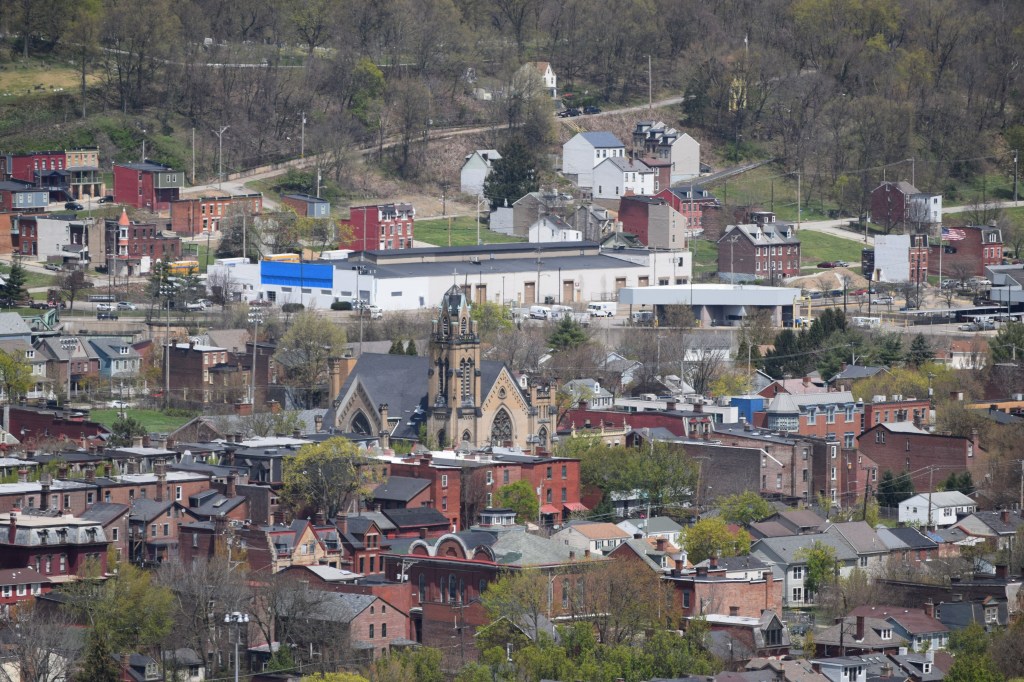
by Savin Kann
Editor’s Note: As I publish this, I just returned from a weekend out of town, more confident than ever that Pittsburgh is home. It felt like the perfect moment to publish Savin’s beautiful essay about the city. He and I have had opposite trajectories in that he moved away from Pittsburgh to New York and I moved from New York to Pittsburgh. In my cab home from the airport last night, the driver was playing Lana Del Rey music videos on his phone, and when I mentioned how much I liked her music, he turned the volume up to 11. So, the city welcomed me back with “Born to Die” blasting under a dark sky on 376. Every time I see downtown rising out of the river as I turn towards the city, I’m reminded that whether you love it or hate it here, this is a special place. Savin speaks to that.
When I was younger, I hated Pittsburgh. I would complain that it seemed boring and plain—everything an angsty teenager who was just discovering himself was against. I wanted to live in New York and “be somebody,” whatever that meant. Ten years later, I stood in my driveway at 7:00 AM, and cried about leaving my beloved hometown to move into an East Village studio apartment near NYU, the campus that I was sure I would call my alma mater when I was younger.
As a child, I always felt like Pittsburgh was on the outs. No movies or TV shows (that I knew of) took place or were filmed here, no popular songs were written about it, and it seemed like every famous story about the city revolved around missing planes in rivers or streetlights that turned on before noon because of all the pollution. By age 13, my offense had grown along with my taste in movies, music, and art. I was precocious, obsessing on pop culture scenes that existed before my time and feeling unsatisfied with the world I was in. I began to idolize the characters in the media I consumed, characters were usually older teenagers who spent all night partying, loving each other, or anything illegal.
To me, they represented everything that I was not—people spending their youth being popular, glamorous, and surrounded by friends and diving deep into the underbellies of the places they lived. They didn’t care how they were perceived in their community, they just did their own damn thing. I recognize now that romanticization of these characters shows a stunning lack of media literacy, but at the time I didn’t care about their tragic fates because in my mind, there was no bigger tragedy than to be a 13 year old gay kid in the suburbs of Pittsburgh.
My camp counselors knew that my interests were a bit different, and encouraged me to dig deeper into them by giving me Alanis Morrissette CD’s or telling me to look up the music of Bat For Lashes. Like most people, I don’t enjoy thinking about awkward teenage years, but I still cherish and regularly cycle through their recommendations and occasional lessons. While my “not like other teens” act was in full force during this time, and continued into high school, I held onto all forms of media as a form of escape. Though this tactic was ultimately something that backfired and isolated me, I had become too used to it to figure out how to change. This attitude lasted until I really did make an escape in the form of a semester program in Napa during the first half of my junior year of high school.
This may be the part where some people may expect the lightbulb to have gone off and I realize how much I miss Pittsburgh. Keep reading. After my brief stint in California, where I complained about the horrors of “Shitsburgh” the whole time, I was at a loss. I had my first real experience of independence taken away, and I was suddenly back in the suburbs with no walkable streets, no queerness, and in my mind, no hope for the future. 2017 was shaping up to be the worst year of my life, an award I had previously given to 2016. In February of that year, I reconnected with an old friend who was two years older than I was, and despite all the darkness that I felt surrounded me, they allowed my world to blossom.
We met when we were both backstage crew during theater season, and my previously mentioned “not like other teens” attitude had sufficiently isolated me to the point where I thought I wasn’t cool enough to be their friend. The chances I got to interact with them before were rare delights, and now those were increasing in length and frequency. I began to spend nights out in Pittsburgh city proper with this former friend and their new partner. To someone who had spent the first 16 years of their life sheltered in a suburb, actually being in the city without the watchful eye of everybody that I knew was a brand new experience. Even if I wasn’t directly involved in the various social events and parties that I would hear about, hearing about them was enough for me. They were little trinkets I could keep in my back pocket to remind me that there was always the possibility that I could one day join in. However, I would soon have to prepare for what at the time became an at the time life-ruining struggle
Alumni and teachers of my Pittsburgh private school (which I won’t name) will hear the words “U.S. History Paper” and shudder with fear. For the uninformed, it’s a thesis length paper that all students must complete. I won’t dive into too many details as I still speak about it in therapy (as I assume all other alumni do), but let’s just say my initial (failed) topic was Andy Warhol. No thesis, just him. It seemed perfect, one of the only famous figures to come from Pittsburgh—he got out of this town.
Through Warhol, I slowly started to romanticize my nights out in Pittsburgh. To me, the line between an all-night party in Manhattan and being on Baum Boulevard at *gasp* 11:00 PM with no parents in sight was one that was getting increasingly thinner and thinner. I really just imagined that this new life of mine was like any aspect that even tangentially involved New York. I felt like Chloë Sevigny sneaking out of her home in Connecticut to go to New York. Just replace the debaucherous partying with going to the East Liberty Target to buy hair dye.
At the same time, my mother was fed up with me being her last child to not have a driver’s license. We attempted one driving lesson on a closeby street in July of 2016 after I got my permit, and never tried again. My still unnamed high school had a notoriously long spring break, and my first driving lesson with a real driving school was to take place during the second week. I expressed concern to my mother that the instructor would make me do a particularly sharp turn on a blind corner near our house. One where people routinely forgot the rules of the road, and would speed through or randomly stop. She soothed my fears, telling me that they would probably drive me to a random parking lot, make me start and stop for an hour, and then drive me home. He arrived on a rainy Tuesday afternoon and helped me adjust my mirrors, the driver’s seat, and gently guided me to drive out of our severely sloped driveway. Now imagine the expression on my mother’s face two and a half hours later as I returned white as a ghost while my instructor told my shocked mother of the route we had taken for my second time driving.

We started with the feared blind corner. One that took me to a Route 28 merge point, where I was instructed to get on the highway, go to PNC Park, up Mount Washington, parallel park so I could take a picture of the view, go down Mount Washington, merge onto the Liberty Bridge before finally taking me back to 28 to go home. Our second lesson was to take me to the infamous Fort Pitt bridge interchange to get to the airport. Safe to say, by the time I got my license, I had seen most of Western Pennsylvania.
After spring break ended, and I received a grade on the history paper outline that can only be described as a pity barely passing one, reality quickly caught up to me. I had to tend to rapidly falling grades, and trade my late nights in the city for late nights spent in my basement writing my essay and trying to catch up in my other classes. My new assigned topic for this paper was to analyze if the hippie movement was a positive social change for America. A topic focused in New York and San Francisco, I expected to be able to dive right in and continue my romanticization. Unfortunately by this point, I was burnt out and frying my brain listening to as much psychedelic rock of the era that I could. Though I eventually completed and passed this paper, I spent the summer trying to recover from all the negative thoughts and emotions that had popped up from that time.
Senior year was when things truly changed for me. Good days became the rule and not the exception. Acquaintances became close friends and I started to become truly social. I was involved in Pittsburgh traditions like being an escort at Cinderella Ball, brunch at the original Square Cafe location, and trips to as many museums in the city that my friends and I could fit in one day. To this day if I listen to Carole King’s Tapestry, I’m back on Bigelow Boulevard on a rainy day after visiting both Carnegie’s, the Warhol, and a brief trip to the Mattress Factory with a new friend for a little adventure, and singing my heart out. Though I committed a Pittsburgher’s cardinal sin of moving to Baltimore for college, I realized for the first time that I was truly going to miss home.
I first began to write seriously and use Pittsburgh as my muse during my freshman year at Goucher College. My perception of a lack of history and cool things in Pittsburgh changed, and I began to dive in and see the beauty in everything in the city. I used my writing to turn Pittsburgh into everything I wanted it to be when I was younger; somewhere cosmopolitan, a place of cultural heritage, and one that had a wealth of stories from interesting people with full lives, whether they were real or imagined. I began to see the ghosts and visions of the past emerge from the hills to let me weave stories that incorporated my own fears with those of what others my age were feeling. That summer after freshman year I dove deep into the city, exploring every nook and cranny that I could in order to explore the history of this city. For the first time since my driving test I drove myself up Mount Washington, I visited locations on the National Register of Historic Places, and spent as much time as I could at the Heinz History Center.
I won’t bore everyone with the details of my returns to Pittsburgh after this. They are mostly the same line of thought as the others; I learn to love the city more and then I am always sad to leave. Instead, I want to focus on what draws me back every time. And that is the sense of community and familiarity that will always be there for me, for better or for worse. I won’t sit here and pretend that Pittsburgh is a perfect city, it has plenty of issues, both personally and on a wider-scale. There have been times where I return and feel a menacing aura in the air, and the familiar becomes almost suffocating with the fear that I am going to run into one of these negative aspects.
But then I feel the positivity come back, and I’m lulled into the security of home. There is a comfort in the paths that I have taken all my life, whether it’s the cobblestone streets of Aspinwall to get to the Giant Eagle, or passing under the bridges over Washington Boulevard and wondering about their structural integrity. When I drive these paths I feel every stage of my life with me in that car, from a childhood when these quick drives felt like going to different states, teenage me confused and annoyed with mine and my city’s lack of place in the world, and my current state: Someone who is just relieved grateful to be back in a familiar surrounding. I learned to love Pittsburgh because I learned to have a sense of wonder about this place.
When I was young and stuck in the suburbs, I felt trapped by surroundings, and from those feelings I trapped myself. In order to avoid others noticing that I was out of place, I preemptively took myself out of place in order to protect myself. Once I learned to open myself up to the world around me, I truly felt like I had a place to call my own. I love living by the philosophy that everything I do should make 13 year old either jump for joy, blush, or be slightly shocked by misadventures that arise from being young and new to New York. Yet, there’s a part of me that yearns for those days when I would be hydroplaning on Route 28 in my friend’s beat-up sedan, listening to Chaka Khan’s I Feel For You and feeling more alive than I had before.
Savin Kann is an artist and writer from Pittsburgh, Pennsylvania currently based in New York. He got his B.A. from Goucher College where he was a Kratz Summer Writing Fellow for the summer of 2020. His other work includes being a dramaturg and director for a staging of Jacqueline Goldfinger’s The Terrible Girls. His work has previously appeared in Grub Street magazine from Towson University.
 PETRICHOR
Leave a comment