Roaming: a column | somewhere between observation and critique | art and sound and movement by David Bernabo
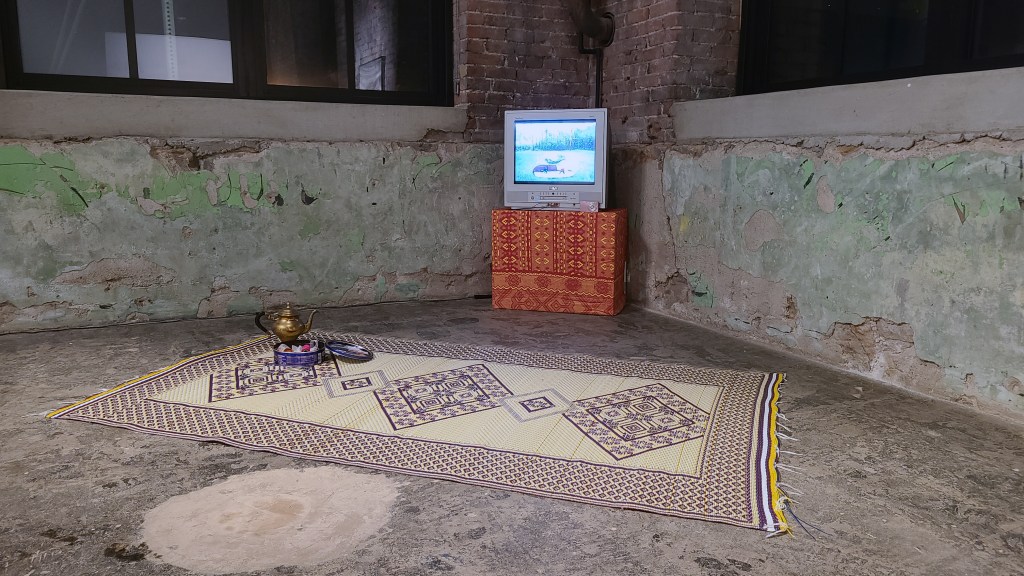
Cover image: Installation view of Azzah Sultan, The Fabrication of Memory
The Google flag was in my viewfinder. The flag flapped lightly atop a building on a warm summer day. I clicked a few shots and managed to capture some video before a nearby door opened and a uniformed employee waved me down and escorted me off the Bakery Square premises. A year later a similar event happened at the postmodern glass castle that is PPG Place in downtown Pittsburgh. A year after that, in the utopian town of Reston, Virginia, the once quaint town center acquired one too many corporate headquarters and apparently tripods were off the menu. Such is life during these times of surveillance capitalism. Sure, I had a camera and was actively surveilling (I’d call it documentary filmmaking), but I was also being surveilled by some hidden camera somewhere, watched by a variety of employees, each of whom represented a source of power acquired through the purchase (or rental) of land. The message was clear. They could watch me, but I couldn’t watch them.
Surveillance, as a topic, emerges quite often in the media that I consume, whether that is season two of Reacher or more noble consumption like Xiaowei Wang’s book Blockchain Chicken Farm and Other Stories of Tech in China’s Countryside. Surveillance makes for good content. We are aware that we are tracked by our smart phones, and for some reason, some of us like watching and reading about the extreme ways we are being watched. Elsewhere, surveillance is less entertaining. In Live Audio Essays, Lawrence Abu Hamdan’s collection of transcripts from performances and films, Abu Hamdan writes how constant and intentional decade(s)-long air traffic violations in the form of drones, fighter jets, and other manned aircraft by the Israeli Air Force has created a persistent aura of fear for the Lebanese citizens that live on these flown-over lands. Drone buzz as PSYOP.
As the density of surveillance increases in our lives, the percentage of time that we have to sacrifice to participating, evading, or giving in to surveillance continues to grow. It’s rare to be alone with one’s thoughts; less rare to be confirmed to be at 40.4406° N, 79.9959° W at 10:57:32 EST with one’s thoughts.
So, here I am at 40.425687° N, 79.976438° W aka Brew House Arts (rated 4.9 stars out of 5 on Google) for the opening of Blank Tape, an exhibition curated by Lena Hansen. The artists in the exhibition examine the idea of surveillance from different angles – inwards out, outwards in, from above, from behind – touching on topics like personal identity, national identity, privacy, and visibility.

At times, the artwork confronts the viewer. Caroline Yoo’s Dance Dance Reversion Re-version Re-version uses two images from a thermal camera to create a lenticular print that calls to mind the view from night vision goggles during a military raid. As the viewer walks by the print, a body is visible, then the body disappears and only its imprint in soil remains. My mind immediately thinks of the price of war and the value judgements that those who surveil assign to the worth of human life. It’s a striking print, both human and alien, with a unique green color that demands attention.

At other times, the viewer is pulled into the artwork and made to be complicit, like in Lena Chen and Maggie Oates’s OnlyBans, a site-specific installation that has a playable web game as its centerpiece. (If you can’t make it to the gallery, you can play at home.) “OnlyBans is an online platform where you post sexy content to attract fans and earn money.” But there’s a catch. “If you’re too sexy, then your account might get suspended, shadowbanned, or deleted – and then you’ll have to start over.” So, as a player, you have to turn the $1 in your pocket into $200. Clicking through text prompts backed by a four-on-the-floor soundtrack and looped video clips, I manage to post two photos, make $186, and get myself locked out of my account. In order to get back in, I need to give the computer a wealth of personal information. As you keep playing, you’ll learn that “45% of sex workers have had their images or content used for a fake account (e.g., catfishing)” or that we should all be lobbying our representatives to repeal FOSTA-SESTA. The game is fun, well-designed, and very informative.

Down on my hands and knees, I’m feeling a little bashful staring into Jamie McArthur’s Dollhouse. I’m straining to see all the technical detail of the dollhouse’s countertops and tiny wall art, along with assorted objects like floating fish, a skull, intricate rugs, and a slice of pizza. More clearly visible in this wall-less, wood-framed house are its occupants – two seated pigs, one in lingerie and hair rollers and the other in kind of a bondage mask and leather briefs. The rendering of the dollhouse is really fun, and while I can see into it from every angle, I still feel like I’m missing something. So, I keep looking. I’m guessing this is the point.
Shori Sims’ video installation ULTRAVIOLET LED GHOST HUNTING LAMP (da waves) similarly makes the viewer the voyeur, peering at partially hidden figures walking staircases. It does so while successfully demonstrating how cameras show or hide skin color; how White skin pops in the camera lens while Black skin can frequently blend into the background; how chroma-key blue, often used in green screening (er, blue screening) can also ignore Black skin. This piece’s inclusion in an exhibition that I’d partially read as wanting less visibility from surveilling eyes adds another layer of complexity – the dual desires to be accurately and equally seen while still keeping one’s privacy.
I’m not sure if it’s my past life in healthcare management, building databases and corralling data, or if it’s my current life in archives, or even the books I’m reading about hackers peeking into private file folders, but Or Zubalsky’s video piece Decentered satisfyingly hits on a number of levels. Sandwiched between two halves of Zubalsky’s face is an animation of folders – the kind you might find on your Mac or PC – being created, labeled, unlabeled, and uncreated. The viewer peers into the folders, trying to perceive the contents. A folder called “Israel” and a subfolder called “1985 Born” identify the artist’s time and place of birth. Additional subfolders unfurl – “fear,” “isolation,” “settler colonialism,” “trauma,” “Zionism.” Just as quickly as they are created, the folders slide back into their parent folders, names fade to nothing. A voice-over provides context for these containers of emotions, concepts, and life experiences. It speaks to the dizzying series of puzzles that constitute a life. There’s something that feels a little on the nose about the split face, but it’s a powerful piece that exemplifies how one’s sense of self and place can be distorted by a country or government’s actions.

I don’t pretend to understand every work that I come across, so it is very helpful that Blank Tape has a gallery guide, especially one so beautifully produced by Makenzie O’Connor and Candace Opper at Point Line Projects, alongside Hansen and Brew House Executive Director Natalie Sweet. The gallery guide contains an essay by Hansen on the exhibition, photos of much of the art, and descriptions that provide context for art works that might not be readily apparent. For example, Tooraj Khamenehzadeh’s I’m Not a Song to Be Sung, a three-channel video piece where figures submerge themselves underwater and struggle to speak to the viewer (and the viewer struggles to understand), takes on greater meaning (at least, for me, in my various ignorances) knowing that the work is situated in post-1979 Iran and that many of the participants are in the process of leaving Iran after years of “war, international sanctions, and civil and social pressures.” Rendered in a hazy blue-gray tone, the work is beautiful, elegantly conveying an unrelenting helplessness. It could be read as universal, but it wields a greater poignancy with additional context.
Likewise, Negin Mahzoun’s Destruction reads as a series of interesting abstract fabric works placed in square frames, but gets more intriguing with a few details about the creation process – “images of herself printed on to fabric . . . stitched and re-stitched to distort, conceal, and expose certain parts of her body.” Jonathan Ellis’s ariel photographs, Heartland Studies, are exquisite; revealing odd angles of shadows and manmade symmetries within semi-natural landscapes. The vantage point is that of a drone. I thought that might be it, but reading about the work reveals that the photographed locations have been historically inaccessible to Black people. Where photographer Trevor Paglen has photographed sites that are off limits to nearly everyone, Ellis’s work takes a more targeted and personal approach.
In some ways, a bit of schooling is needed to fully grasp the scope of the work in Blank Tape. Consider the exhibition as an entry point into the long process of building understanding among complex peoples with complex histories living in complex places. The longer my memories of the show linger, the more curious I become. I think that has something to do with the quietness of the show. There is a gentle flow throughout, from installation pieces to video works to interactive experiences. The artworks feel approachable and inviting. And there is a quite a bit of humor throughout.
Amidst a mat, a teapot, and a biscuit tin filled with thread and jewelry, a TV displays a landscape where Azzah Sultan introduces home videos via a few stationary and mobile green screens positioned within the frame. Where Sims (across the way on a different TV monitor) shows how blue screens can erase, Sultan teleports memories from a different time and place into the present, creating a new hybrid realm somewhere between documentary and fantasy.
I watched Ajunie Virk’s animation Do You Reckon That My Fingernails Are Touching Right Now or Do You Also See That Gap Between Them five times through. There are two scenes: 1) a computer sits on a desk and an unseen user checks email, answers revealing surveys, and replies to a job rejection letter and 2) A room where a variety of layered Ajunie’s are working on tasks like cleaning, dressing, and getting ready for a graduation ceremony. The piece has multiple levels of absurdity from how characters react in unreal spaces to seeing folders on the computer labeled “Bigfoot Spottings” and “How to Drive 101.” But a creepiness arises within the viewer. Yes, it’s fun to pick out all the little details in the piece, but we are seeing two views that we, ethically, shouldn’t have access to without some kind of consent.

Click. “100.” That’s how many people came to the opening. Not bad for a frigid January night. And it’s surely reasonable to count the number of attendees. I bet it helps with grant applications. And grant applications make up a portion of annual revenue. And revenue keeps the lights on and the walls painted.
So, this small incursion into attendee surveillance is explainable; it’s needed to successfully participate in a system. In a sense, many of the examples of surveillance that crop up in Blank Tape are explainable by systems; surely, much more sinister than grant cycles. Some systems are legal, some are extralegal. Some systems are internalized. But each system ties to some form of power – white supremacy, patriarchy, governments, militaries, hackers, corporate America, corporate World. It all raises the blood pressure. But it reminds me of a passage from Naomi Klein’s book Doppelganger where she quotes writer John Berger as saying, “calm is a form of resistance.” It’s not calm as in subservience. It’s not numbness. It’s a type of calm “that can coexist with fury, that can coexist with a lot of passion.” I find learning to be calming, because you are equipping yourself with knowledge. Knowing of what is surveilling me or what could be surveilling me oddly makes me more calm that not knowing what is out there. And after viewing this show, I have a number of new things to be, er, calm about.
David Bernabo is an oral historian, musician, artist, and independent filmmaker with a deep interest in local history and its repercussions on today’s Pittsburgh.
 PETRICHOR
Leave a comment