
by Emma Riva
image courtesy of ROMANCE, photography by Chris Uhren
Doing something to “fill the void” usually implies that it’s meaningless or maladaptive. The Netflix episodes you watch while washing dishes to feel less alone. The beer you drink when you get home from work to forget the drudgery of the day. Mindless scrolling on Instagram. Sex with somebody you met on Bumble who’s just okay-looking. A bag of chips. A vape. The list of vices is endless. But artists Max Guy and Elly Reitman ask viewers to think about what it really means for something to fill the emptiness in Wheel of Time we love time, which opened 1/27 at ROMANCE (5294 Howe Street). When we get down to it, almost everything fills the void in some way. How can we accept the ways life does fill us, and see the empty spaces not as things to fill up, but as opportunities or places of beauty?

Attending an opening at ROMANCE feels a little like a house party. There are places in the space to duck out and hide or smoke. I took in a lot of the work by myself, taking notes on the artwork on my phone, drinking seltzers because I had committed to Dry January and copping out when there were only 72 hours left would be lame. The night outside was dark and wet. With its parquet floors and French doors, Romance reminded me of Meredith Rosen Gallery in New York, or Goldfinch Gallery in Chicago—the apartment-gallery phenomenon I’ve observed in other cities but not in Pittsburgh, where Romance is one of the few places of its kind. It’s playful and inventive, bringing in artists from outside of the city using curator Margaret Kross’s interests and connections while still feeling approachable with its apartment-style layout and location in the cozy residential Shadyside. I’ve started recommending ROMANCE to artists in Pittsburgh who are interested in branching out past the more hyper-local DIY scene to galleries with more of an art world connection. ROMANCE feels intimate and tucked away, but Kross’s has a wide repertoire.
One of the show’s most striking series is Max Guy’s Leaf Negative works. They’re inkjet print on paper, the simplest of materials. Guy’s use of color in the Leaf Negative series is captivating, magentas and yellows and reds. I caught fragments of narrative in the words, made more evocative by their fragmentation — “pulverizing the dirt Horses galloping.” Notably, on a few of the pieces,Guy leaves the watermarks and timestamps from printing on ordinary printer paper: file://Users/maxguy/Pictures/Malmo Leaves/Chicago/River Books/1265859900.jpg, 1:10PM. There’s something kind of charming about this and its inclusion brings to mind similar questions about technology and our relationship to it in Anisha Baid’s MS User at the Pittsburgh Cultural Trust or Lena Hansen’s group show Blank Tape at Brew House.
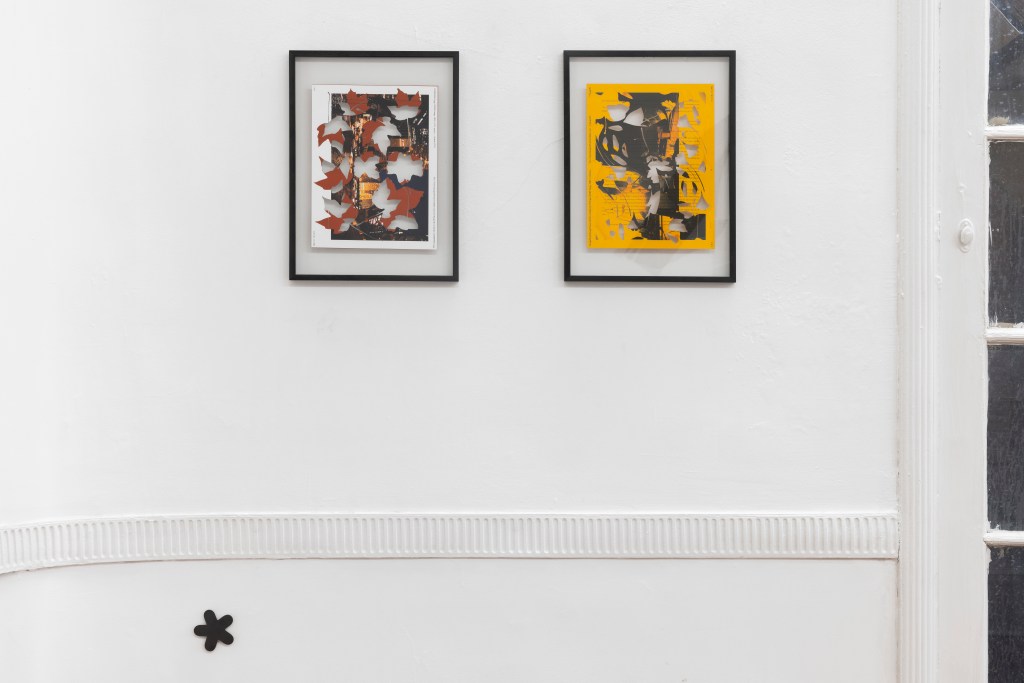
The empty cutouts are part of what makes the Leaf Negatives so compelling. They force you to look at the holes. The leaves are fragments, same as the printed text reading “Cities hurt. Chicago loop re—“ then obscured by ink and scissors. The choice to frame them using reflective glass makes the viewer look into their own face along with the material itself. The pieces are small, simple, and effective, with layers of detail you can look at for a long time. The watermarks offer clues for what might be in each, including images of George Floyd protests in Chicago. The city itself feels like a character in Guy’s work, with images of the Marina Towers or the Loop serving as signifiers for the city’s Gilded Age beauty and decline.
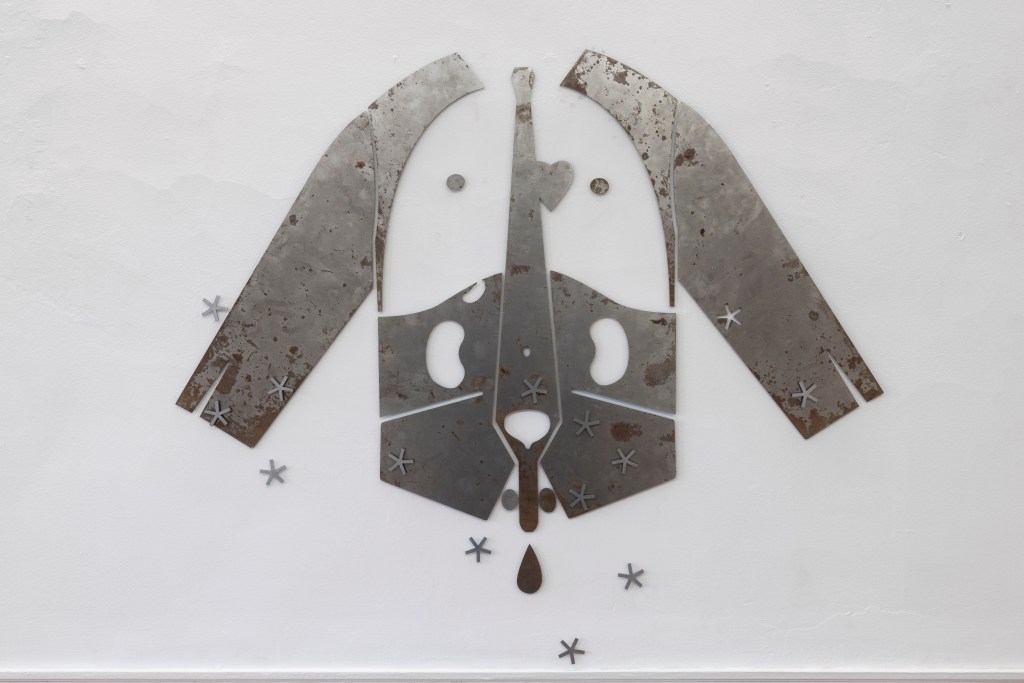
The strongest of Reitman’s works are the steel and rare earth magnet Sinus Diagram (2020) and Winter Jacket (2024). Winter Jacket leaves a single metallic leaf at its periphery, perhaps a nod to Guy’s leaves. Both use metal and magnet as nods to the shape of the human body, with kidneys and a heart. Small spots of rust along the steel soften the work—I found myself standing in front of Winter Jacket for longer than I anticipated to, taking in its shape. There’s an irony in creating a garment of warmth made out of metal.
Another standout from Reitman is Road. Though it has the composition of a straightforward landscape, veins of green and grey and two starburst shapes in either upper corner take it into a more abstract realm. Those shapes are the approximations of dashboard lights, or suns. A flash of pink at the vanishing point. What makes it so great is that Reitman makes it their own—The painting would have been beautiful as a landscape, but there are touches of personality in it that give it its own narrative.
Wheel of Time we love time is an outgrowth of Reitman and Guy’s friendship, and their work serves each other well. In ROMANCE’s basement, the pair collaborated on a sound/video installation featuring dual shots of the Chicago River’s famous St. Patrick’s Day green water aside its ordinary blue-black. (I once had a conversation with someone who said “In Pittsburgh, we don’t need to dye the water green! Have you seen the Mon?”) It’s mesmerizing to look at in the dark of the basement and makes clear that Guy and Reitman speak each other’s language as collaborators. Part of what makes Reitman’s and Guy’s work, both individually and together, dynamic is that it allows for so many interpretations. The title of the show, Wheel of Time we love time is an ode to that in itself. Two things can look or sound the same and in actuality be totally different. Conversely, two people can see different things in one object. Some viewers might see the holes in Leaf Negatives, some might see the collage materials. The green dyed Chicago River is still the same river. The collaborative video pieces forces us to look at two versions of the same thing side by side, separated only by time.
The accompanying statement for Wheel of Time we love time features a short question-and-answer between Guy and Reitman that concludes with Reitman bringing up that they finish each other’s sentences. The show as a whole feels like just that—the works finish each other’s sentences to combine into something new.
ROMANCE is at 5294 Howe St and Wheel of time we love time runs through March 1, 2024 by appointment.
 PETRICHOR
Leave a comment