
by Zach Hunley
I never quite understood the adage “time heals all wounds.” If anything, from my experience, time can leave wounds festering, sore and untreated. Time’s irreverent compounding and unwavering incisiveness means that our role as humans, the same humans who uphold the regime and concept of time itself, is to grapple with it and its inherent messiness in some way. To do so is to simultaneously sort out the messiness inherent in ourselves.
This dichotomy between the temporal and the corporeal is of central concern in The Wind Got Up in the Night and Took Our Plans Away, a contemporary group exhibition comprised of intergenerational Serbian documentary photographers. The exhibition reveals that time, though immaterial, is still well within the reach of our collective grasp.
This exhibition marked my first encounter with 937 Gallery, positioned on the second floor of a comparatively small three-story building in downtown Pittsburgh, I was thoroughly impressed by the space’s physical and curatorial layout, a balance that is not always easy to strike in the context of a group show. The more sculptural installations were given ample breathing room, which makes a huge difference for the viewer—making the works all the more effective.

Of these pieces that venture off the wall and into the physical gallery space, there are around four total, the most impressive and expressive is Vesna Pavlović’s Fototeka (2013/2016). Comprised most centrally of an undulating grey curtain (a metaphorical nod to the “Iron Curtain,” which divided the capitalist, western portion of Europe from its ideological counterpart in the east) onto which 35mm slides containing archival photographs are projected, the piece’s sculptural stature is accompanied by the aural click and mechanical whirring of the slides advancing, approximately once every seven seconds.
This action does several things, but it most readily demonstrates the limits on our perceptions of history and time; we are presented with a document of the past only to have it forcibly replaced with another. This removing of choice positions the viewer as someone with limited agency, and highlights the extent to which history distorts and fragments as it recedes and breaks from our present.
In contrast, The Morning of Our Dawn: Looking for a Factory, We Discovered a City (2022)is perhaps the weakest link. The multicomponent work from the collective Jednostavno rečeno includes a small video installation from the POV of the archivist protruding from a black and white wall print of a desolate stretch of road on the outskirts of a town, with a metallic grey storage cabinet for printed materials positioned a few feet in front of the wall on a pedestal comprised of stacked industrial wooden pallets. That component reaches for the sculptural, and it presents viewers the opportunity to do something rare in a gallery context—the ability to touch, manipulate, and disrupt its components, in this case a tangled matrix of historical photos interlaced with didactic texts. The result is an activation of the archive; the viewer leaves the piece in a curatorially different state than the previous participant.
Such actions call into question the precise notion of the archive itself—who is responsible for its state, and what structural impacts do the actions of the archivist have? Meaningful questions, no doubt, and worth asking in the context of the exhibition, but I could not help find the piece’s overt artifice weak within the context of Pavlović’s comparatively stronger approach to the theme. Perhaps this is due to its proximity to the other, more effective piece; their positions within the same wing of the gallery beg a direct comparison. Still, the interactivity is welcomed, and I enjoyed the physicality inherent to the piece.
The exhibition’s focus on the geopolitical and socioeconomic context of Serbia feels omnipresent in the works on display. The rear of the gallery carries the weight of how history itself is curated and preserved, with an emphasis on the archive. A through line through much of the art, the archive and its insurmountable volume of sheer historical record gives way to the more personal archive of familial memory and histories of the home, such as Katarina Radović’s I’m Going to Live a Hundred Years! (2012-2023) which presents an array of tenderly intimate photos of the artist’s grandmother and her domestic surroundings accompanied by a highly expressive essay written by Radović’s “Great Mother.” The work conveys the complexities associated with maternity and serves well as reminder for the living history each of us fragilely embodies throughout our time on Earth.
I have strayed from too closely detailing the specific histories present in this exhibition, particularly those of political concern, primary out of restraint, a restraint I felt was similarly present in this exhibition. The works feel carefully researched, and there are plenty of accompanying texts to read over and aspects to the histories recounted that may make certain viewers want to explore more upon exiting, but these texts don’t feel vitally essential, nor do they get in the way of the art itself. The emphasis is clearly on exploring photography’s ability to capture and play with notions of perception and the enigmatic nature of the “real.”
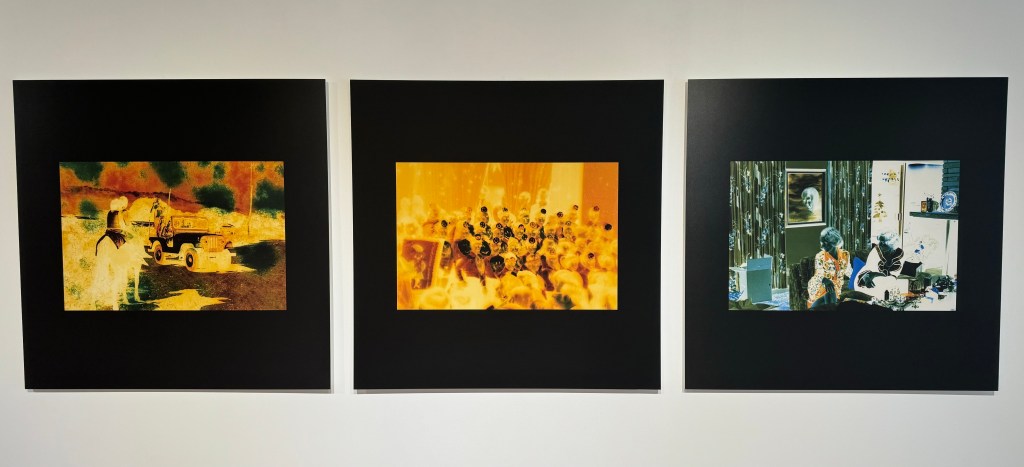
This lack of overt didacticism is refreshing, as is the overt presence of the human figure in many of the works. Abstraction is present—such as in Mihailo Vasiljević’s arrestingly vibrant triptych comprised of saturated found photo negatives—Familiar Objects (2012-21), but nearly all of the work feels committed to a certain level of humanism, as with Ivan Petrović’s stark seven-part series showcasing the realities of food production in rural, (un)developed Serbian villages, Salt and Light (2014-23), that feels increasingly rare to encounter, and serves to demonstrate the link between ourselves, our collective time, and our shared future.
Speaking to futurity, Alesksandrija Ajduković’s vertically oriented triptych from 2023, Beings from the Future, and its neighbor, Ivan Arsenijević’s four-part array taken from his 1999 People From the Barracks series, Untitled #3, #25, #38, and #47, tackle this theme most directly. The former features three fantastic documentary portraits of older Slovak women dressed in traditional garb accompanied by their bicycles, and plainly demonstrates the capacity for cultural tradition to inform a sustainable future—these lovely ladies are embodying that future, right here in the present. The latter series documents those living on land and occupying buildings that were previously part of an urban worker’s settlement housing project, showcasing the potential for health and the persistence of life within communities situated around and tethered to extractive economic industry.
Time is a reflection of us, a part of us, and an integral component of our perception. Photography as a medium offers us a vehicle for literalizing and making this truth material, but it also instructs us to be present in our current moment, to direct our attention to the impending future, and to acknowledge the liquidity between the two. History is in flux just as much as our present and future.
I approached The Wind Got Up… with the goal of deducing what might be gleaned from it in the context of urban Pittsburgh; what would an exhibition of contemporary Serbian photography have to say in this context?
937 Gallery’s sweeping wall of floor-to-ceiling windows that beautifully frame the tripartite intersection of Liberty Ave., Seventh Ave., and Smithfield St. revealed one potential answer: the power of history and place. For a thematically dense show, the manner in which photography as a medium offers us a window—a window into the historical archive, into home and family, into place and politics, and into memory and time—is palpably conveyed. Being offered the space to consider Pittsburgh alongside this work makes the weight of the city, its vast history, and its people past, present, and future feel astonishingly close—as though in the gallery with you.
Time may not heal all wounds, but it certainly offers us space. What we choose to fill that space with rarely feels like it is up to us as individuals—so much seems to be out of our hands. The Wind Got Up in the Night and Took Our Plans Away reminds us that, despite this lack of control over the macro, there are endless potentials once we allow our unflinching gaze to bear witness to the indeterminacy of what we feel, remember, and hold close in our hearts and minds.

The Wind Got Up in the Night and Took Our Plans Away is on view until Sunday, Mar. 17 at the Pittsburgh Cultural Trust’s 937 Gallery, located at 937 Liberty Ave. and open Wednesday-Sunday from 11-6, closed 12-12:30. The exhibition is accompanied by monthly film screenings of Serbian documentaries at the Harris Theater, along with a public art installation by the collection Belgrade Raw in the Downtown alley of Tito Way.
J. Zach Hunley (they/he) is a modern and contemporary art historian, arts writer, photographer, collector of things, and proud father to a senior guinea pig. With a keen observational eye, they use their writing as a means to refract their deep appreciation for formal aesthetics through a socially engaged lens. They hold an M.A. in Art History from West Virginia University, Morgantown, WV.
 PETRICHOR
Leave a comment