
On February 28, 2024, Carnegie Mellon University’s Center for the Arts in Society (CAS) presented a screening of Zeina Al Qahwaji’s short documentary film Sugar Cage at the Frank-Ratchye Studio for Creative Inquiry. A chronicle of Zeina’s daily life in the midst of Syria’s violent conflict from 2012-2019, the documentary provided a number of themes to reflect on – migration, war, political instability, familial love, domestic tranquility, the comforting presence of the arts, and the aging of one’s parents. According to Zeina herself – who spoke to the audience by video chat before the screening commenced – the main theme was of generations being stuck in time.
Zeina stated that although she sometimes refers to her current life in Brussels, Belgium as “exile”, her move across borders was voluntary. Her story, in contrast to the frequent tales one hears of destitute war refugees, more closely reflects the observation of the migration scholar Han de Haas in his recent book How Migration Really Works that the majority of migrants are those who have the means to move, and are seeking opportunity on distant shores rather than fleeing from strife. In this, Zeina’s own story may have come as a shock to anyone in the audience expecting a significantly more traumatic recollection of a migrant’s difficult journey.
There are of course allusions to refugees from Syria fleeing to Lebanon through a radio announcement that plays in the background – but that is a story that has already been told time and time again. As much as Zeina seeks to escape anything, it is the “Sugar Cage” of the title – the pleasant but largely stagnant experience of living with her parents, who are shown to have a stable, affectionate relationship and to deeply care for their daughter.
Significantly, Zeina’s film opens with a sequence of storks engaged in a seasonal migration. Zeina comments sardonically that it makes little sense that the storks would travel to somewhere as underwhelming and undesirable as Syria. The migration of the storks foreshadows Zeina’s own departure from Syria at the end of the film, in which she is seen off by her parents as she awaits a taxi to the airport.
Both Zeina’s desire to leave in 2012 and her eventual choice to leave the nest of her parents’ stable, well-kept suburban house in 2019 reflect her own desire to escape the feeling of being stuck in a singular time and place. Surprisingly, the Syrian Civil War is not addressed as a factor in this decision. There is, of course, significant anxiety expressed by Zeina’s mother over the fate of neighbors or whether the location of the family’s house is in the path of any potential violent activity. During several sequences, the family get together and watch missiles firing or airplanes dropping bombs on buildings in the distance. While Zeina and her family show worry, these viewings are portrayed in a way not dissimilar to a family gathering by the window to watch an adverse weather event, such as a particularly aggressive lightning storm.
In this, war is portrayed less as a human activity than as a force of nature that exists outside of the protagonists’ control. However, what is in the characters’ control is their access to the arts. A recurring theme within the film is Zeina’s mother’s habit of listening to the radio. The greatest feelings of emotion, passion, and nostalgia in the film occur when a melodic Arabic-language pop song plays that Zeina’s mother feels a particular connection to.
The film is refreshing in its portrayal of a family amidst difficult political events, showing that life goes on as normal even in the midst of violence and chaos. And amidst this chaos, so do universal concerns such as a desire to leave the nest – not so much to escape as to seek greater opportunities with the resources – such as creativity and curiosity – that one already has.
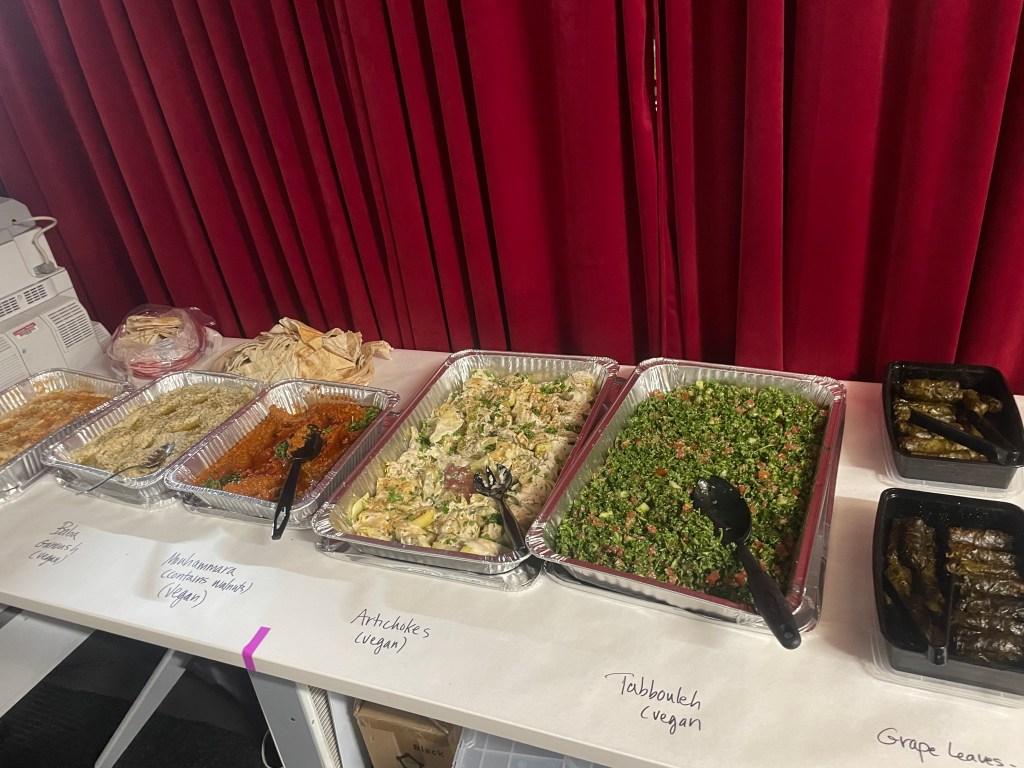
The screening was accompanied by a light dinner consisting of hummus, dolmades (lamb and vegan), baklava, and baba ghanoush catered by Ali Baba. The initial questions during the video chat with filmmaker Zeina Al Qahwaji were presented by Reem Alghazzi, a participant in and beneficiary of Carnegie Mellon University’s Artists and Scholars at Risk (ASAR) program.
Adam Arthur holds a graduate degree from Florida State University. He is the author of two poetry collections, Levers of Power and Sound and Substance. A transplant to Pittsburgh, he has lived in the area for three years and takes inspiration from his surroundings in his written work.
The Frank-Ratchye Studio for Creative Inquiry was founded in 1989 within the College of Fine Arts at Carnegie Mellon University (CMU) and serves as a locus for hybrid enterprises on the CMU campus, the Pittsburgh region, and internationally. As a venue, a classroom, a laboratory and a commons the STUDIO boasts more than three decades of experience hosting interdisciplinary artists in an environment enriched by world-class science and engineering departments.
 PETRICHOR
Leave a comment