Part 1 of a Series on Catalina Schliebener Muñoz, Isla Hansen, Marvin Touré at the Mattress Factory
by Zara Yost
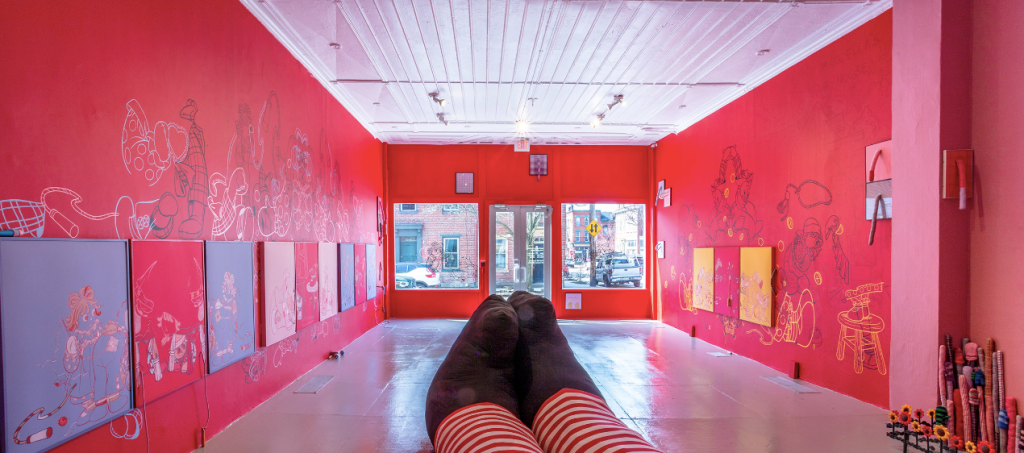
Catalina Schliebener Muñoz’s solo exhibition, Deep, Deep Woods, opens on the first floor of the Mattress Factory. Visitors will immediately notice a curious installation in the middle of the gallery—giant legs and feet protruding from underneath a wall. It’s as if the museum just landed on top of them, much like the Wicked Witch of the East’s ruby-red slippers in The Wizard of Oz.
Throughout the front of the gallery, animated Raggedy Ann and Andy characters cover the walls and canvases. Some are incomplete, unraveled, and undone. Some mirror each other. One doll on the wall appears to be playfully lifting another’s skirt.
Raised in a socialist/communist family in Chile in the 1980s, Muñoz’s family prohibited Disney movies. Nevertheless, Muñoz imbibed North American culture and drew inspiration from the distinct, heavily stylized Disney caricatures. Painted like McDonald’s signature red and yellow colors, the dolls’ animated likenesses surround the gallery walls and canvases. The canvases are garnished with sprinkles of embroidery, and a few have braided rope hanging from them.
Deep, Deep Woods pays homage to Greer Lankton, a transgender artist who has a permanent installation at the Mattress Factory titled, It’s All About ME, Not You. Lankton passed away in 1996, and her final installation was a replica of her apartment in Chicago, where she lived and worked. Lankton’s apartment featured a pair of red slippers at the end of striped stockings sticking out from under her house. The sewn and stuffed legs and feet of Muñoz’s exhibition are monumental—perhaps as a reminder that Lankton’s artistic practice are big shoes to fill.
Also, from Lankton’s installation, the Raggedy Ann and Andy dolls were a significant inspiration throughout her career.
For Lankton, the obsession and infatuation with the dolls highlight the broken, violent youth she suffered at the hands of those meant to care for her. For Muñoz, the dolls refer to Lankton’s intent while simultaneously providing a backdrop for the artist’s interest in and fascination with Disney animation. The canvases imitate the traditional film animation process with distinct and intentional imperfection.
“Pinocchio, Little Mermaid, [and] Beauty and the Beast all really wanted to be human. They’re almost human. All of those things are metaphors [for] queerness, and I think that’s where my work plays,” says Muñoz in an interview for the Chromatics Studio NYC Art Doc series, “…I try to find myself in these different images.”
Muñoz’s art feels clownish and playful but also refers to important human experiences. The Raggedy Ann and Andy characters are inelegant and gimmicky. They represent themes of self-discovery and youthful exploration of one’s body, as well as the experience of being queer and trans. The giant inflatable legs are kitschy, but their connection to Lankton is key. Like the awkward limbs of a preteen and the sudden onset of puberty—hitting like a ton of bricks – like a house. Puberty can be a tumultuous phase. The physical, emotional, and psychological changes can feel overwhelming and confusing. It can often feel like one’s own body is going against them, causing them to feel betrayed, especially for a trans person. They are also a stylistic contrast to the delicate collection of items behind glass and pinned-up drawings in the other parts of the gallery. The wall of drawings offers a glimpse into the creative minds of two artists, with Lankton’s drawings framed in red and Muñoz’s drawings framed in pink. The drawings give an idea of what their teenage bedrooms may have looked like, complete with a small side table and two doll lights. The drawings were created by Muñoz during childhood between 1996 and 1999, and they clearly reflect an exploration of bodies and gender.
Muñoz’s soft sculptures of phallic limbs hang on the wall and rest in a bunch on the ground in one corner of the gallery behind a picket fence with artificial grass. The limbs stand on end, and children’s gloves are placed on top of them. The use of the tiny found gloves is unsettling and suggests an underlying sexuality and a loss of innocence.
The artwork created by Lankton and Muñoz highlights the issue of the public and private lives of queer and trans individuals. It is unfortunate that the personal lives of these individuals become a topic of public discussion because their lifestyle is deemed “controversial.” In reality, all they are doing is being themselves. The artists have created work based on deeply personal items and themes. Deep, Deep Woods, is set up like a folk tale. Even though it may appear playful and bright, it’s important to recognize that some individuals, like Lankton, have experienced dark and twisted childhoods. Unfortunately, the statistics for queer or trans individuals being subjected to violence and abuse due to their identity are disproportionately high. Muñoz balances this darkness with the exquisite use of pastel pink and blue in the soft fabric of the framed limbs and in enchanting shrines of preserved items from Muñoz’s youth and archival objects from the Greer Lankton Archive.
The shrines contain framed sculptures of belly buttons, Woody dolls from Toy Story, books, drawings, tiny shoes, trinkets, tools, makeup, and other tchotchkes. These closet-like bedroom shrines are behind glass, with peaches and cream plaid wallpaper and shelves. They evoke a sense of voyeurism in the viewer and are a tender display of youth and imagination.
Catalina Schliebener Muñoz’s solo exhibition, Deep, Deep Woods, is at the Mattress Factory with Marvin Touré and Isla Hansen through March 30th, 2025. It is open Wednesday from 11 AM to 8 PM and Thursday through Sunday from 11 AM to 6 PM.
Zara Yost is an interdisciplinary artist, curator, and writer living in Pittsburgh. Her career is heavily influenced by her time in Chicago’s music and art scene. She has written for publications such as Newcity, the Chicago Reader, and Fnewsmagazine. Zara is best known for her work with organizations such as the Museum of Contemporary Art Chicago, United States Artists, Boston Society for Architecture, and The Roberto Clemente Museum.
 PETRICHOR
Leave a comment