
by Zach Hunley
I cannot recall having ever personally experienced an exhibition dedicated entirely to collage until Kelli Connell’s and Natalie Krick’s o_ Man!, on view at Silver Eye Center for Photography through April 13. Prior to seeing the work there, I had foolishly read collage’s absence from shows as a negative indication of the medium’s “standing” in contemporary art. Collage always felt on the periphery. This exhibition affirmed that collage can be humorous, cutting, nuanced, and beautiful all at once. Collage can be a more useful interface with time and history than the photographic image itself—collage is vital.
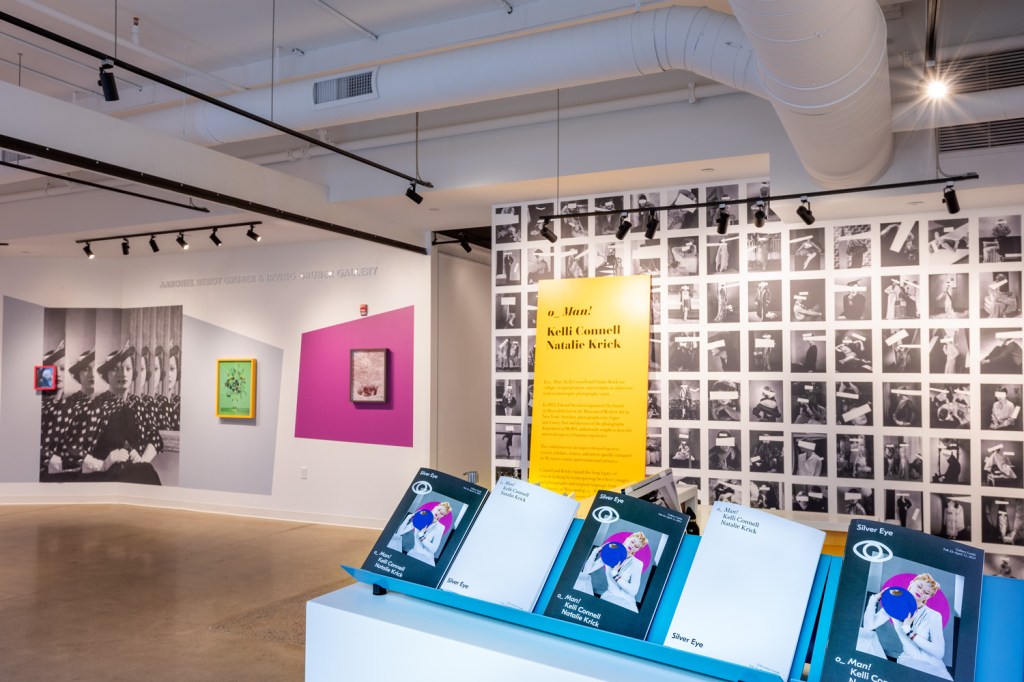
You are met with vibrant colors upon entering the space—exciting hues of yellow, pink, purple, blue—which add not only a welcomed juxtaposition to the black and white images taken up by the artists, but nicely foreground the duo’s central aims for their exhibition: the rewriting of a specific chapter within art history—a 1955 photo exhibition titled The Family of Man executed by Edward Steichen. Today, this exhibition is often discussed as embodying photography’s historical tendency to depict subjects through a privileged viewfinder. This subversive reimagining of segments of Steichen’s oeuvre demonstrates collage’s powerful capacity for acting as a tool for cultural critique, as well as its ability to illustrate new possibilities.
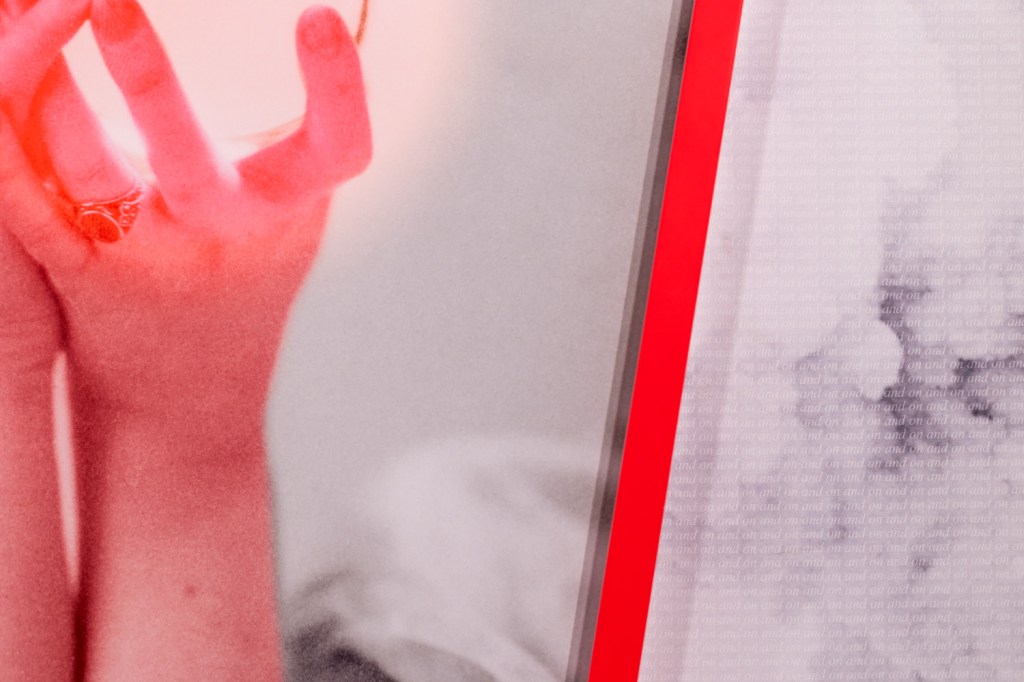
The array installed in the outer gallery space is sweeping and kinetic. I was first drawn to the three works that feature bouquets of flowers, My eyes, my arms, my breasts, and his will; And then I Ask, Ask Again; and I Asked Him to Ask Me First, wherein Connell and Krick have refracted the original Steichen images through an x-ray-like spectrum of pinks, purples, blues, and greens. The text overlaying these images (appropriated from the exhibition catalogue for Steichen’s exhibition with some written by the man himself) is haunting and contemplative, and the stylization in arranging the words makes them widely open to interpretation and boundlessly poetic.
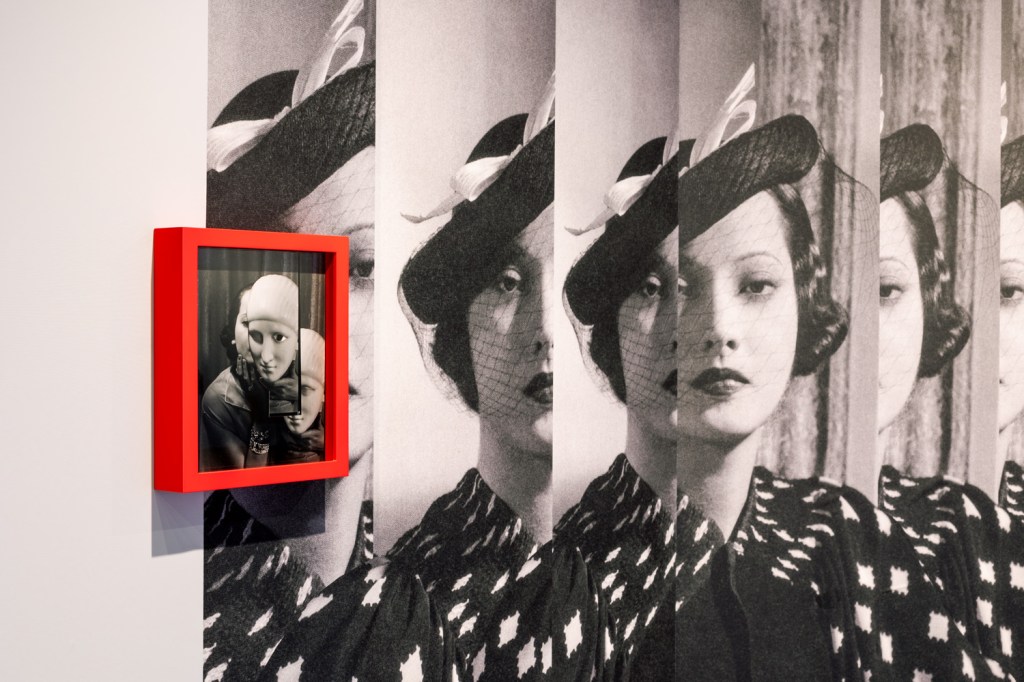
Vinyl wall prints are deployed throughout the exhibition and help extend the work beyond the frame—a cheeky way of moving beyond the confines of historical frameworks that makes the work feel almost monumental; the reworked images rise to meet the viewer, offering bold new truths. Woman Gazing I coupled with Truth Appearing (both 2022) are one such example; the former features a black and white image of a seated, colorized white woman inquisitively peering through an empty frame, with the eponymous text of the latter work posited to the right. Both pieces work in tandem to investigate the tenuous nature of “truth” that has been historically determined by men. It offers a speculative reimagining of what may be found beyond these structures.
A tremendous source of this exhibition’s efficacy lies in its concise brevity; each work feels essential. As a result, the show’s layout manages to offer viewers a sort of free-form roadmap, with the fragmented reappropriation of Steichen’s images and words serving as tools for deducing one’s own experience in the space. If this analogy is true, then the neighboring pieces Pregnant Gaze (2024) and Curator (2021) are major sights to behold along your route.
Gaze uses fragmentation to break up a portrait of an expectant mother across five black and white rectangles. Separating the woman’s protruding torso from the rest of her body plainly speaks to the current sociopolitical moment. Spending time bearing witness to her decidedly unemotional expression reveals a groundswell of complex emotions lying close to the surface; the work is arresting and stark.
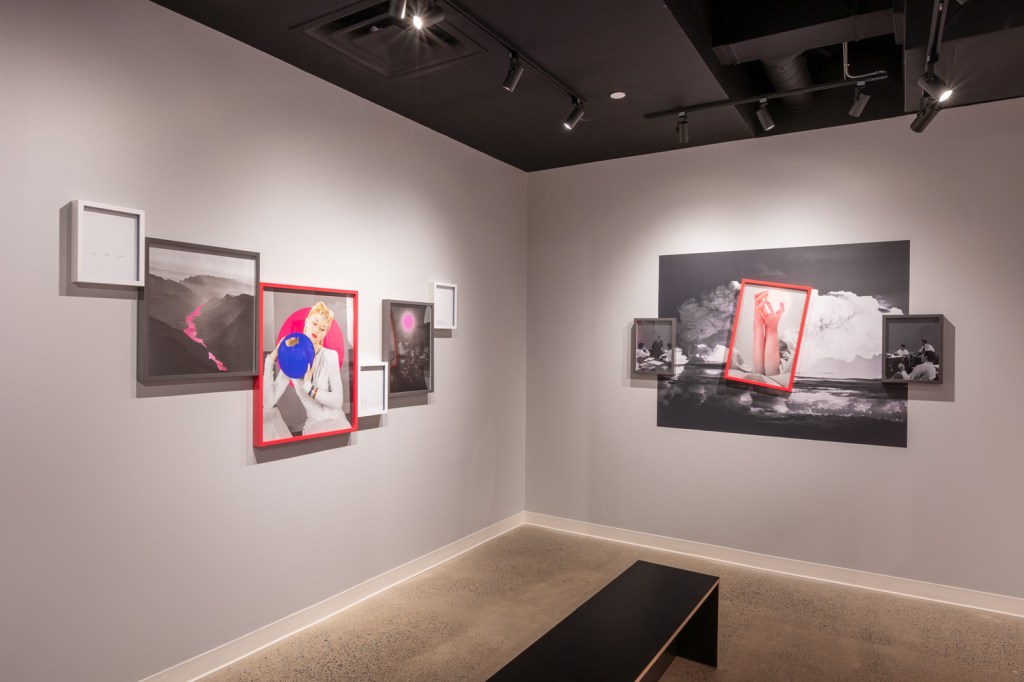
Curator—perhaps the strongest work in the exhibition—stopped me dead in my tracks. Centrally featuring a newborn being strewn from the womb by a series of disembodied gloved hands, Connell and Krick craft a complex and open-ended matrix of potential meanings; the work is a fable for the forces that guide and shape our work, its meaning, and ultimately our lives.

In the canon of western art history, few works in collage are pointed to as often as Hannah Höch’s 1919 landmark Cut with the Kitchen Knife Dada Through the Last Weimar Beer-Belly Cultural Epoch in Germany. It feels relevant to mention this work here, as Connell and Krick demonstrate the medium’s continued propensity for working as an essential vehicle for navigating contemporary life, just as Höch accomplished over a century ago.
I left o_ Man! feeling renewed of the energy that sparked my desire to pursue a career in the arts, an energy rooted in being critical of what has been said to be true, and a desire to use art as a means to investigate what those at the margins of power have lived, felt, and experienced as truth.
—
o_ Man! is on view at Silver Eye Center for Photography through April 13, free and open to the public Tuesday-Friday from 11-6pm, Saturday 11-5pm. More information on Connell and Krick’s work can be found at womanmoan.com and on the project’s Instagram @womanmoan. On Friday, April 12, 6-8pm, Silver Eye will host “Art+Feminism MeetUp: Silver Eye Edition,” more details about the event and exhibition can be found at silvereye.org
Zach Hunley (they/he) is a modern and contemporary art historian, arts writer, photographer, collector of things, and proud father to a senior guinea pig. With a keen observational eye, they use their writing as a means to refract their deep appreciation for formal aesthetics through a socially engaged lens. They hold an M.A. in Art History from West Virginia University, Morgantown, WV and currently work as Visitor Services Coordinator for Carnegie Mellon University’s Miller ICA.
zhunley@andrew.cmu.edu
 PETRICHOR
Leave a comment