by Pria Dahiya
When I first met artist/curator Davine Byon I couldn’t believe she was in the theatre department. I was genuinely shocked someone with such an artist’s presence, mellow and altogether cool, could be working alongside the mass of screaming and shouting in the Department of Drama.
I came to discover over time we shared many interests, and even shared a room once, while working on a theatre project in Boston. Davine has remained an inspiration to me for years for her talent as a collaborator as well as her singular voice as an independent artist. While she works full-time as a Curatorial Assistant in the visual arts department of the Pittsburgh Cultural Trust, she has done brilliant work as a performance artist, as seen in her Freshworks Artist Residency at Kelly Strayhorn Theatre this past fall.
Over the course of our interview we discuss her work with the Cultural Trust, as well as the exciting night of of art, music and and community vendors happening downtown July 26th (mark your calendars!) which she has helped organize.
We get a sneak preview of the two upcoming art shows opening at the Trust’s downtown galleries – kʼidéin yéi jeené (You’re doing such a good job), a solo exhibition by Nicholas Galanin, and On Air, an installation and video piece by Lenka Clayton and Phillip Andrew Lewis.
I’ll let you enjoy some snippets from our rambling conversation:
PRIA: So the three things I wanted to talk about were one – you – two – your job – and three – the upcoming shows downtown you helped organize. Where would you like to start?
DAVINE: Let’s talk about the event first!
PRIA: Lovely
DAVINE: There’s two shows that are opening on July 26th downtown at the Trust. The first one is by an Indigenous artist named Nicholas Galanin. The actual title is a long Lingít title but basically it translates to “you’re doing such a great job.”
It’s a video piece, it’s a very simple artwork, single channel, and it features the artist talking to his son, offering these sweet affirmations in their native language. It seeks to compete with indigenous stereotypes, negative stereotypes which are war-oriented and don’t accomodate or center affectionate, tender and community-oriented depictions. It’s this beautiful native boy, the artist’s son, hearing lovely words and smiling.
The artist is really incredible. I’ve known about him for a little while but I think he hasn’t shown in Pittsburgh yet, or at least not had a solo show.
PRIA: And this will be a Wood Street Galleries?
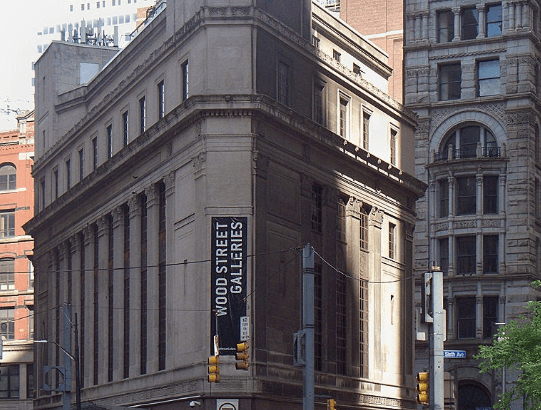
DAVINE: Yeah! This will be on the third floor of Wood Street Galleries.
PRIA: And what is the other piece opening on the 26th?
DAVINE: Ah! Yes those are also wonderful artists. It’s a couple, their names are Lenka Clayton and Phillip Andrew Lewis. They’ve done a bunch of other pieces around Pittsburgh. They have an amazing studio, which out front has a window gallery called Gallery Closed.
The central idea is that the gallery is always closed, but you can always look in through the window and see what’s on. The Gallery – Gallery Closed – is in Troy Hill.
My general understanding of how they arrived in Pittsburgh is that when Lenka was elsewhere – overseas, or New York, perhaps – she had this project where she mailed a bunch of letters to a selection of small cities all over the world. One of the cities she chose was Polish Hill in Pittsburgh.
So she begins mailing all these Polish Hill Residents random little letters – and notices a lot of them were writing back to her! And she loved the responses she got from this place, so she came to visit, kind of fell in love with it, and then shortly after moved to Pittsburgh.
She had no institutional reason to be here – she didn’t go to school here or grow up here – but now they have a beautiful studio and they are living and working in Troy Hill. Lenka’s work was actually featured in in the Carnegie a few internationals ago, a collaboration with artist Jon Rubin. (Davine was thinking of the piece Fruit and Other Things, which was featured in the 57th Carnegie International in 2018.)
PRIA: What’s the piece that Lenka and Phillip are showing?
DAVINE: Yes! It’s this: an exhibition at 820 Gallery called “On Air”. More of an installation, really. It’s primary component is a video piece which is hours long – it’s going to be very very long – where they’re compiling clips from commercial films primarily, ranging from indie to blockbuster to foreign films – anything they can find, basically.
They’re compiling clips of wind, ranging from a flutter of a curtain to a tornado. The Beaufort Wind Scale measures wind, and they’re arranging these clips in sequence of the scale.
PRIA: It reminds me of the 24-hour clock piece. (I was thinking of the piece The Clock by Christian Marclay);
DAVINE: Yes! It’s this super long compiled film of wind.
The other components in the space – this is the installation aspect of it – is that they are installing floor-to-ceiling curtains with fans that will run automatically on and off to activate the curtains. So from the street, it seems like the curtains are billowing from a secret wind hidden inside the space.
PRIA: That’s sick. It’s like the wind is coming from inside the building. It reminds me of the other day when all the power went out in my house.
DAVINE: Right. They artists are in an era where they’re thinking a lot about wind both as content and as material itself. So they currently have a public art project in the district that we commissioned. They’ve created these aluminum kites – and the idea is these kites have been flown and they got stuck in the tree’s branches. They did a past iteration in St. Louis where they installed a ton of these kites in this one tree. We’ve done it so that there’s 90 trees throughout the district that have all these kites on them. The project is entitled A Sudden Gust of Wind.
I really like their work because it’s equal parts funny and tasteful. They have a meticulous process but there’s just enough, not too much, but every detail has been perfectly thought through. For instance, for the kites, the color used for the paint of the kites was matched as cosely as possible to archival photos from past Three Rivers Arts Festival branding.
PRIA: So why should people come out and see both of these shows?
DAVINE: Well! Both these shows are opening July 26th for the Gallery Crawl. The Gallery Crawls are a really lovely event because you can come down, knock them all out at once, have a drink, meet other people – I think it’s one of the most valuable way to enjoy these works altogether.
One of the spaces that we have is this big lot called the backyard. It’s where we have the food court for the Three Rivers Arts Festival, it’s a parking lot that’s kind of cute but mostly empty and sometimes randomly has art in it.
So the programming of that space was up to us but it’s actually going to see a big redesign. We are working with a firm called Better Block, that identifies sites that need a little sprucing up and allows these spaces to become sites for events. They came to the Trust and said, hey, can we work with you on this project?
So they’re redesigning that space for the gallery crawl. And I asked, what’s a thing that Pittsburghers love? And it’s pop up markets. We love a vintage market, a flea market, a farmer’s market, we have a really strong local vendor community.
PRIA: From vintage stores to ceramics… sometimes I feel like this entire city exists just to manipulate me into buying a hand-blown glass ashtray.
DAVINE: Yes! So there will be a Gallery Crawl pop-up market, all local, all Pittsburgh people, it’s for the Gallery Crawl and associated with the trust, and we’ll have DJ’s. Can you help me come up with a name?
PRIA: Um, Push, Pushing Pittsburgh. Pushing, Pushing Pittsburgh. Like Pushing P. Um, Pittsburgh Pop Up. Backyard brat. Backyard, backyard brat. No, wait, okay, sorry, that’s not gonna work.
DAVINE: So it’s July 26th, 5:30 – 9:00pm, and it’s everywhere in the cultural district downtown – that’s what we call it, i don’t know if anyone else calls it that, but – it’s all within a mile radius of each other, the galleries, the pop-up market, the music.
PRIA: I’m familiar with that area. It’s got like the Benedum, the Pittsburgh Public Theatre, and that one 7-11 that sells beer. Everywhere I’ve ever wanted to go.
DAVINE: Oh! I have one more event to tell you about that’s part of this night.
This is probably somehow my favorite part of everything. Even though I’ve obviously just listed a bunch of stuff I’m very excited about. So: the hours are 5:30 to 9:00 – but starting at 8:00 pm we have an event with DETOUR which is a subcollective of the Hot Mass group. (Editor’s Note: DETOUR is a collective that has existed for ten years and thrown a number of events across the city beyond Hot Mass).
Detour is doing an LP release at at Wood Street Galleries on the second floor, in conjunction with the Nicholas Galanin show on the third floor. The Galanin show is stopping at 8:00 so they can do the release with sound.
It’s going to be a proper release party, going from 8pm until 2am. There is a precedent – Hot Mass did an event at Wood Street in 2013 that went from 9pm to 2am and from 2am to 7am at Hot Mass. So they did this major two-part event, and we’re hoping to bring back this kind of unconventional gallery programming.
PRIA: How are you going to be in all these places at once?
DAVINE: I don’t know. It’s a lot. It’s chaotic.
PRIA: But people are going to go!
DAVINE: They should!
PRIA: So what do you like about the Pittsburgh Arts community? What are the benefits to being in the arts here as opposed to anywhere else… and the downsides too?
DAVINE: The positives are that it’s actually very easy to know people. You could literally be on instagram, thinking to yourself, wow, I really admire this one artist’s work, and then you literally run into them on the street, and have a great conversation and buy their work.
People are very approachable and warm and community oriented, and that comfort allows for some more experimental programming – For example, think about these random saunas we have now, where there’s DJs playing at saunas. (Signal Sauna is one of many such cases.)
We have that! I also just did a two part writing workshop for my friend Karen’s exhibition at Bottom Feeder. Our friends Jenna and Alina did a writing workshop, they’re writers and they made it super fucking weird of course, in a very fun and experimental way. (Karen Lue exhibited these works this past spring at Bottom Feeder Books).
But I also feel like Pittsburgh is this place where out of context you can’t just assume that people will know what something is gonna be. I explain things like the sauna or these openings to people from New York and they’re like – that’s crazy! – and yet it just happens and keeps happening here.
PRIA: I mean, I love Pittsburgh because I feel like you can do anything for fifteen dollars. You can see the craziest shit you’ve ever seen in your life for 15 dollars. At like. An empty boatyard.
DAVINE: Yeah! And additionally the fact that our music scene is largely in these abandoned illegal places and not big clubs, it feels kind of stuck in time in a really nice way.
I feel like there’s a lot of endearing events that couldn’t happen anywhere else, that aren’t making a big deal out of themselves but just are cool.
I think the thing that is tough about that kind of intimacy is there is a jealous vibe, people are definitely watching other people, so in a way it’s very supportive but I also know whole friend groups that have applied for the same residencies, and that part is definitely challenging.
PRIA: Everyone is frothing at the mouth for Heinz Ketchup money.
DAVINE: Yeah, and you feel personally about being rejected because everyone knows someone who knows someone who’s on the selection committee or board or whatever.
But I think it’s up to you – you can either make it great, and it’s like a networking community-building thing, or it can feel very personal and competitive, it’s about outlook.
PRIA: What’s your favorite part of your job?
DAVINE: My favorite part of my job is that I get to resource artists that I care about. Being able to say, here’s money to do the thing that you’re good at – it makes me feel really good.
Pria Dahiya is a director, visual artist and writer exploring internet culture through literary adaptation, movement and media design. With a passion for exploring the intersection of technology and humanity, Pria’s work transcends the boundaries of traditional art forms, seamlessly blending literary adaptation, movement, and media design. Pria has also spent twenty-one years being biracial, bisexual, and chronically online.
 PETRICHOR
Leave a comment