
by Emma Riva
Why is your phone so dark? If I had a dollar for every time I answered that, I would be rich. Or, anyone who’s ever tried to watch a movie on my laptop has gotten confused by the pervasive sepia tone reminiscent of the Mexico scenes in Breaking Bad. I have “dark mode” on essentially all the time to prevent eye strain from blue light. This might be a futile exercise. But “dark mode” is a very cool name for something. And John Burt Sanders’ Dark Mode at Zynka Gallery is anything but dark. I got to the show at 7 and at least a quarter of the paintings had been sold. Little red dots abound. Clearly, the work resonated, and I found myself wanting to spend more time with the paintings to feel them out further.
Sanders referred to “dark mode” itself as “a daily ritual of gradual psychic decomposition from technology and information consumption. Most people who use dark mode probably are aware that reducing points of blue light is not changing how addicted they are to the piece of metal in their hands. It’s a contradictory state.
Sanders’ paintings live in that contrast. They straddle the line between frenetic and fluid. He manages to create a three-dimensional glow on a canvas with the combination of the soft anachronism still life and the gestural swirls of Sanders’ style. His paintings are about contrast. They feel both tactile and cold. There’s texture and also the untouchable. Later I realized the word that summed them up best: alien.
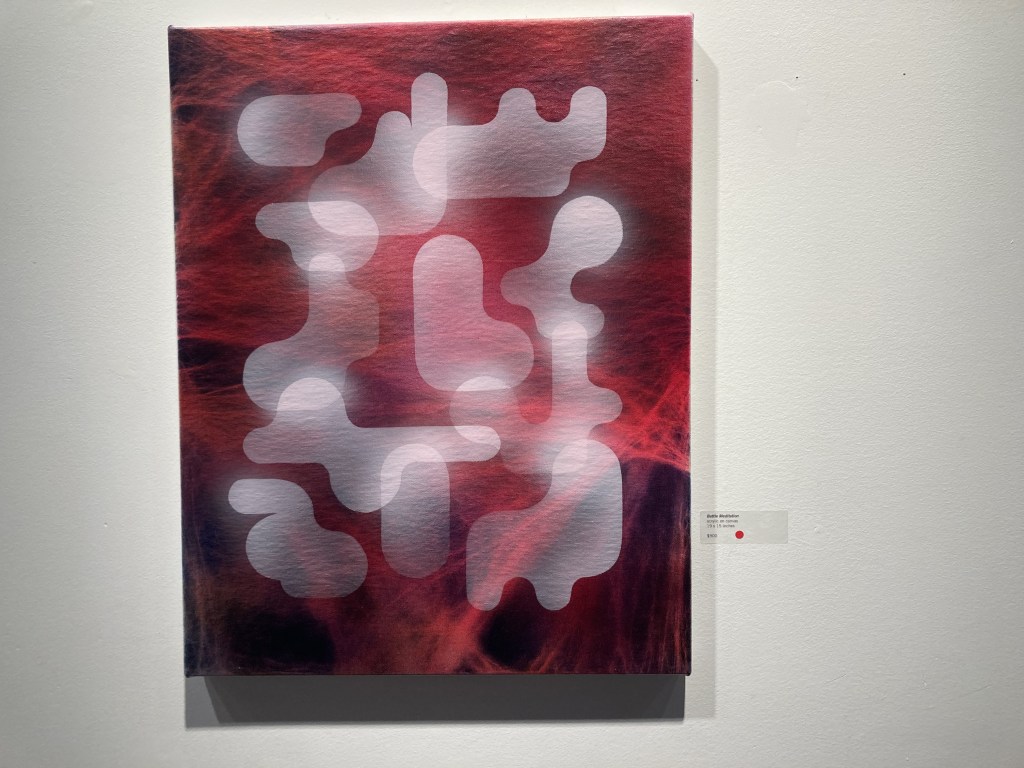
Battle Meditation shows tesseract-like shapes interacting with each other. The changes in weight of each brushstrokes give it a dynamic glow. Sanders shows just how much can be done with just acrylic—the paintings are remarkable technical achievements. He leans into the alien motif with imagery from the Hubble space telescope.
In the corner of Hi-techstacy, an indigo squiggle adds a tiny bit of surprise to the smoothness of the composition. There were times when as I photographed the paintings, my phone tried to scan them as QR codes. How are images now made to be decoded or scanned rather than experienced?

The show is a sensory delight, but at the same time, there is a sadness to it. We can see, with our own eyes, galaxies we could never reach, but now we know that there are worlds beyond what we can actually experience. That knowing is a lack. When you have access to the right answer to any question through a device in your hand, no wonder so many people feel always wrong. Dark Mode can be meta, it’s a show of beautiful achievements that also works as a meditation on existential emptiness.
Just a few paintings, Chaos Stream, Shadow Net, and Still Shift, remove the tessellation lines. One shape in it brings to mind the face of a pigeon or otherwise colorful bird. It’s a softened version of the sleek composition of everything else that reduces the image to its shape. Sanders frequently places moths in the still life images behind the tessellations, and the paintings bring to mind the eerie, nocturnal beauty of a moth. The show’s staging also lent to its success. Gallerist Jeff Jarzynka has a real eye for where to put works that need natural light in the spots that make them pop.
One of the things I found most compelling about the work was actually when I left the gallery. As I walked through Sharpsburg, I found I could see Sanders’ tessellations in the nature and manmade structures around me. Moss poking through cobblestones. Electric wires criss-crossing the gradient of the horizon. The crests of waves in the Allegheny River. Sanders’ work can be an invitation to get out of your head and look at the world without neurosis.
John Burt Sanders: Dark Mode is open through September 7.
 PETRICHOR
Leave a comment