
by Zach Hunley / Photo by Zachary Riggleman of Beate Kuhn, Bosom Book (Busenbuch)
Few things excite the modern art historian in me than a truly new, unprecedented exhibition. Of those I have recently encountered, Meret Oppenheim’s My Exhibition at the Museum of Modern Art in 2023 comes to mind, as does the Met’s comprehensive 2022 exhibition of Louise Bourgeois’s paintings. In both cases, however, the artists have been widely recognized and shown—Bourgeois’s massive fabricated spiders are a hallmark of many large museums, and Oppenheim’s Object remains a landmark in art history courses. With Beate Kuhn: Turn, the Carnegie Museum of Art illuminates a body of work heretofore unseen by American audiences in a solo capacity. The exhibition is one of the most delightful displays of ceramic craft I have had the pleasure of experiencing.
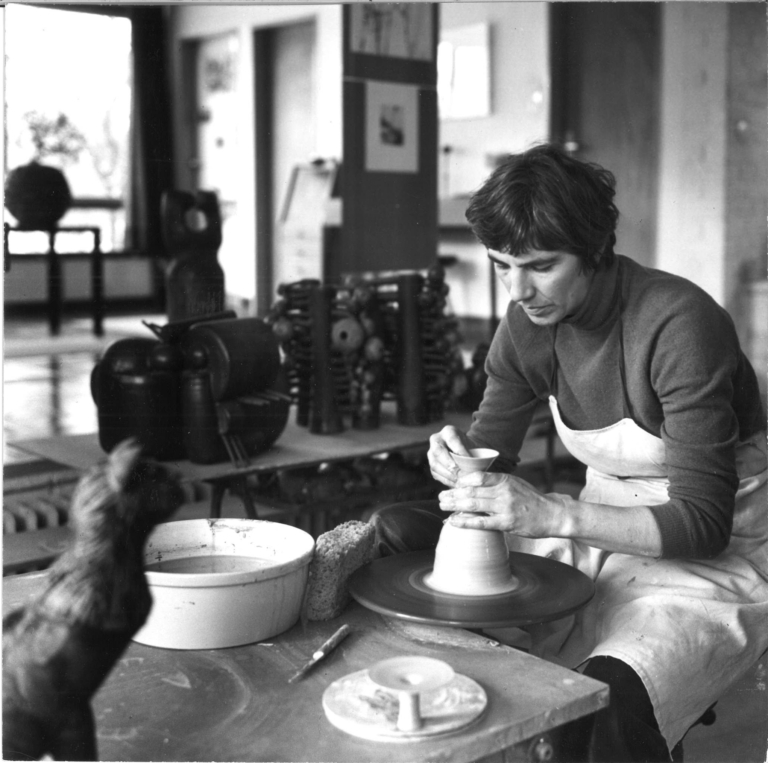
If the name Beate Kuhn is unfamiliar, you are not alone. The German sculptor, who lived from 1927-2015, has been largely unacknowledged outside of Europe. In turn, this assemblage presents a unique opportunity to engage, to learn, and to highlight the fluidity of art history. Turn may mark the artist’s first solo museum show in the U.S., but her approach to ceramic vessel-making feels familiar within the canonical scope of European modernism — the works embody the era’s emphasis on introspection expressed through gestural movement and dynamic form. The central didactic makes it clear: Kuhn’s ceramic practice occupied the intersection of Modernist painting, studio pottery, and sculpture.
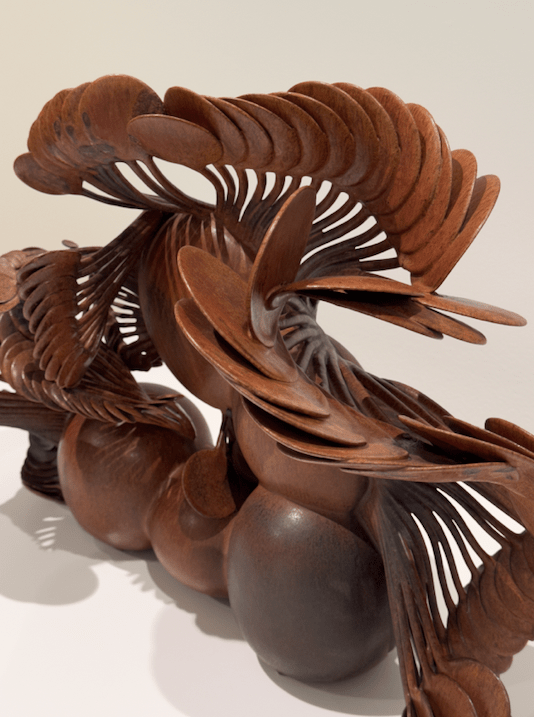
The work that welcomes you into the space, Spoon Sculpture (Löffelobjekt), 1975, demonstrates Kuhn’s position within historicized understandings of art from this period, while epitomizing her creative approach and areas of interest that are distinctly her own. Large in size, Spoon Sculpture is graceful and mesmerizing. Its rusty glaze combined with the undulating, almost animated, layering of the spoon forms — that for me recalled some sort of marine organism, perhaps an anemone — is a tremendous accomplishment.
Lively work such as this highlights several levels to Kuhn’s unique ways of depicting: an emphasis on painterly glaze work and expressive form, an uncanny reference to everyday objects — the crafting of which she had de-centered from her practice by the mid-1960s — and a high degree of technical mastery. All of these components to the work gives it a tactile life-force — the pieces feel like living organisms, ecological systems. Mammon, 1967, appearing to reference a bundle of seed pods, and Braid / Space Lattice (Geflecht / Raumgitter), 1970, a network of fungal forms, epitomize this aesthetic interest.
Repetition and contrast are seen across Kuhn’s oeuvre, be it through form (often negative and positive space), color (a bright and cheerful glaze or a dark, earthen and moody one), texture (matte or glossy), or a combination of the three. Bosom Book (Busenbuch), 1969 is an overstuffed clamshell of orb-like forms, closely bound and commingling in a way that makes you want to walk in circles around the pedestal. Object (Ball 1) (Objekt (Kugel 1)), ca. 1976 is a mirrored, three-unit tall stack of bowllike vessels housing spheres that are rendered so exquisitely that I am still in disbelief that they were made by human hands.
Though primarily interested in elemental forms, Kuhn warmly embraced playful expression through literal representation as well, seen in Madame, 1957, a slender vase with painted anatomical features. This object is shelved in an array of 14 total works that anchor the entrance side of the Scaife Gallery, making great use of the corridor-esque space that has posed a curatorial challenge for previous exhibitions, sometimes feeling claustrophobic and cramped.
Video installations with loud audio typically irk my senses when viewing an exhibition, but in this case works quite well. Projected floor to ceiling on the exit wing of the gallery, the overview showcasing the interior and exterior of Kuhn’s studio as it has been preserved today is elevated by a mix of field recordings (birds, church bells, rustling plants) and ambient tones. It provides the exhibition with a complementary aural experience and effectively highlights the sensorial, naturalistic, and rhythmic qualities present in the work.
There is something deeply comforting and warm about this exhibition, a joyous and triumphant space to witness and celebrate one artist’s chapter in art history that could have easily continued to have been denied, but is now being fully realized (at least for those of us in the U.S.). Her work serves as a wonderful reminder to seek and uncover the persistent beauty present in our surroundings and in ourselves. Kuhn’s life and practice are so rich in their history — I am excited to see what conversations and observations develop around this show that feels long overdue.
—
Beate Kuhn: Turn is on view at the Carnegie Museum of Art until December 1st. Supplements such as wonderfully researched essay, the studio video mentioned above, and a Spotify playlist’s that containing some of the artist’s studio favorites can all be found on the exhibition website: https://carnegieart.org/exhibition/beate-kuhn/.
A two-day experiential ceramic and botany workshop will take place in collaboration between CMOA and Phipps Conservatory and Botanic Gardens on August 24 and 25 from 11am-3pm, details can be found here: https://carnegieart.org/event/nature-and-clay/.
Zach Hunley (they/he) is a Pittsburgh-based modern and contemporary art historian, critic, photographer, collector of things, and proud father to a senior guinea pig. With a keen observational eye, they use their writing as a means to refract their deep appreciation for formal aesthetics through a socially engaged lens. They hold an M.A. in Art History from West Virginia University in Morgantown, WV.
 PETRICHOR
Leave a comment