by Pria Dahiya
The 10 works on display in Tracing An Outline Around A Man’s Shadow playfully throw space, time, light, weight and shadow across the room to each other. Though the show consists of six distinct artists of varied ages and mediums, the works whisper to each other with cool simplicity, textural whimsy, and refractory wonders.
Liberty Avenue is not usually where I go when I need a breath of fresh air. That is until I learned that nestled between a Five Guys and a Dialysis Center there is a miniature David Zwirner right in the ambiguous no man’s land between Bloomfeild and Shadyside. The Tomayko Foundation nonprofit was founded in 2015 by John R. Tomayko, a long-time art collector, but the building itself was purchased in 2021.
The former doctor’s office was subsequently reborn as a swanky circular lobby, well-drenched white room gallery, and small secondary red-paneled gallery – a room solely dedicated to one of Tomayko’s personal favorite artists (a new American oil painter who uncannily mimics old Dutch masters) Frank Mason. While not a part of the show, this small room was so personal and specific it genuinely endeared me to the collector himself. The gallery thrust its doors open a little less than a year ago in October 2023 with Commence, an AAP group show. Since then, it has been off to the races, with Shadow coming in as a fourth show before their big one-year-anniversary.
La Vispera’s Breakdown Reimagined ‘introduces’ the show – you encounter it directly as you enter the circular white lobby. Little red specks of light peeked through a stained glass lattice. The piece was blurred in my peripheral vision until a $99 symbol grabbed my eye. The panels filtering the scraps of glowing light were carved and layered neon plastic bags.
I stood there and thought about how when I look at stained glass I can feel a little dizzy. The older the glass, the more I’m slapped silly. A friend recently gave me a spur of the moment tour of a glass studio he works at which refurbishes centuries-old glass in historical homes and churches across Pittsburgh. I had never in my life seen the intricate process of cutting, smoothing, welding and warming which forming stained glass requires until that first friday. It’s special to learn new things by simply being alive. Hot, volatile, materials being transformed into an glowing image of divine light! What’s better than glittering images!
Looking at Breakdown Reimagined I thought of someone – fifty, maybe a hundred years from now – seeing a work like this. What would they feel encountering it? What would they think about when looking at our present as their past? Our single-use plastics have an ironic durability. Talking about it feels a little whiny; We no longer build columns of marble, but piles of microplastics, blah blah blah.
And then I entered the show. Ed Panar’s photographs activate the wall as you enter, and I immediately understood the artist’s installation choices. His crisp portraits of shadows spilling across concrete, on walls, and nature are hung at the rough level at which one should find them flâneuring today. I had to kneel down to examine shadows on the sidewalk, and get up to my toes to see his image of a little round moon. Clever.
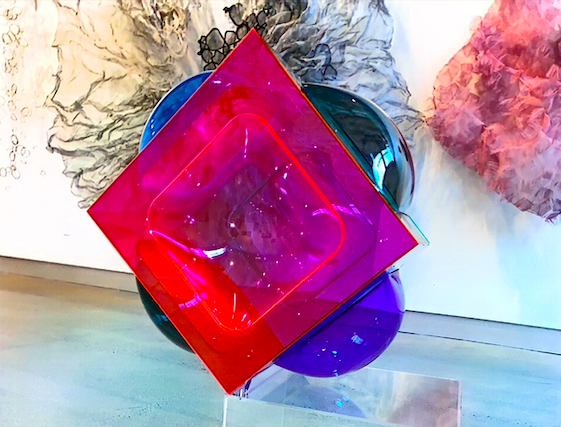
But it’s Aaronel deRoy Gruber’s 1969, 1968 and 1971 sculptures that play with perception itself. It took me close observation to determine if a surface had been popped out or vacuumed in on the sculpture’s surface. Concave and the convex surfaces refract with a deceitful similarity. The sculptures are totally modern, totally chic. The very idea of “table” or “chair” gets taken out of the equation, despite the materials composing the sculptures hinting at some abstract functionality. Gruber’s assemblages exist simply for the joy of taking up space, no purpose but to absorb or diffuse light. Gruber had some futuristic intentions with her plexiglass, steel, motors, aluminum rods and acrylics. I am keeping these works on my mind.
Atticus Adam’s work, displayed on the far wall, tie the materiality of Gruber’s sculptures with Panar’s thematic investigations. His semi-transparent, floating, glowing scultures are constructed with insect screens. Looking at the manipulations of the insect netting that intrinsically evoked India, mosquito netting around the bed, a cot on the roof. Who hasn’t lain in the sun and watched the shadow of a chain link fence dance across their palm? Watching the shadows these sculptures cast evoked a similar peace in me. Adam’s sculptures are airy, light, massive little things, but there’s a harness to the materiality of netting which lends exciting tension in the artist’s effort to make them soft and beautiful.
Grounding the entire show is the work I thought about for the longest – Michael Morrill’s Kugelblitz, (2005-2011) and Blue Moon, (2002). I admire any artist who’s found a way to create works intersecting the digital and physical process of painting. Morrill’s work is no exception – these two paintings are drawn from Morrill’s body of work called SHADOWwork, which employs a process of digitally synthesizing a range image collection of shadows cast surfaces.
Morrill then replicated the process of digitally layering images by layering paints. Kugelblitz alone took six years of layering, and it shows. The colors feel impossibly deep, and the canvasses seem to suck up the light around them. While these paintings represent a relatively early exploration of digital image intersecting with traditional painting, knowledge of his process made the resultant paintings are fresh and engaging. It’s worth looking closely. Layers fade in and out of view from every angle.
It’s a special feeling to be able to see one of the first shows the Tomayko Foundation is presenting, as it is proving to fulfill a unique role in Pittsburgh’s arts galleries – a serious gallery with an exciting future.
I’ll close by sharing with you a fun fact: The architecture of art galleries are so specialized that there are specially designed and painstainkingly coated panes of glass in all the windows which are designed solely to allow in filtered, safe, UV light which bathes the work in a muted but natural wash. So, you don’t truly know a painting until you’ve examined it in the light of the morning, the light of midday, and the light of the evening. If the painting retains it’s brilliance across the day – and shines right back – it is a painting deserved of a day’s length of attention.
I loved the show. All the works in this show deserve this manner of close observation.
Tracing an Outline Around A Man’s Shadow is curated by Nina Friedman, who Petrichor thanks for her time with this piece. The show is open through September 13.
Pria Dahiya is a director, visual artist and writer exploring internet culture through literary adaptation, movement and media design. With a passion for exploring the intersection of technology and humanity, Pria’s work transcends the boundaries of traditional art forms, seamlessly blending literary adaptation, movement, and media design. Pria has also spent twenty-one years being biracial, bisexual, and chronically online.
 PETRICHOR
Leave a comment