by Zara Yost
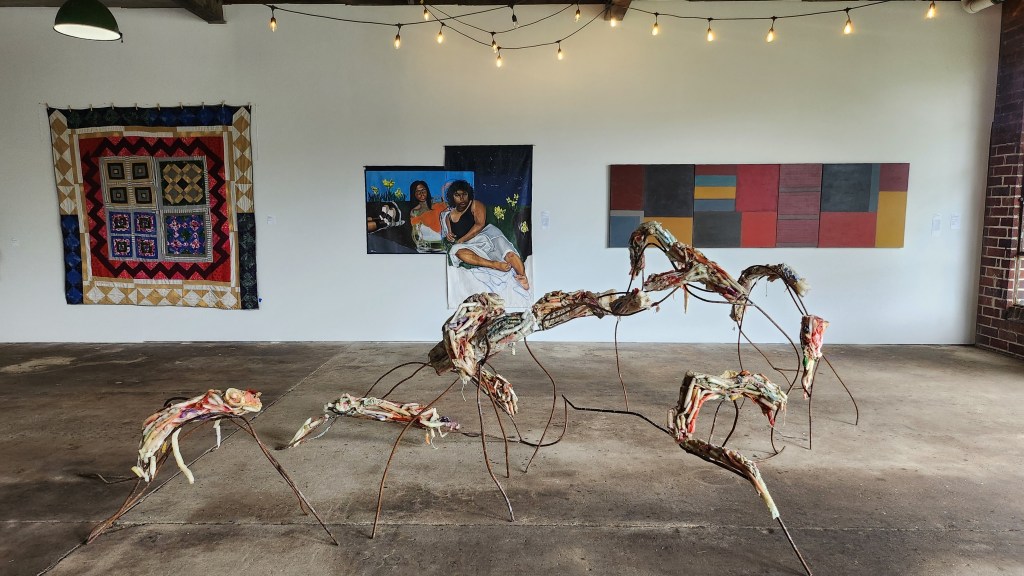
Photo: Oreen Cohen, “Havdalah: A Separation Found” הַבְדָּלָה (2021), candles (collected from local churches) scavenged rebar
An early Sunday getaway turned confusing as I twisted and turned down country lanes. My toddler nodding off in the backseat, I finally made it to Confluence, Pennsylvania after an hour and a half. The micro-town is about the size of a parking lot, and I already missed my turn. I thought of the town’s meaning as I circled the block.
Confluence hosts rivers Youghioeny and Casselman along with Laurel Hill Creek, Licking Run, Hen Run, Ramcat Run and a handful of others that converge into the larger waterways. In fact that’s what Confluence refers to—the point where several bodies of water converge—and where Radiant Hall’s group exhibition was on display. Nestled in a building adjoining a petite coffee shop, “Routes” houses works by artists Tony Balko, Oreen Cohen, Dara Etienne, Nick Falwell, Juliet Phillips, Sukeshi Sondhi, Sara Tang, Adam Rousseau, and Rell Rushin.
Far from the bustling city of Pittsburgh, Tissue Farm and its large garage-shop windows, concrete floor and aged brick give presence to works like Oreen Cohen’s sculpture, “Havdalah: A Separation Found,” Rell Rushin’s “A Place for Us All,” oil and acrylic tapestry, and Sukeshi Sondhi’s abstract pastels, oils, and acrylic work, “Shut Your Eyes To See (Quadriptych)” on canvas.
Tissue Farms, a newly appointed gallery and espresso space, is overflowing with vintage charm and historical significance. A once auto shop, and former Captain’s farm, the gallery-cafe hybrid has been restored, repackaged, and reimagined into a quirky oasis in a small town.
Radiant Hall’s exhibition plays on the themes of Confluence by integrating the artists, and their work into a multifaceted display of directions. While deep into their art practice, the artists in “Routes” are venturing into novel conduits of study. Each has found their way to the city of Pittsburgh in a myriad of different ways. Sukeshi Sondhi is a great example. Having moved to Pittsburgh from Singapore, the artist’s “Shut Your Eyes To See” is a part of Sondhi’s latest series inspired by the rust belt urban terrain of Pittsburgh. The work is also an examination of influences like Mark Rothko—the darker hues of burgundy, and brick reds pair well with the blurry acrylic patches of amber and gray-blues. Sondhi’s earlier works and series, Shifts in the Urban Landscape also follow the city environment but orient themselves towards the influences of the sharper lines and abstractions of Alice Trumbell Mason and Anne Truitt.
Also in the exhibition is artist Dara Etienne, who explores textile as a medium. Etienne’s “Untitled” is the artist’s first quilt, while “Devotion” combines linoleum carvings with weavings. Following the long history of quiltmaking and fiber art, Etienne’s quilt is large and colorful against the gallery wall. A study in geometric patterning influenced by the African diaspora, the black strips of embroidered zig zag lines, and pop of rich vermillion draw the eyes around the piece.
Oreen Cohen’s sculptural work “Havdalah: A Separation Found,” continues to examine the artist’s relationship to faith, neuralgia, femininity, and the body. Simulating skeletal, and neural networks Cohen created this sculpture with found materials, including scavenged candles from various churches. The meaning of “Havdalah” can be traced to the declaration of Shabbat in the Jewish faith. Havdalah can only be declared Saturday night, after the sun has set, and it’s in this announcement that the holy day is separated from the rest of the week. Cohen’s work is represented by her ties to family, religion and her practice as an artist. The work of rebar bound with melted wax is visceral, and navigates the complexities surrounding beliefs and community and their effects on the flesh, the form and humanity.
“Routes” finds us at the convergence of artistry and existence. The exhibition highlights that while each artist comes from a different background of faith, race, or country, and yet a city and a commitment to their craft can unite them all.
Zara Yost is an interdisciplinary artist, curator, and writer living in Pittsburgh. Her career is heavily influenced by her time in Chicago’s music and art scene. She has written for publications such as Newcity, the Chicago Reader, and Fnewsmagazine. Zara is best known for her work with organizations such as the Museum of Contemporary Art Chicago, United States Artists, Boston Society for Architecture, and The Roberto Clemente Museum.
 PETRICHOR
Leave a comment