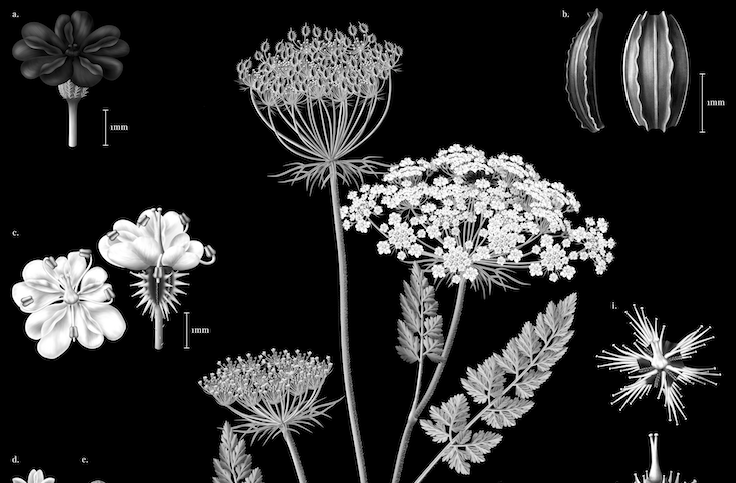
by Zach Hunley / Cover image from Andreia d’Almeida (Portugal), Wild carrot from Côa Valley
The meaning behind the term “hidden gem,” as with any cliché, can erode when overused — this feels especially true when applied to arts institutions. I lay out this semantic grievance to say that the Hunt Institute for Botanical Documentation is, without question, a hidden gem to be treasured, a secret garden to explore. Tucked quietly away on the 5th floor of Carnegie Mellon University’s Hunt Library, the Hunt Institute’s 17th International Exhibition of Botanical Art & Illustration is a spectacular showcase of the Institute’s commitment to the illustrative genre as it exists now, in our time.
Despite being comprised of work by global contemporary artists (43 works by 43 artists from a total of 19 countries), the Hunt Institute space itself is straight out of the mid-century — the elevator up to the Institute feels almost like a time machine. Opened in 1961, the Hunt Institute’s warm, oak paneled walls imbue the space with a welcoming charm more akin to a cabin than a library. Immediately to the right is the Institute’s exhibition space, and stepping through its threshold your eyes are met with the bright liveliness of the work mounted along the gallery’s perimeter.
I cannot say I was strongly drawn to any one piece at the outset of my looking; my eyes readily and happily bounced between works as I circulated the room. The display feels very nonhierarchical, though some works are larger than others — such as Michele Rodda’s Macaranga gigantea (2021) which anchors the rear wall. The piece is a glorious nature print of an enormous leaf and offers exquisite detail of its intricate vascular network.
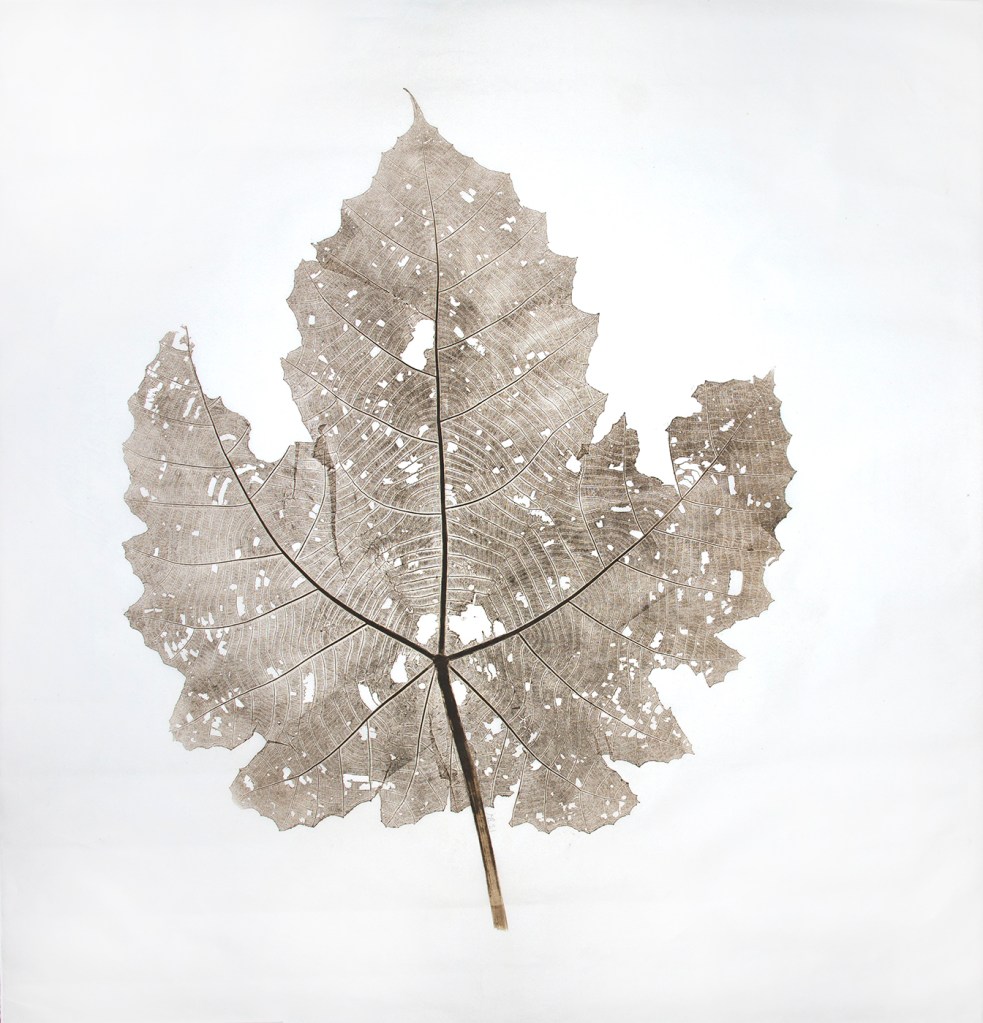
Macaranga gigantea (Rchb.f. & Zoll.) Müll.Arg. [Macaranga gigantea (Reichenbach f. & Zollinger) Müller Argoviensis,Euphorbiaceae], 2021, nature print on machine-made Xuan paper, 102.9 × 97.2 cm, HI Art accession no. 8614
I found delight in comparing the similar and contrasting elements between the works. This is something that would have been more difficult in previous iterations, as Hunt Institute Curator of Art Carrie Roy noted to me in an interview that previous iterations had multiple works by each artist. The singularity now present in the International makes for a dynamic show, one that maintains a holistic feel while embracing and celebrating the stylistic and formal (dis)similarities across the genre.
For someone who enjoys color as much as I do, I found its absence in some of these works to be more visually impactful. Andreia d’Almeida’s Wild carrot from Côa Valley (2022) is perhaps my favorite piece in this exhibition. Depicting the botanicals that grow from carrots, above the ground, the delicate florals are starkly rendered without color on a pitch-black backdrop — the work demands your attention.
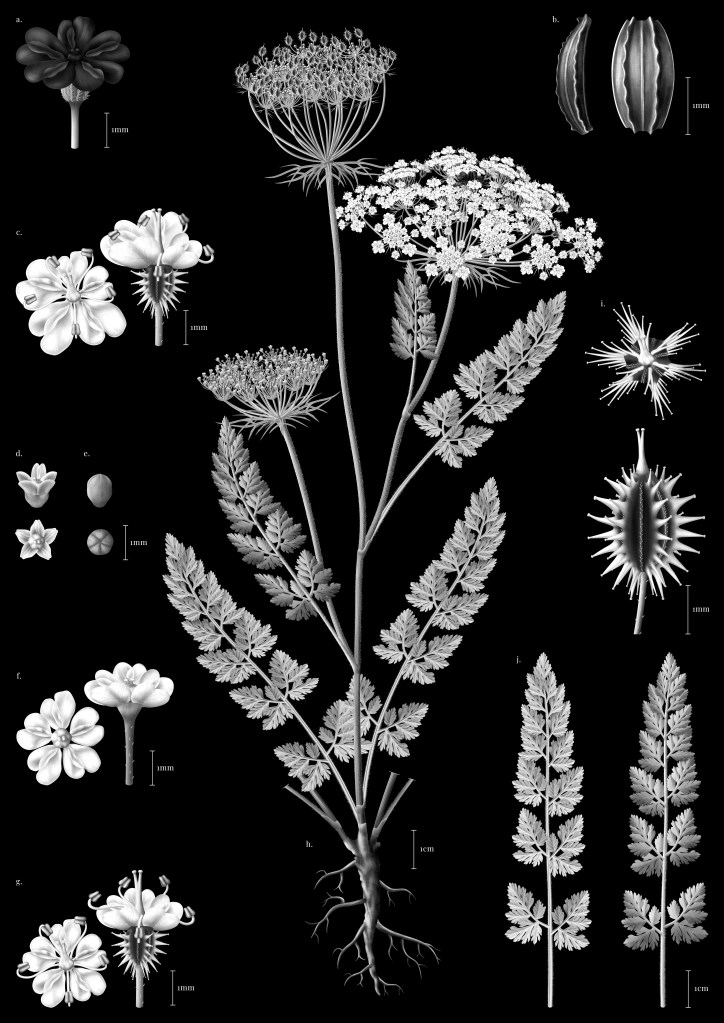
Wild carrot from Côa Valley, Daucus carota subsp. Carota L. [Daucus carota subsp. carota Linnaeus, Apiaceae alt. Umbelliferae], 2022, digitally rendered, inkjet print on paper, 42.1 × 29.2 cm, HI Art accession no. 8636
I was intrigued to learn that this piece was one of two in the exhibition to be entirely digitally rendered. For a genre known for its technical rigor and exacting specificity, the inclusion of pieces not rendered by hand directly onto paper (or board, or vellum) may surprise some, but it highlights exciting new horizons and possibilities for this centuries old cultural practice. Digitally made work does not equal lesser quality work.

The longer you look at the work in this exhibition, the more you will notice the breadth of formal choices made by the artists. I have already mentioned color, or the absence of it, but there is also the selective use of it, as seen in Keiko Nibu Tarver’s Horse Chestnut (2022). Two separate branches from the tree are depicted at two distinct points in the seasonal growth cycle — the flowering of spring and the chestnut harvest of autumn. These components are done in full color. Sketched in the bottom right corner of the work is a full view of the tree without its foliage, and without color; there is also a precious and easily overlooked drawing of, I’m told, the artist’s husband standing next to the tree, for scale.

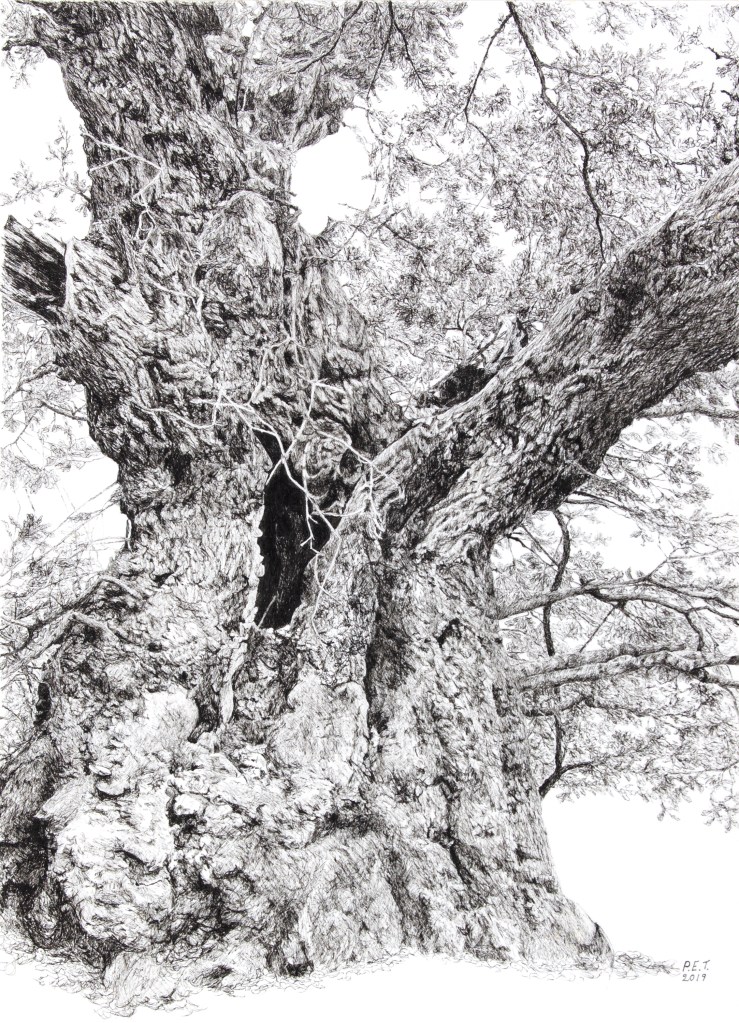
Some works extend beyond the picture plane and really pull you into their worlds, such as Kimiko Miyahara’s Endemic plants of Japan’s Ogasawara Islands, A UNESCO Natural World Heritage Site (2016). I love how luscious this work feels, it somewhat reminds me of the plush groves of rhododendron bushes I grew up around in West Virginia. Pamela Taylor’s The Druid’s Oak (2019) is another work that pushes outside its frame. The gnarly trunk of the tree looks absolutely wicked in contrast with the rest of the exhibition — just in time for the imminent Halloween season.
Truly, there is no bad work in this exhibition; everything feels highly refined, highly technical, highly educational, and extremely beautiful. Each piece possesses a commanding quality that demands we look closer, exactingly closer, at the natural world that surrounds us. Roy told me she hopes visitors “take away a reinvigorated sense of awe about the world around them.” Quietly alive, this show certainly left me with a renewed sense of wonder and joy. Spending any amount of time with this exhibition is sure to alter your perceptions and attune them to appreciate the natural beauty that surrounds us.
—
The Hunt Institute for Botanical Documentation’s 17th International Exhibition of Botanical Art & Illustration is on view until December 17, 2024. Located on the 5th floor of CMU’s Hunt Library, it is free and open to the public Monday-Friday from 9:00am-5:00pm. More information can be found at huntbotanical.org.
Zach Hunley (they/he) is a Pittsburgh-based modern and contemporary art historian, critic, photographer, collector of things, and proud father to a senior guinea pig. With a keen observational eye, they use their writing as a means to refract their deep appreciation for formal aesthetics through a socially engaged lens. They hold an M.A. in Art History from West Virginia University, Morgantown, WV.
 PETRICHOR
Leave a comment