I’m very tired right now. Coffee hasn’t done much for me in a while, but it used to do . . . something? Yet . . . now I’m too fatigued to wax in my grandiose, ecstatic voice. Which is unusual, though currently, sitting here this morning, I would be lying if I denied: when asking myself how to describe the effects of coffee upon me, many inner doors appear. I see that all I must do, were I to desire entry, is nudge against any path—knock with only a word.
That’s writing. It’s to realise the numerous, diverging ways—one standing for each possible pen scrawl or keyboard stroke—and entrance inside requires only that you intend and apply force. That force etches its symbol and walks you into that new space.
* * *
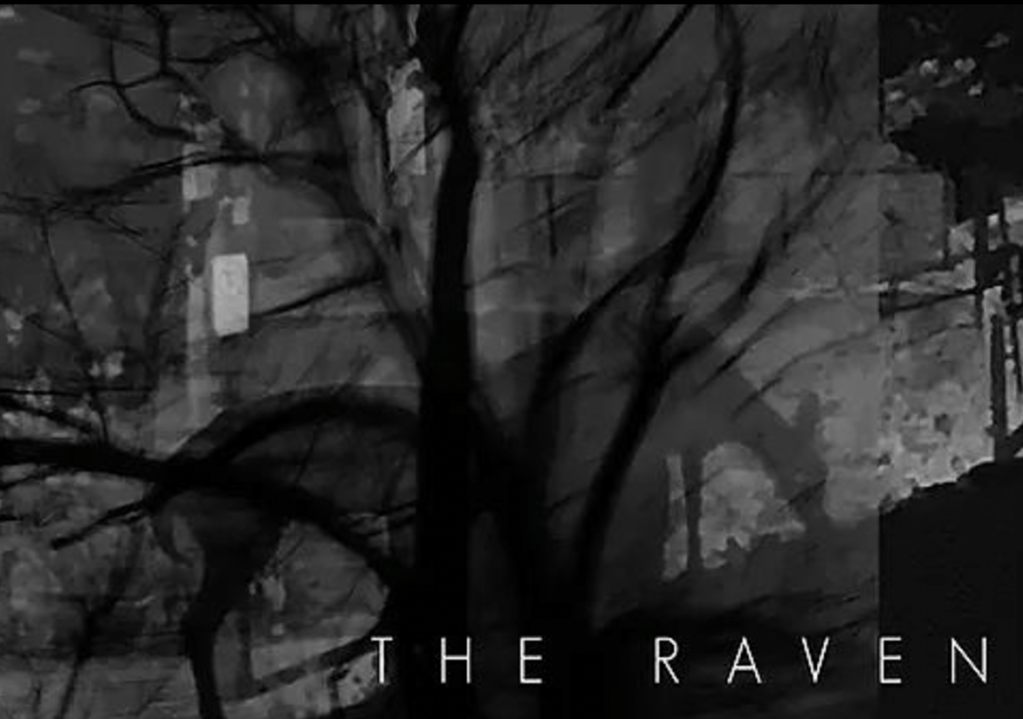
On Friday, , I watched the premier of The Raven at The Space Upstairs. The Raven was the first dance production led by Lennon Richison. Richison is one of the recent additions to the The Space Upstairs’s collective of resident artists. Kaben Benavides, a dancer featured in The Raven, is the other artist recently inducted into residency..
I intended to return for the show’s second and final run on Saturday, the second of November. This was out of genuine interest, enhanced by the pleasure I took in the premier of The Raven. I also thought the performance deserved to be better understood, an understanding of theme and narrative which I did not achieve on my first viewing. But I abstained from the second performance, I’ll admit, though not without adding: my having missed the second show was only due to my neuroticism, and not as a result of any distaste.
* * *
It is now Tuesday, the fifth of November. I have most of the day off, which is nice. I will go to get bloodwork and shopping done, and take a nap. I’d also rather just look out my window, into the glass studio, whose broad door was propped open late into the night yesterday evening, and as a signal for what is always a rapid, too fast escalation into the holiday season.
* * *
It is still Tuesday, a few hours later. My bloodwork was taken—a set of lupus, lyme, and arthritis tests—and I borrowed Balthus’s memoirs from the library. My friend Mark had, a couple days ago, read to me the blurb off the back as we sat around his kitchen table before breakfast. The blurb is an excerpt. Let me quote a slice: “I lived a while on earth in the exaltation of painting, as a vocation in the religious sense of the word. I was devoted to painting, having no other duties than the one painting condemned me to: to finish the canvas and rework the design.” Balthus continues boldly: “Henceforth one day breeds another, [a day] that must be given to painting, the pursuit of work until God finally wants to summon you to Him.”
And so for us as well, I claim. If we obey our instinct toward art, whether we know it or not, we seek within our work the sublime, the sacred. Though . . . I feel like I have written myself here into a corner, especially with this quote by Balthus. I suppose I look for this sort of self-imposed pressure, as desperation often clears the mind (or at least begs focus of it), but I here now endeavour to write myself an escape. This peaking frustration, found in me now, always seems to be the point within which a piece of my writing truly begins, at that corner where the process feels most to be disaster.
* * *
I spoke with Jaka Porter, one of the artistic directors of the Space Upstairs, before the start of last Friday’s performance of The Raven. I will recall this conversation now, from election day. It’s a discourse upon a subject I find more pertinent than any talk about political results or general politics.
But first—if I may divert—here’s a poem. As Yeats wrote:
How can I, that girl standing there, My attention fix
On Roman or on Russian Or on Spanish politics,
Yet here’s a travelled man that knows What he talks about,
And there’s a politician
That has both read and thought,
And maybe what they say is true Of war and war’s alarms,
But O that I were young again
And held her in my arms.
We are young. The symbolic beauty of art, which Yeats found in that girl, is before us. Yes, Yeats here was an old man, and writing about a literal woman, I’m sure, but I insist also that this poem was more truly the artist in him raving. Yeats was a romantic who famously had many muses. There is an entire textbook devoted to Yeats’s relationships with the nine or however many women to which he bowed, these human idées fixes that, I say, each served to represent to Yeats the objective, externalised ideal of his creativity. And the creativity that these women symbolised is superior to either geopolitics or impending doom. To be young is to know that yes, one can hold this artistic ideal within one’s arms, and this ability is only dependent on one recognising it as the priority, just as Balthus did. Within such an embrace . . . well, that embrace with such inner vitality is the only where within which wars evaporate. Such beauty comes before any of this political garbage, it’s where we find true representation, and . . .
Sorry, let me calm down.
* * *
Jaka and I spoke before the premier of The Raven. I was sitting on some rinky chair with my legs crossed, the back of one knee resting on top of the other, while Jaka sat behind her computer. Jaka is a professor of dance at Point Park University, and more students of hers students are injured than at any other point of her career in living memory. Jaka encourages each one of her students to progress through such injury, even if they must grow through the act of dance in a chair—anything to keep the dance moving.
Injury is difficult, even in art. To the young it most seems to serve as the excuse to quit. I had multiple hand injuries as a young, frustrated musician, mysterious and chronic aches which still daily exist after more than a decade (—I periodically talk to doctors about it, and they provide me blood tests which solve nothing). As a response to the pain, I decided to quit music altogether; I mostly abandoned guitar and stopped producing metal instrumentals by the age of eighteen. Instead, I swapped for stand up comedy, which had less physical demands.
Many of Jaka’s dancers will give up, I suppose, as most young artists move on, perhaps never having been artists. But injury may be most that opportunity which enables one to begin in art: an injury, as a limit, is real; it is something to which the artist responds, something tangible, an experience that grounds, finally, the young artist’s work in something more than hubris or lofty desire—for art has become rooted in necessity. The young often create with such excellence because they don’t know what the boundaries are, but, when faced with true resistance, what does one do in the encounter with one’s first impossible barrier?
I looked around the warehouse where The Space Upstairs is housed. Exposed wooden floors, intimate lights, and then couches and chairs aligned toward the bare, black wall against which Benevides was positioned. She was in character, brooding blank-gazed and near fetal on the wood panes even before the show’s start. She wore nothing expressive on her face, a void which was not an absence, but something super-vacant and made ever-empty because that is how we gain chance to fill her gaze, it never having had chance to be truly bare. I placed within it dreadfulness. I was witnessing someone stare back into herself, via the reflection found before vision had even exited her own eyes. A hall of mirrors segregated from company.
Richison was behind the ticket desk, running around, doing everything. They had choreographed the show and were now tasked with greetings, lighting, a list of duties that I couldn’t keep track of. My focus fixed only on how Richison’s role was, for the first time I’ve seen, removed fully from the immediate performance of dance itself. And as Richison played their many roles, the room kept filling.
* * *
This was a show put on by young artists. I, too, am young, and make things for some odd purpose. I identify with a lot of the uncertainty about life which I saw in the piece. Even if I projected such uncertainty upon it, I could argue uncertainty’s place and argue well, proving I’m right to have ascribed such emotion.
There was something about this show—(and something similar within all dance, this similarity that I note perhaps making me want to avoid literal description, as my near layman’s, impressionistic eye would recount the dance in a way which was dishonestly impersonal)—this show captured something large, if only for passages, sequences, or moments. If missing the mark as a cohesive totality, I argue that The Raven, whether intentionally or not, sacrificed some more basic forms and techniques and to serve a higher purpose.
This sacrifice did not go unrewarded. There were moments which struck something grand, and the angle of that strike could have only have occurred within The Raven as a youthful endeavour, and not within The Raven as a rote, proven recipe. This, admittedly, may have been lost on some who demand more mature precision. But even if within the naïve, half-blind trial of a premier we are denied full satisfaction, we are offered something—perhaps the glimpse of a more wholesome ambition—and that glimpse has more stay.
Richison’s piece welcomed me into some—again, to keep with the vague language—some larger state. I have the belief that most careers in any art are regularly based upon achieving with greater consistency a quality less pure than this large state here reached. That consistency is important, but its professional march often forgets to strive for the mystery which mistakes or awkwardness open us to.
The Raven had its awkward moments. A transition or two was harsh and went far against my expectations, but . . . It sometimes seems to me that mastery is to perfect what is revealed to us only through our biggest failures. Failure is a loaded word here, and to be clear, I call The Raven a success, but I must note that The Raven was inconsistent. Though loose moods and roles were described clearly in the performance, I had no idea what I was looking at much of the time.
But this not knowing did not stifle. As the components of story and the occasional jarring transition clashed against me—me and my broken or upset expectations—this friction created a valuable set of conditions. The conditions were at times unintelligible, but their unintelligibility ensured I had something I had to feel. I couldn’t trace out the story of the dance as predicted, because it didn’t go where I thought it would (and it perhaps existed at a bit of a remove). As a welcomed consequence, I had to open myself to the show. I needed to see, had to feel. This revealed to me The Raven’s effect. The effect I think contained a small but significant something that perhaps can never, in any context, be reproduced with consistency. It’s hard to define it, but that something is what is worth aspiring to, even if while working to achieve it one does demand of oneself more reliability in the qualities beyond such aspiration.
* * *
The show ends and the larger feeling falls out of the room, though I possessed (and possess still) something of it.
The question I ask myself after I create anything—whether what I have made is a song, a performance, or a piece of writing—this question is the same question which has haunted me for the past fifteen years. I ask myself: but will I stay open to making such a feeling again? In other words, after I make anything, the most common thing I ask, even if for a moment, is whether that most recent piece of mine is not the last thing I’ll ever make. This is the manifestation of my uncertainty.
Because how could I create again? I could never create again, not now, as I can finally see how much work it took to compose that work as a whole, after the fact. It is a laborious sort of work, really something for which one cannot be compensated by anything. But I suppose that is why I do create something again, because I see there is no compensation available within it because it is of a unique value of itself.
But I do, even after writing that, ask whether I too will not quit like so many. Why do so many quit? Who am I to say whether I will write another line, pick up a guitar, or perform comedy again? How do I know I will not give everything up tomorrow? Or worse, have everything taken. But I am not sure there is an option . . .
The Raven makes me ask the same thing about Richison, or any of the dancers involved. This was the work of a young team of artists. With youth, there is less proof one will follow through, less evidence of having previously followed through, which perhaps makes it more difficult to possess blind faith in the fact that one can continue.
I, looking at The Raven’s ensemble, see a bunch of artists at the start of their career. Or, perhaps, these people are nearing an artsy journey’s end—who knows. If careers, they are arcs which have hardly, if at all, taken shape. And how does one trust what one does not even know? I relate to this as a near penniless writer. I have made perhaps $200 dollars in the arts in the last decade, despite thousands of hours of work and several hundred performances. This is perhaps due to my having been too busy with impractical ideals than with playing certain PR-styled self-promotion games, but there are a lot of other reasons, too, some of which include uncertainty.
I don’t know what’s ahead. I have quit what I had thought I would do for the rest of my life now twice. Music as a vocation is gone. Comedy too is gone in the same way. But I see now, after having quit, that quitting wasn’t necessary. Yet for some reason I still decided to quit, even if I cannot explain why in a way which satisfies. That struggle in articulation keeps me going now; each art I abandon will only leave me with another painful, unresolvable question.
But what’s my point. Much of this has nothing direct to do with Richison and their show, yes, but rather has to deal with my own, again, neurosis. But I’m curious what Richison does next. I’m curious what this whole ensemble will do next, whether apart or together.
Danny Mckaveney is a writer and poet living in Pittsburgh.
 PETRICHOR
Leave a comment