
by Pria Dahiya
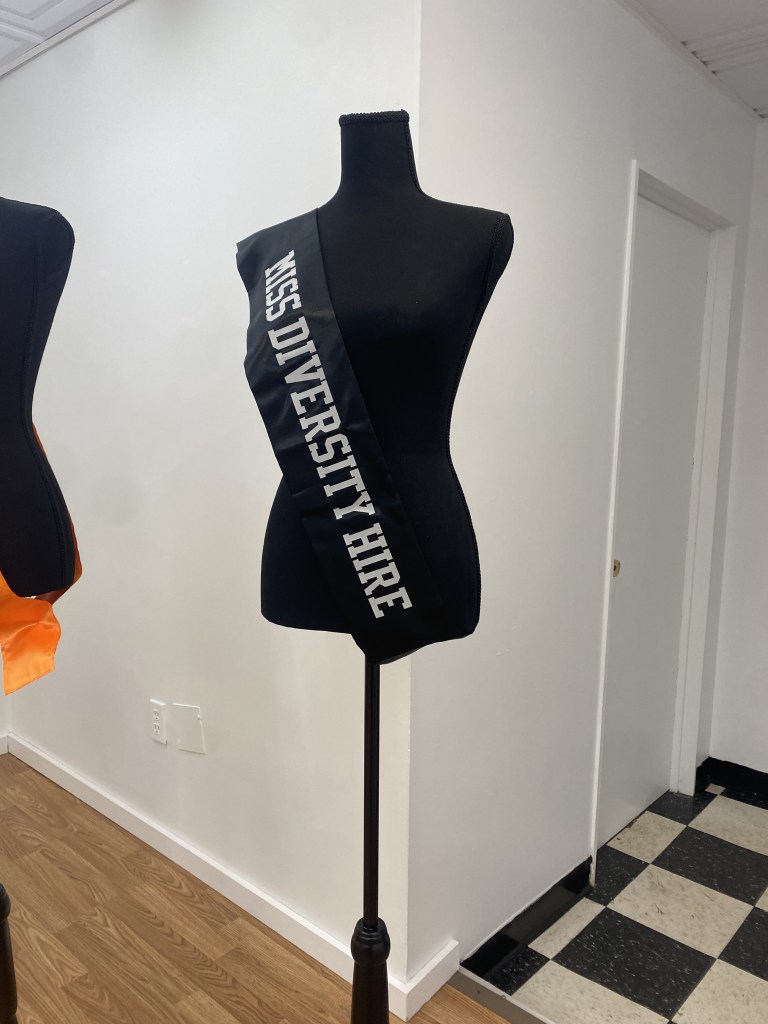
It is a pageant no one signed up for, competing for an award no one wants to win. A line of eleven headless, legless dress forms stand silently, sashes screaming.
Candy-colored satin loops emblazoned with acerbic archetypes – “Miss Mediocre Lightskin”, “Miss Respectability Politics”, “Miss Diversity Hire” – are arranged in a claustrophobic, semi-circular tribunal in the small back-room gallery of Point Breeze’s Bottom Feeder books. Tara Fay Coleman’s Pageant Queen‘s deceptive simplicity mirrors the reductive power of words often used to flatten an artist into a system of symbols and signifiers.
My assessment of good conceptual art is similar to my assessment of a good joke – you can “get it” instantly, it provokes an immediate and involuntary reaction, but as you sit with it, new truths are revealed. Pageant Queen does just this. As Coleman writes, she “critiques how Blackness is often commodified, celebrated, and erased in spaces that purport to value diversity.” I use Coleman’s own words because they are as much a part of this work as the physical sashes themselves. Coleman is interested in language, how identity is simultaneously “rewarded and erased” through monolithic terminology.
There is sharp intentionality in the ordering of each phrase. The four sashes on the right – “Miss Mediocre Lightskin”, “Miss Lighter Than A Paper Bag”, “Miss Angry Black Girl”, “Miss Tragic Mulatto” – speak to legacies of historical racism, the sashes to the left – “Miss Model Minority”, “Miss Diasporic Disconnect”, “Miss Post-Racial Fantasy”, to name a few – reference backhanded contemporary language, skewering artspeak and institutional racism. ( “Miss Tragic Mulatto” also serves as a reference to Lisa Jones’s Combination Skin, a “a one-act comedy . ..about a futuristic game show called $100,000 Tragic Mulatto,”)
While this is my first physical encounter with Coleman’s work, I have been following her digital footprint for months. Coleman fires from the hip: real-time insights on critical theory sit alongside affectionate homages to her two children and envy-inducing fit pics, all dissolving in the 24 hour time bomb of Instagram Stories.
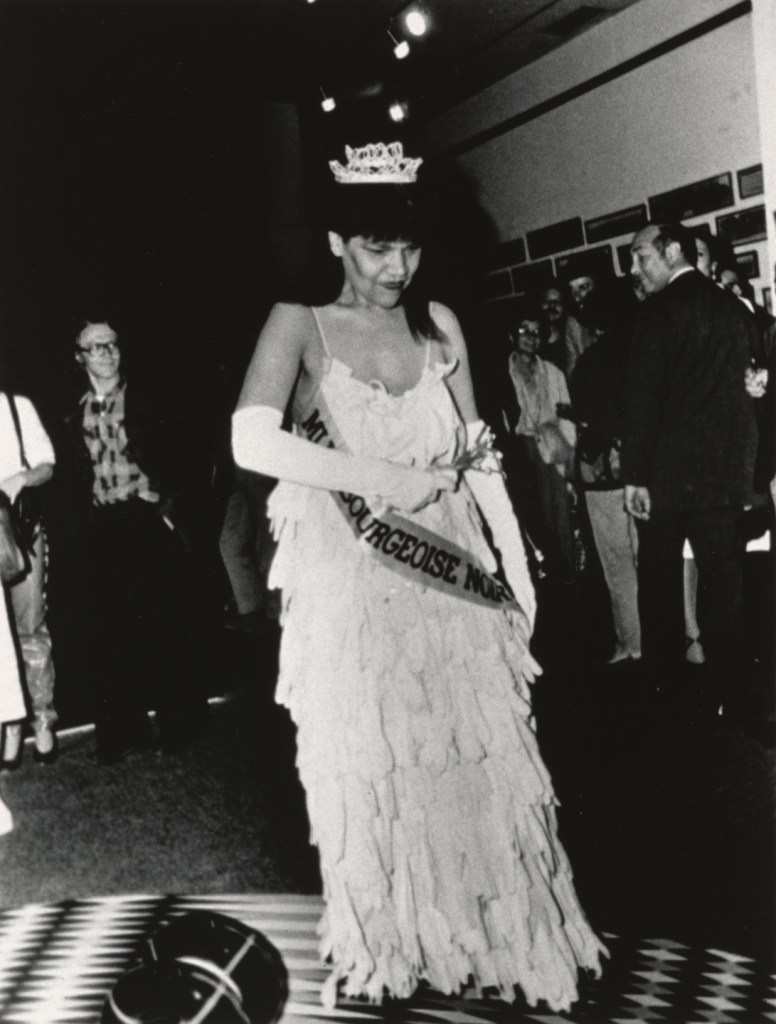
Speaking with Coleman provoked the same delightful juxtapositions as her digital dictums. She weaved accounts of her first encounters with the major influences on this piece – Lorainne O’Grady’s Mlle Bourgeoise Noire and Lisa Jone’s Combination Skin – alongside frank discussions of the subtweets and slights that directly inform her work. These lived experiences “can be really difficult to sit with”, she shared, “which is why I’m always gabbing to the internet.” Gabbing is one way to put it – digital performance art would be another, equally accurate term. Identity, motherhood, Black womanhood, taking up space – the central themes of her practice – are explored in exciting ways each time she logs on.
When I asked her how it felt to finally display these sashes altogether, Coleman shared that “being able to make the work, and provide it with such robust context, feels like a purge… there’s a joy in that, and a sense of relief.”
Context is the other important ingredient to the show’s presentation. Laid like pieces of evidence on a stark white table, Coleman offers up the sources that informed this work, a physical bibliography fitting for the show’s setting in a bookstore. These materials consist of three books on Lorraine O’Grady’s work, Two Books on Lisa Jone’s work (Contemporary Plays by Women of Color and Bulletproof Diva: Tales of Race, Sex, and Hair) and two printouts: “Black Women and Pageantry: A Legacy of Resilience and Revolution” and a summary of Lorainne O’Grady’s Mlle Bourgeoise Noire.
This context was extremely valuable, particularly the two printouts, aiding any attendees unfamiliar with O’Grady’s work to situate it within that tradition. It also reminded me of Read-Shifting Web, a show JADED Pittsburgh did with Bunker Projects this past summer. A “communal reading room and literary art exhibition”, it transformed Bunker’s gallery with books borrowed from the the personal libraries of local Asian/American artists and organizers. I’m excited by the inclusion of reading materials in local shows. Including books alongside art enriches both the art and the texts simultaneously. Reading in public is a lost practice, with transformative, radical potential. Coleman proved as much in her 2022 work, …as if to a lover, where she read from Bell Hook’s All About Love on a bed in the middle of Market Square.
There’s a sore lack of conceptual art in Pittsburgh, which I theorize has something to do with our city’s general emphasis on craft. Perhaps this is a symptom of our ever-present steel and glass legacies, or perhaps it might just be that mid-sized rust belt cities don’t have bustling conceptual art scenes. Coleman’s work fills a sore need in Pittsburgh’s arts scene. I would love to see Coleman continue to display these sashes. I would also be thrilled to see them engaged in the context of performance, but perhaps that is asking too much.
Crafting this show has been hard work – that much is clear – and Coleman deserves to rest on her laurels (or sashes). I leave you with the text of a poem O’Grady performed as she ‘invaded’ the New Museum. Coleman’s work is in direct response to these words.. Adorned in a gown of white gloves and sash, Mlle Bourgeoisie Noire proclaimed;
wait in your alternate/alternate spaces
spitted on fish hooks of hope
be polite wait to be discovered
be proud be independent
tongues cauterized at
openings no one attends
stay in your place
after all, art is
only for art’s sake
THAT’S ENOUGH don’t you know
sleeping beauty needs
more than a kiss to awake
now is the time for an INVASION!
Pageant Queen is this necessary invasion.
Pageant Queen runs through January 25, 2025 at Bottom Feeder Books (415 Gettsbury St.)
Pria Dahiya is a director, visual artist and writer exploring internet culture through literary adaptation, movement and media design. Pria has also spent twenty-one years being biracial, bisexual, and chronically online.
 PETRICHOR
Leave a comment