
by Emma Riva
In Brent Pheto’s Environmental, there’s a sense of both overwhelm from the exterior and claustrophobia from the interior. Think “The call is coming from inside the house,” the horror trope where the real violence is that the very space you’re trying to take refuge in is the source of your terror. When you really unpack that, it’s a violation. Pheto’s most recent show merges both external violence and internal complicity, dealing with both existential pain and structural despair.
The fact that Pheto uses block prints of repeated images creates a sort of language to the pieces, like recurring motifs in a novel or film.Take a series in which Pheto shows missiles assailing the outside of a home, but the home itself resembles a missile. In Brown House 1, the figure bursts through its own roof, while in a different Brown House painting, the figure cowers beneath the missiles pelting its rooftop. Pheto pulls no punches—his work often borders on the macabre and grotesque, and while it certainly can be a little surreal, it’s closer to uncannily figurative than abstract. His use of text and gesture feels like Raymond Pettibon, while his familiarity with disturbing symbols feels like David Lynch.
A new element for Pheto the self-portrait (pictured in the cover image). The show opens with it, in the entryway of Bottom Feeder Books. Pheto depicts himself made of tobacco plants and ghastly fabric specters, no surprise in some ways, but there’s a real feeling of depersonalization that emanates from it. Pheto is also to be commended for the multimedia elements of the show, a playlist of natural sounds and a poem accompanying it. He jokingly re-assured me at the opening that “This show is about the environment, and nothing else.” In reality, each of us is a part of the quote-unquote environment, and discussions about climate change and environmentalism are really discussions about choices we make in our day-to-day life and the futility of existence. Removing human life from nature denies the central fact that we are a part of nature, a denial that got us to where we are now in the first place.
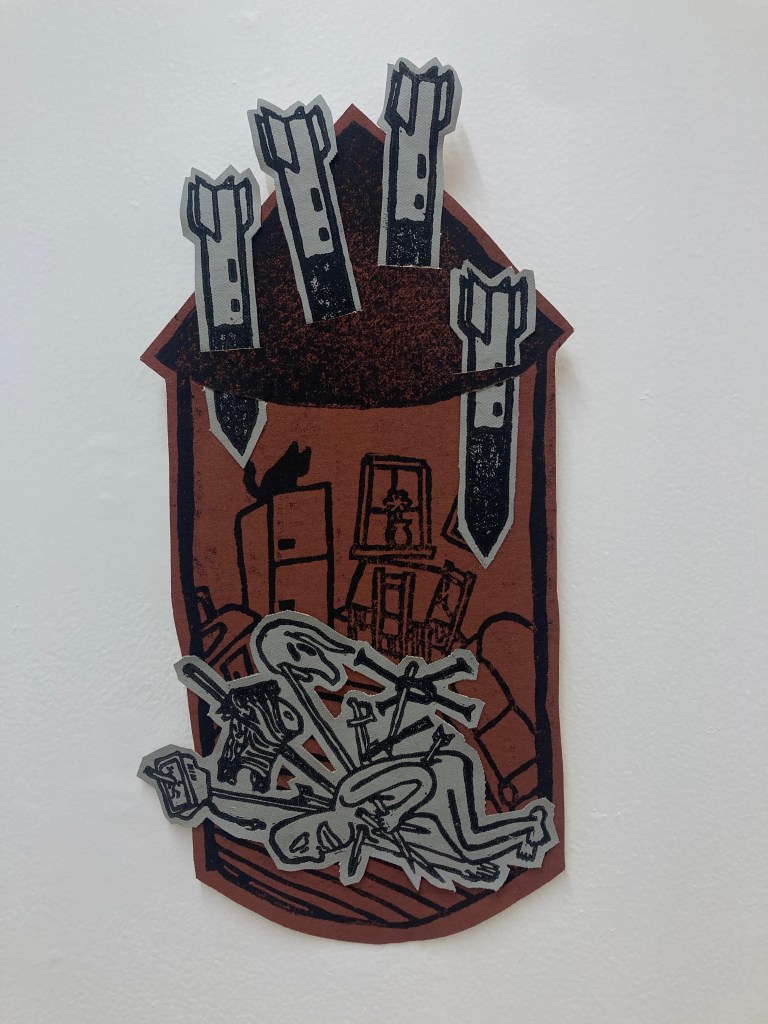
There’s a repetition of symbols in Environmental that feels vaguely sinister, like you’re trying to untangle a visual code. But this is, in some ways, Pheto’s most personal show yet. I’ve followed his work for two years now and have found that though it alludes to his internal life, it often doesn’t totally go there. Environmental does. Pheto’s allusions to depression are some of the most poignant parts of Environmental, including a poem referencing the abject meaninglessness of violence and the attempt to move forward in the wake of mental health setbacks. In reality, each of us is a part of the quote-unquote environment, and discussions about climate change and environmentalism are really discussions about choices we make in our day-to-day life and the futility of existence.
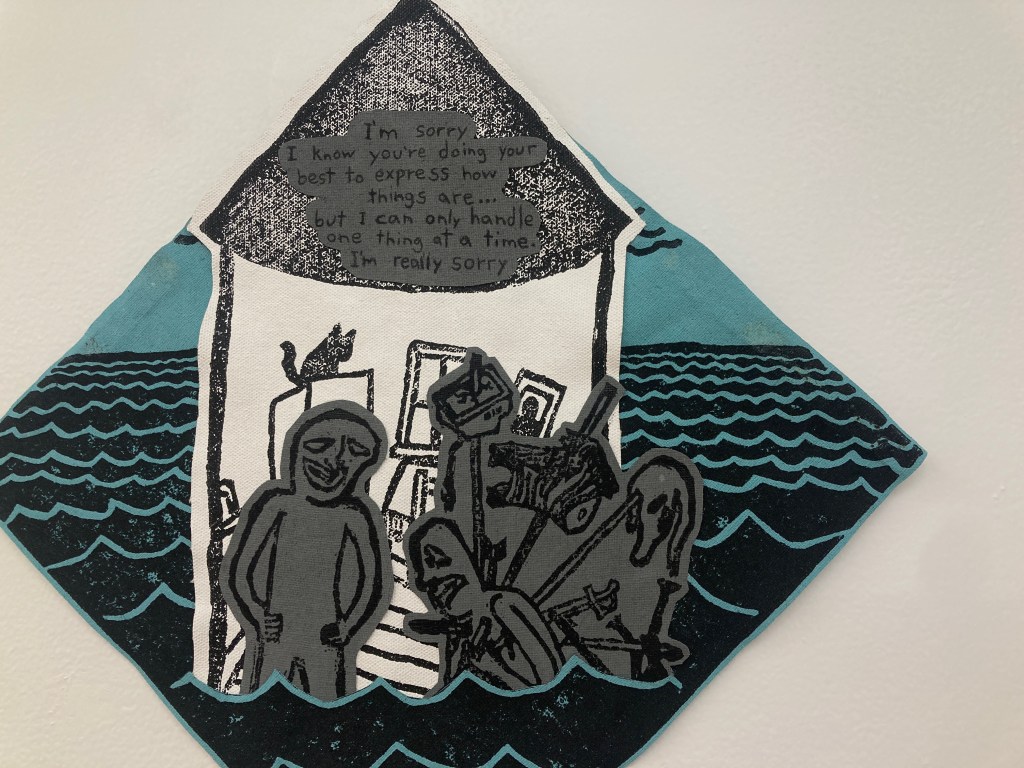
Part of what makes Pheto’s work unique is that it’s not so-called “doomer” nihilism, but it’s not all unicorns and rainbows either. One of his most prevalent figurative images is a figure stabbed through the abdomen with multiple swords, one a television, another a ram’s head, others unidentifiable objects. It’s always reminded me of a tarot card from the Swords suit, the person either penetrated by their doom or holding the power in their hands to inflict doom upon others. This is much of Pheto’s work in Environmental, the intersection of power and culpability, and the fact that sometimes pain is penetrating, acute, and other times it’s overwhelming, swallowing you or drowning you. Brown House 3 shows a knife piercing an unsuspecting hand inside a house, showing that even the one that holds the sword isn’t safe from its blade.
This snake-eats-tail type logic isn’t uncommon in Pheto’s aesthetic. A panther sits in a cage in another one of the Brown House series, still and somber in a cage inside four walls of an otherwise placid home. Notably, a black cat sits in the block print of many of the houses, which reminded me of the idea of being complicit in your own caging.
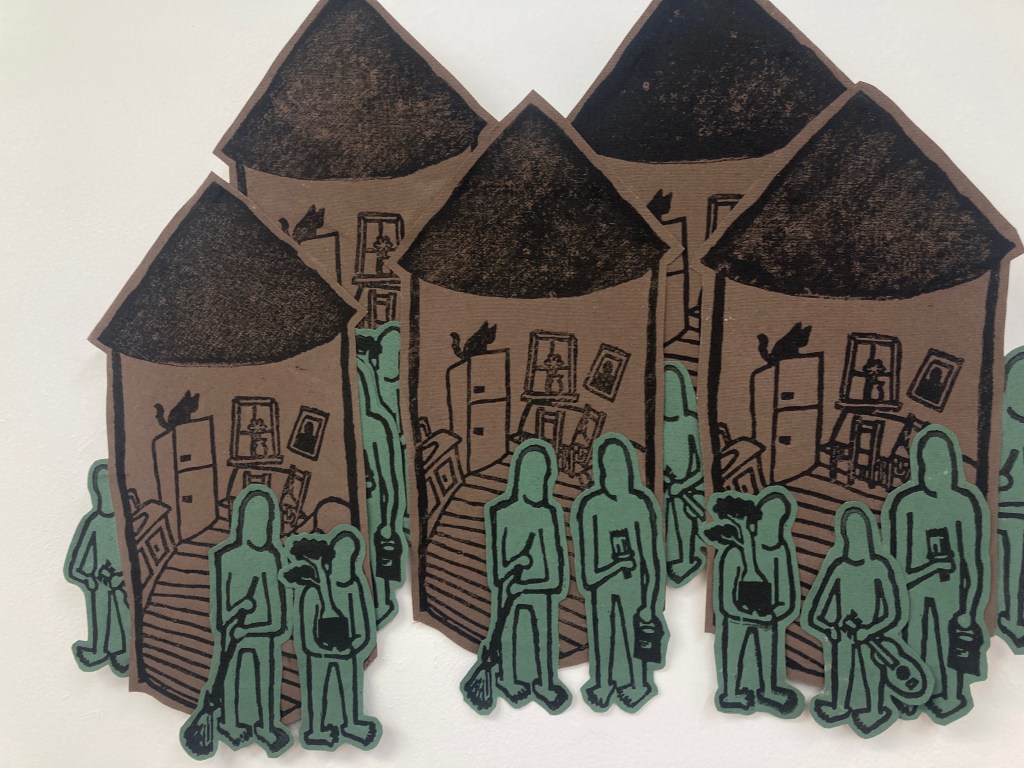
Pheto does not lay out a clear, obvious message or statement, and yet his work is more resonant than some that do have that more clear-cut method. It plays with the absurdity of information overload we live with. What sets him apart is that there is a craft technicality to what he does, as well. If I have any critique of the show, it’s that I simply wanted more of it, at a bigger scale. It’s clear that Pheto thrives with the space to play with hanging and installation work, and I’d love to see him really take over a whole space. His work is undeniably political and provocative, but also, pulling back from my art writer hat for a moment, it is just straight up good. Environmental is a creator pushing himself to a deeper, more complex direction. You will regret not seeing it.
Brent Pheto’s Environmental runs through February 22 at Bottom Feeder Books.
Emma Riva is the founder and editor-in-chief of Petrichor.
 PETRICHOR
Leave a comment