
In an era where artificial intelligence is both an ever-changing tool and a source of existential anxiety, composer and multimedia artist Ramin Akhavijou steps into the discourse with Ego. As part of the New Hazlett Theater’s CSA program, Ego is not just a musical composition– it is a conceptual exploration of identity, technology, and the tension between human autonomy and artificial intervention.
Musically, Ego is a tapestry woven from experimental contemporary composition and silence, alongside improvisational elements. Akhavijou is known for his exploration of silence as a compositional tool, a fascination that took root during his studies at Carnegie Mellon University.
Through his PhD and master’s programs, he delved into the role of absence in music, influenced by composers such as John Cage, who emphasized the power of quietude in sonic expression. Akhavijou structures the performance to highlight absence as much as presence. Moments of stillness punctuate the soundscape, urging the audience to reconsider their relationship with quietude and noise. “Silence is not nothingness,” he explains. “It is an active space, a passage of time.”
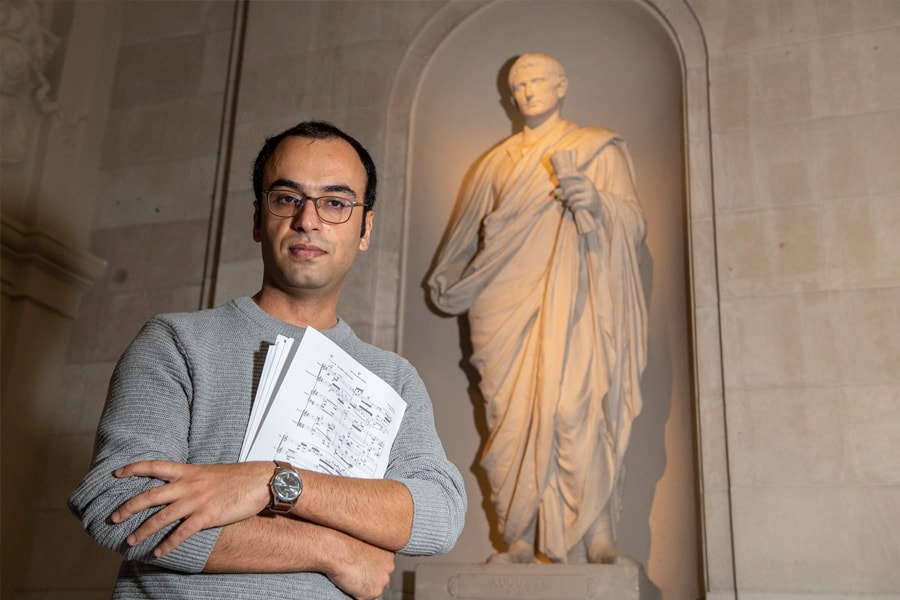
Akhavijou’s use of AI is not in the generation of the music itself, but as a narrative device. Instead of using AI for compositional aid, he engages with its implications as a mirror of human data. As an entity trained on us, by us. “AI is human,” he asserts. “If we are afraid of AI, we are afraid of ourselves.” When I asked Akhavijou if he was afraid of humans, his answer was succinct: “Oh no, I love humans. And I mean that.”
Akhavijou recognizes the duality of these current and expanding technologies, and this is reflected in his work. Ego challenges the audience to sit with discomfort, neither condemning nor exalting the technology, but presenting it as an extension of human intention, for better or worse.
Much of Akhavijou’s work of recent years has been inspired by social and political issues. He does not provide easy answers. Rather, he wants his work to invite discussion rather than resolution, leaving audiences to consider its implications after the music ends. “It’s all about intention,” he says. “What we create is not inherently good or bad—it’s what we do with it.” Ego asks us to consider not just the future of AI, but the future of our own egos, our ability to navigate technology without losing ourselves in it. “It’s all about intention. So what will we create?”
Set to premiere as part of the New Hazlett Theater’s 2025 CSA Performance Series, Ego is more than a performance—it is a meditation on the intersection of humanity and its ever-evolving digital shadow. Akhavijou’s work ensures that, even in the face of the artificial, the questions remain deeply, unshakably human.
EGO will be performed on March 20 & 21 at New Hazlett Theater.
Lindsay Anne Herring is a performer and folklorist, specializing in art-based research, documentation, and public programming.
 PETRICHOR
Leave a comment