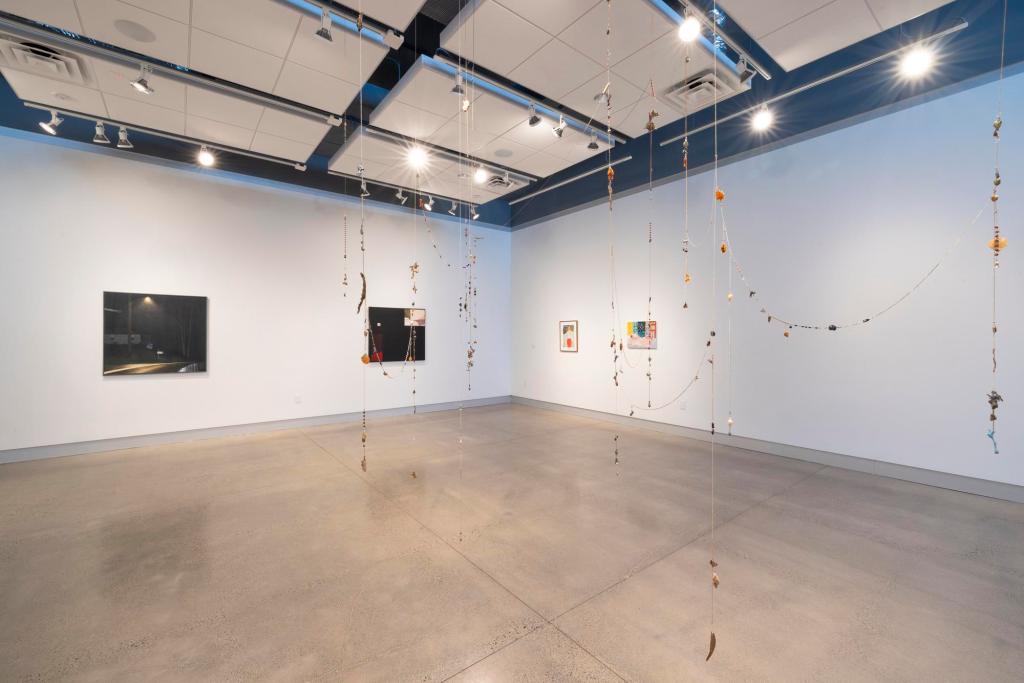
For the last show at the Tomayko Foundation, Zach Hunley and I did a dual review we called “Two Takes on Tomayko.” It proved to be a fun and conversational way to engage with the work, so for this most recent show, we decided to do it again. every speck of dust illuminated is a group show in conjunction with Associated Artists of Pittsburgh and curated by Lucas Regazzi and Patrick Bova of april.
Emma Riva: This show led with a very concept that was very grounded in reality, which I appreciate. Patrick [Bova] and Lucas [Regazzi]’s vision wasn’t just a conceptual one but had a literal visual through-line, the image of the “speck of dust illuminated,” a line from a Richard Siken poem. The image appears most literally in Joseph Ryznar’s work, where he used layers of paint and unconventional means to create this “speckled” texture on even the darkest of works.
His paintings were a definite highlight for me in the show–in fact, when I woke up this morning I thought about his Saturday Morning, Another Day Without Sunshine. I have a window directly above my bed, so the first thing I see on a day like today is the white sky, and I think to myself, “no sun today…” What’s really unnerving about this sort of weather is the lack of shadows. But, in any case, Ryznar captures the peace in the domestic banal through this painting.
Late Night Drizzle at Dolphy Road is a spectacular painting, and what really makes it is a for-sale sign on the plot of land beside the road. That pulls it together and elevates the work, in my opinion–it made me think of the literary movement “KMart realism,” where authors lean into the fact that so much of how we see the world is through commercial brands. Ryznar is an older artist and a longtime AAP member–he dazzles in this exhibition. In Late Night Drizzle, a street-lamp illuminates the glimmer of rain.

Zach Hunley: I strongly second your praise of Ryznar’s paintings. His eye for composition, the way he crops and frames his scenes, is highly refined and really just impeccable. Saturday Morning… spatially almost collapses in on itself, with the painting within the painting not only recalling the work we view, but feeling materially related to the curtains at the surface of the picture plane; the dabbled palette here felt like a subsection of a Jackson Pollock. He takes quotidian mundanities and makes them sites for nearly universal memory and experience.
I loved Late Night Drizzle…; as you and I discussed, the realty sign in the yard is sort of the cherry on top of a scene that makes impressive use of space, atmosphere, and light. I loved closely examining the colors comprising the illuminated street lamp, and seeing it precisely carry over to the warm pool cast on the pavement. The way he manipulates the surface with the vacant home, as it stretches back into a blurry, wet haze, is painterly perfection.
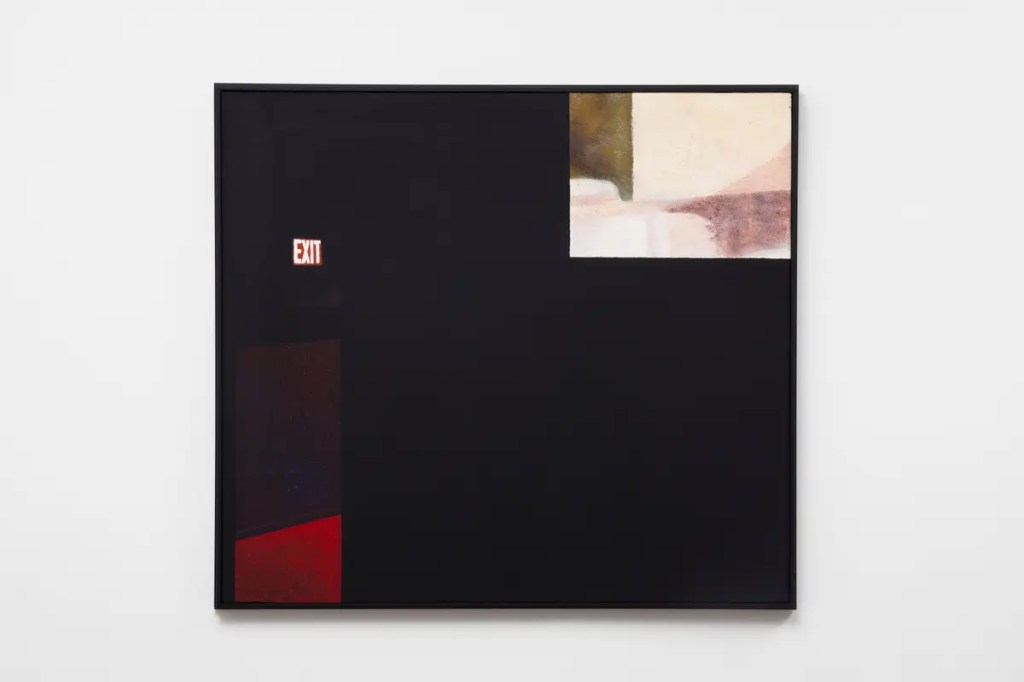
I was most looking forward to seeing the work depicting the Roxy theater, At the Roxy, and it did not disappoint. A movie going experience is one where wherein we — as the lovely Nicole Kidman reminds us with every showing at an AMC — share experience, emotion, and transcendence. Ryznar veils the distinct character of the historic theater with his use of negative space, casting a chasm of pitch-black abyss and opening up the scene so that it is universally felt. The immersion of our focus on the silver screen is interrupted by the illuminated exit sign and exterior corridor. Ryznar provides room for us to consider space that is by design not to be considered; it allows us to recall the times we’ve spent at the movies, the limits of our unbridled attention, and the memories that make our theatergoing experiences so much more precious than streaming content at home. What I really want to know is — what movie was he seeing?
ER: Alexandra Lakin’s Drift/Past reminds me of a more pastel version of Faith Ringgold’s Tar Beach. It’s a really sweet painting, with a dreamlike nostalgia to it, and provides a nice contrast to the Ryznar paintings nearby with such muted color schemes. Larkin works with the interior, and the painting beside Drift/Past, Mom Genes, shows the struggle to understand what’s in the interior of your own self.
A lot of this show dealt with the difference between interior and exterior, and I came away from it wondering about whether such a thing as interior/exterior and private/public life really exists anymore at all. Just as painters of previous art movements fetishized nature in times of industrial growth, a lot of contemporary art seems to fetishize the domestic interior, when now even when we’re not working or spending time socially, everyone can have instant access to us inside of our own homes…and in some sense inside of of our own minds. Ryznar’s paintings get at this in the most subtle way.
ZH: Erin Mallea’s Condition Report is a unifying force in the middle of the gallery. The work is an airy and rhythmic presence that I found utterly entrancing. The jewelry chain drapes and flows naturalistically downwards from the gallery’s roof, like a bejeweled spider web. Caught in its metallic grasp are eclectic items like fishing sinkers, beads, pennies, foam, sculptural slag fragments, and our regional frenemy, the oh so cute but ecologically destructive spotted lantern fly, preserved by Mallea in resin, beeswax, nail polish, and sugar and used as bead and structure. I loved the immersive aspect of this work; when you step into the middle of the work, you feel as though you too have been caught in its grasp. It also provides a beautiful and ever-changing frame to view works across the gallery through. Mallea’s sculpture is the heart of this exhibition.
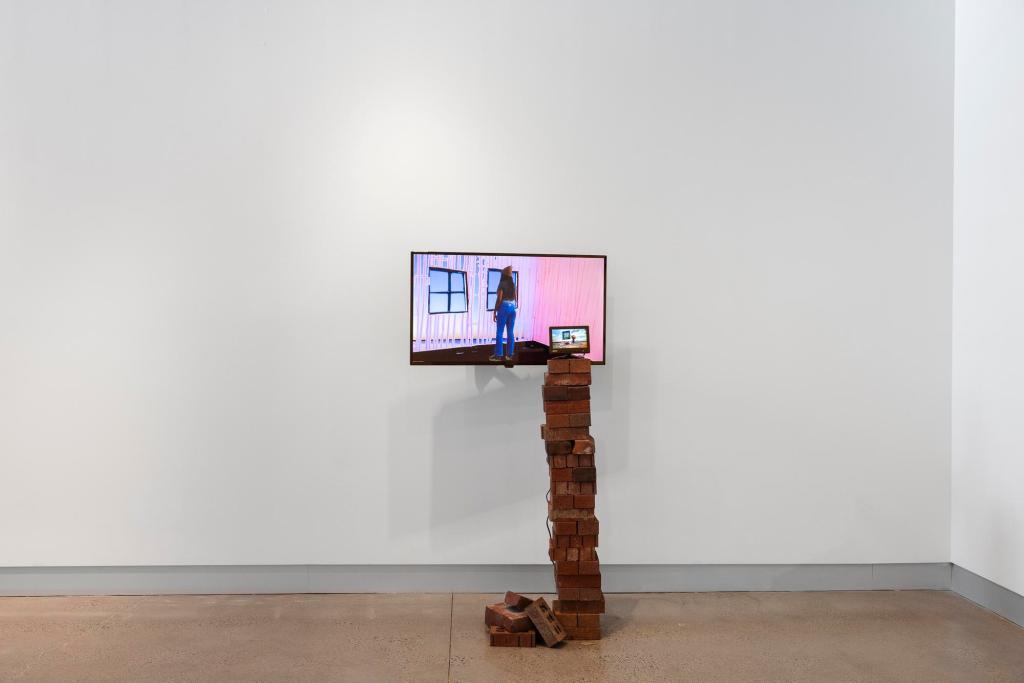
Shori Sims’s sculptural video installation was an intriguing take on the show’s themes of interiority and quietude. The short, two-channel looped video piece combines surrealism with raw digital editing that shares a stylistic spirit which feels very much rooted in internet aesthetics. The smaller monitor resting on a precarious stack of bricks features a floating still life that reminded me of a Dalí painting. Behind it, the artist peers through a set of windows out to a seascape that ultimately becomes the inhabited space. The dreaminess of this work conveys notions of agency in meaning/myth making; the collapsing of space between the windows and walls highlights the role of embodied perspective in truth telling and world building.
ER: Mallea’s work is usually much more scientific, and her presence in this show leaned into her abilities as a sculptor. This iteration of Condition Report ties the whole show together. Getting to see Patrick and Lucas work in a bigger space was a real treat, as it gave me a deeper look into their curatorial tastes. I would have liked to see a few more works by Karen Lue, whose stunning photographs welcome you into the space, and Alexandra Lakin, maybe expanding it a little more. But this was a solid exhibition and showed how a group show with a cohesive theme and narrative can be a really enjoyable viewing.
every speck of dust illuminated runs through April 14.
Looking to go deeper on more conversation-sparking details in artwork? This month’s articles are published with support from The Frick Pittsburgh for Kara Walker: Harper’s Pictorial History of the Civil War (Annotated). As Zach Hunley wrote in Petrichor: “When viewing the work of Kara Walker, you are bearing witness to history and time compounded.” Revisit the past and rethink the present now at the Frick Art Museum.

 PETRICHOR
Leave a comment