by Emma Riva
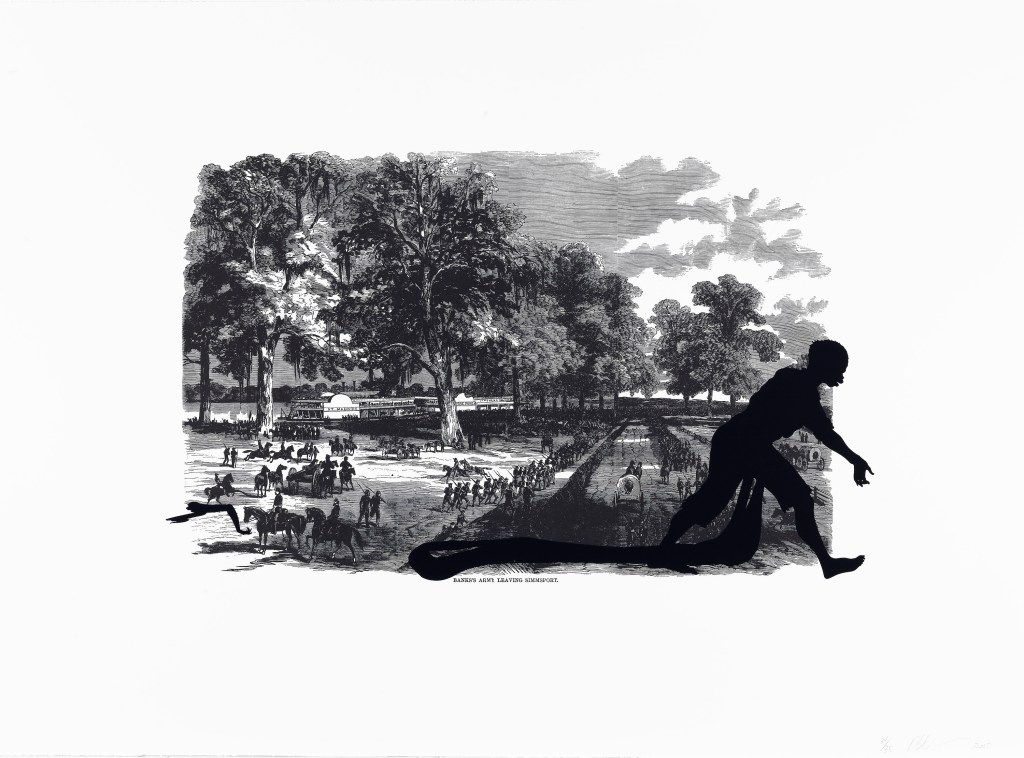
Cover image: Kara Walker, Banks’s Army Leaving Simmsport, from the portfolio Harper’s Pictorial History of the Civil War (Annotated), 2005, offset lithograph and screenprint on paper, 39 x 53 in. (99.1 x 134.6 cm), Smithsonian American Art Museum, Museum purchase through the Luisita L. and Franz H. Denghausen Endowment, 2008.19.1.3, © 2005 Kara Walker
Chief Curator Dawn Brean of the Frick Pittsburgh wanted to create something living with Kara Walker: Harper’s Pictorial History of the Civil War. Like a touring band, a touring exhibition is the same basic framework in each place it visits, but it has to bring some individual flavor to each stop on its tour. Brean was the one who figured out what the Frick could bring to Harper’s Pictorial History of the Civil War: The voices of the people of Pittsburgh. She decided she would reach out to academics, artists, writers, and community members to create guest labels for each piece in the exhibit. “Kara Walker’s work is a significant influence to many—artists, historians, museum professionals, other creatives and community leaders,” Brean explained. “There are many ways to approach Walker’s work and we wanted to offer visitors different inroads and perspectives.”
How this works in practice is that when you enter Harper’s Pictorial History of the Civil War, you’ll see your standard museum label with the title, dimensions, and a brief description, but then underneath it, you’ll see another label. Each piece has a brief essay or quote from someone in the community, along with their photo and role. “For new contacts, we cold emailed them to share details about the exhibition and ask if they would be willing to participate. We’re honored that they took the time to read our email and reply,” Brean said. “Because we only had so many artworks, we reached out to only a few people at a time. We wanted them to be able to write about the artwork of their choosing so it was on a first come, first serve basis.”
One of the most affecting is University of Pittsburgh Assistant Professor Shaun Myers’ reflection on Walker’s Bank’s Army Leaving Simmsport. Myers’ own great-grandfather escaped from a plantation nearby Simmsport, Louisiana, showing the relative historical closeness of the Civil War and the real, human memories behind what many think of as historical facts and lessons.
At a time when it seems fear and social unrest keeps us from being able to have difficult conversations, Walker’s work is deeply necessary. The works in the Harper’s Pictorial History exhibition are in themselves multi-layered conversations, where memory and political history collide, reminding us that history is made up of collective human experience. The addition of the guest labelists grounds the exhibition in the community around it.
Artist and writer Tara Fay Coleman was one of the featured guest labelists. “I had to do a fair bit of research, but in the end my focus was really on linking the past with the present, themes of erasure, and the idea of histories being distorted,” she said. She saw writing her guest label as an opportunity to challenge institutions and “highlight the importance of difficult and violent histories.” Her label appears with Scene of McPherson’s Death, one of the most evocative of Walker’s work in the lineup, where a figure’s severed limb hangs on the periphery of the original illustration. Though she described her knowledge of the Civil War as initially limited, Walker’s work spoke to her and she ended up writing a brief essay in response to Walker’s lithograph.
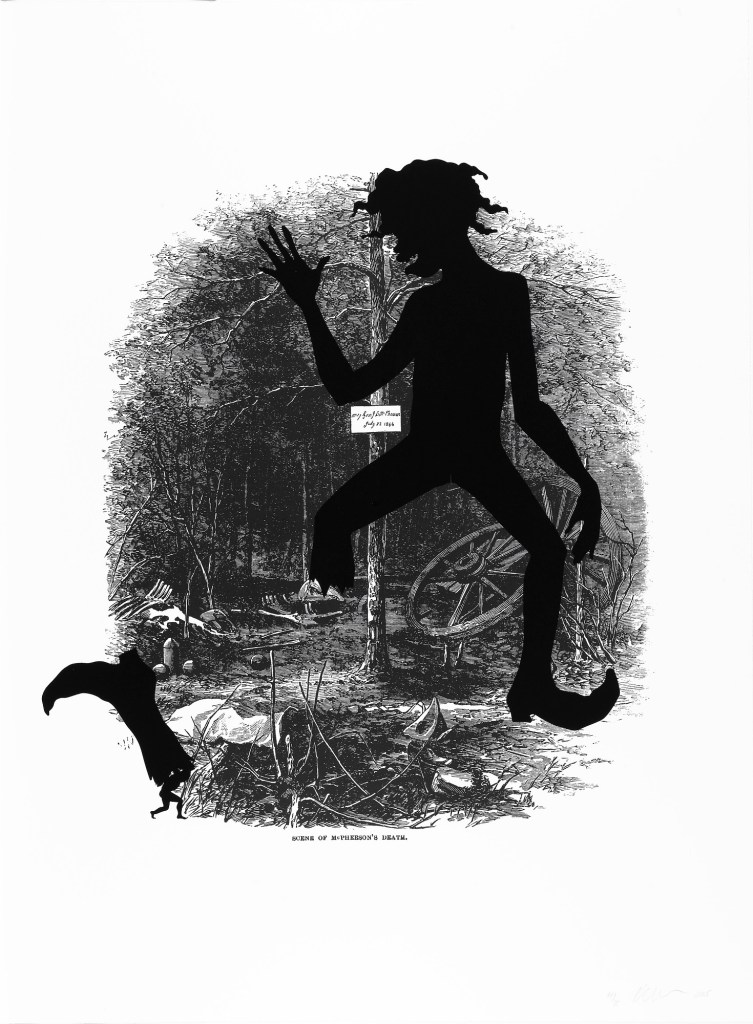
Brean called Coleman a “brilliant writer, [who] gave us more than we had room for, but we had to find a way to share her full essay.” She felt she wanted to cast “a wide net” and find people who both resonated with Walker’s artwork and had something to say about it. “We had a long list of people whose artistic practice, community work, or academic study aligned with Walker’s work. We extended invitations to them and asked for their recommendations for additional voices. It was great to deepen some existing relationships and also create new connections. We had a list ten times longer than we had artworks for.”
Coleman felt the label offered a way to “confront the censorship that’s becoming more prevalent in the arts.” She also added that “I think what the current administration is trying to do is going to cause a lot of damage, and frankly I’m scared of what all of this all means.” Though Walker’s Harper’s Pictorial History is now 20 years old, it speaks to current questions about censorship, race relations, and how museums teach and display history. In my time covering the arts in Pittsburgh, I have been pleasantly surprised that the Frick—a historical museum rather than a contemporary art museum— is one of the that best at managing the balance between institutional old money and boundary-pushing contemporary work. It shows that active, engaged leadership can push a museum forward and help it become not just a bastion of knowledge and culture but a place for growth.
For Coleman, the exhibition felt like a timely warning for coming budget cuts to the Institute of Museum of Library Studies and the overarching trend of anti-intellectualism and historical revision. “I think things are going to get really, really bad for a lot of individuals and a lot of institutions. We are in scary and uncertain times, and I approached [guest labeling] as a way to speak to that,” Coleman said. “What helped is how astoundingly timely this exhibition was, so it felt necessary to be able to acknowledge everything that’s happening within the text.”
Brean was hugely impressed with the outcome of the guest labeling. Though the Frick has done it before, this showed her that it really enhanced engagement with the exhibition. Coleman also mentioned that people who had never been to a museum before said they came because they knew her, showing that bringing in more people expands a museum’s reach. “The emotion that everyone captured in only 100 words or so was really astounding,” Brean said. “There is so much thoughtful talent in Pittsburgh.’
On May 1 7PM-9PM, the Frick will be holding a Guest Labelists’ Symposium where you can hear from Tara Fay Coleman, Shaun Myers, and other local artists, administrators, and academics. Tickets are available via the Frick’s website.
The Frick Pittsburgh has generously supported April and May’s articles in Petrichor in conjunction with Kara Walker: Harper’s Pictorial History of the Civil War. The exhibition is open through May 25, Tuesday – Sunday 10AM-4PM, tickets here. If you are an arts organization interested in a digital paid sponsorship, please reach out.
 PETRICHOR
Leave a comment