by Emma Riva
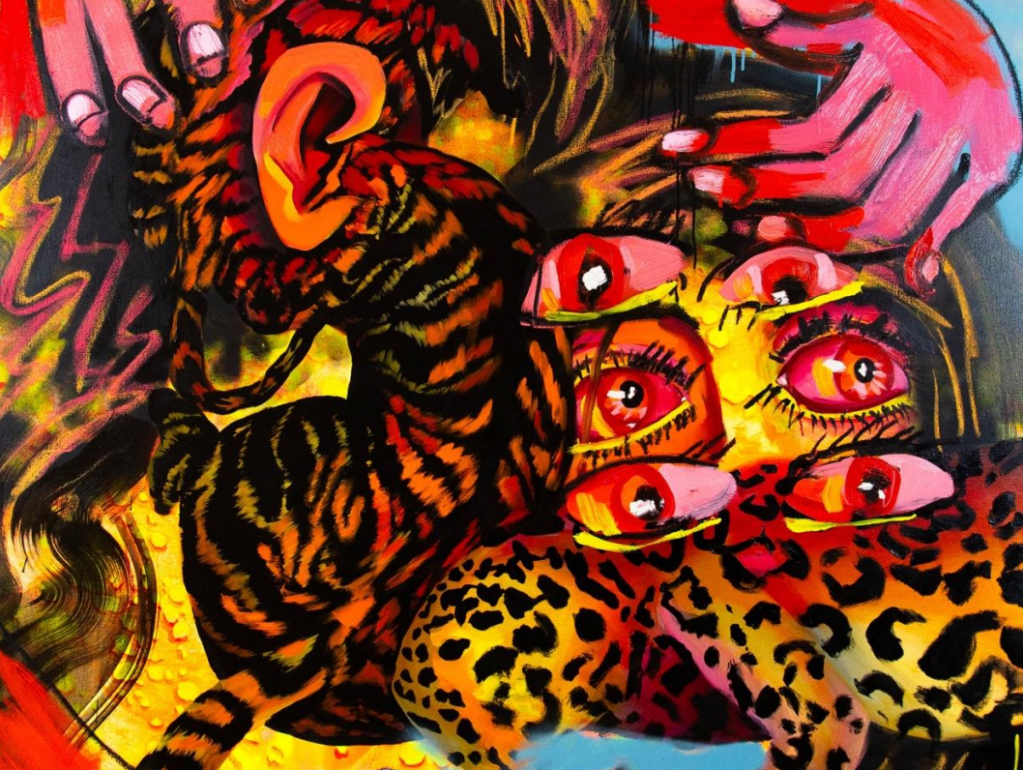
Cover image: details of Natalie Westbrook, Whispering Bells
As the temperatures rise in Pittsburgh, ZYNKA Gallery has one of the summer’s hottest shows already with Louisville-born Natalie Westbrook. If you haven’t gotten a chance to see Corners of my Mind yet, it’s open until July 19. To add some extra context for viewing, Natalie generously answered some of my questions about her work, which scratches the leopard-print-loving maximalist itch in my brain and is full of surprises through and through.

Petrichor: You’ve exhibited all over the world. How have the meanings or interpretations of your work changed in the different contexts you’ve shown it in? Favorite experiences exhibiting?
Natalie Westbrook: My approach to making work doesn’t change based on the location of an exhibition, and the interpretations are beyond my control, but regardless of the context I find myself iterating on consistent conceptual themes and visual motifs that continue to stimulate my curiosity, and I’m constantly exploring the boundaries of material techniques. A favorite exhibition experience was a solo show at Keijsers Koning in Dallas where I showed sculpture and painting together for the first time. I’m also especially excited about my current show at Zynka because the works are so new, and I’m pulling together a wide vocabulary of abstraction and figuration together into a single space that I feel holds the range of my vision together in a compelling and authentic way.
The colors in your work are very striking. How do you go about creating the palettes for your paintings?
NW: My color palettes come from a theatrical sensibility. I worked in scenic design for years in NYC— one of my favorite collaborations was with The Paper Bag Players, the oldest theater company for children still performing in the United States. Scenic painting is meant to project from the back of the stage out into the expansive space of the house, and communicate visually to people seated everywhere— from the orchestra section to the highest balcony. I’m most at home when working on a large scale and with bold, bright color, or a decisively black and white palette. There’s a theatricality to my process too in that the experience of making my work involves sweeping gestures and a dance like approach to engaging with the canvas. I work on the wall, moving up and down a ladder, then move the painting to the floor to use gravity for various stenciling and drip techniques, then back to the wall. I listen to music the entire time I’m working, and the whole process feels theatrical and animated.

How did you connect with Jeff/with the Pittsburgh art community?
NW: I was living in New Haven, teaching at Yale for nearly a decade when I relocated with family to Pittsburgh a few years ago. I was looking for a studio to rent and found Jeff’s name online associated with the local arts scene so I reached out to him. Not only did he connect me with the perfect building that has been my studio ever since, but he gave a warm welcome to Pittsburgh, visited my studio and brought local collectors to check out the work, and now I’m having my second solo exhibition with Zynka thanks to his enthusiasm.
What was the process for putting this show together like?
NW: Putting together this show was particularly exhilarating, as I was coming off of a long period away from the studio, recovering from chronic health problems over the past year. I had months of creative ideas pent up and waiting to be unleashed. The chance to put a show together added to this excitement, and so there’s a definite fiery energy, intensity and optimism embedded in the works. I started making very small paintings while I was still recovering, which led to surprising discoveries with experiments in color and form, then later made my way to the larger works in the last month before the show. I don’t normally work small, so it’s been enlightening to see how my world can cut across scale and exist as both a macro and micro experience. Making small studies for larger works rarely appeals to me as it can take away the spontaneity of the process, so it was important to me to make small works that can stand alone, that would have as much vitality and energy within a 24” canvas as I would create on a 9’ scale. Installing the small and large works together in the show provided a thrilling opportunity to create a kind of dynamic conversation around the room between the paintings.
Your titles really correspond with the abstractions in your paintings, even though they’re often not literal images (i.e. Unseen Pearl, Offspring). How do you come up with them?
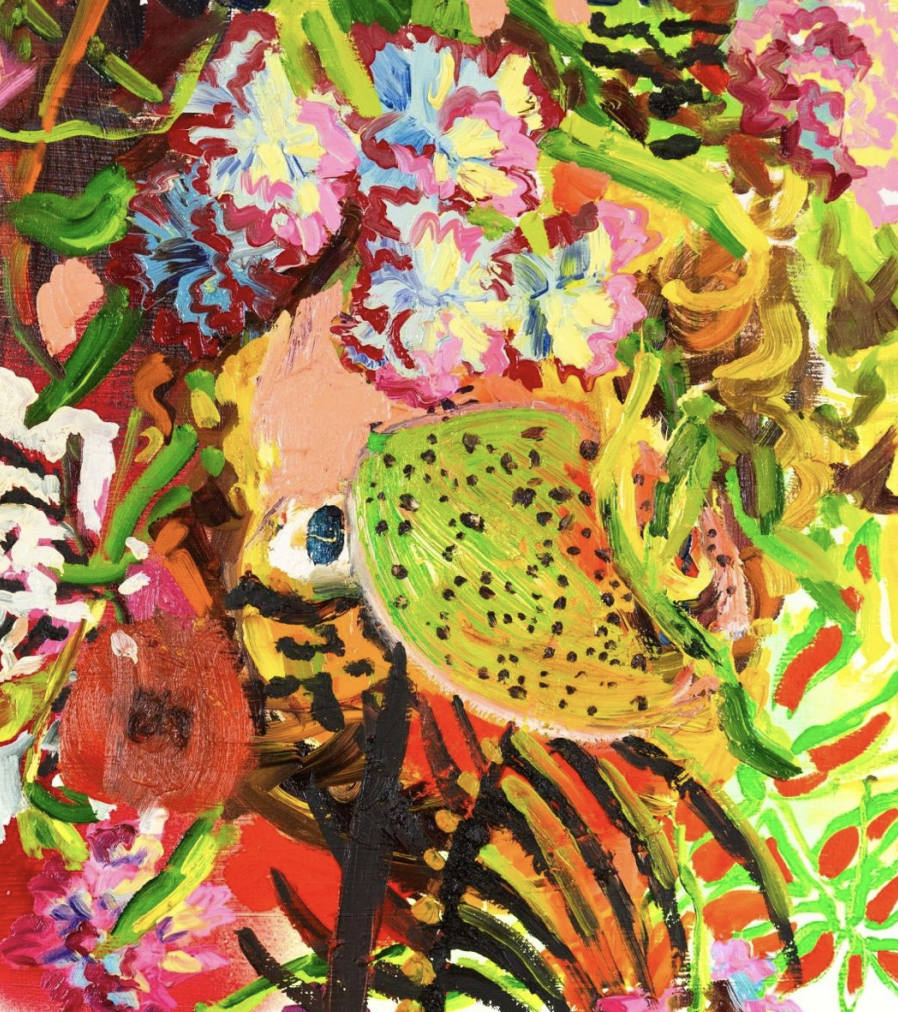
NW: Unseen Pearl was made in 2011, right after I graduated Yale, and it’s the only painting in the show that wasn’t made in 2025. Just before installing the show it occurred to me that I was thinking a lot of figures hiding or emerging from a kind of jungle of plants or jungle of paint, and I remembered making a painting just after graduate school that was the first time I expressed this idea using a glimpse of a human figure rather than only animals or invented creatures. At the time I painted it I considered it a self-portrait. Jeff was excited to see the painting when I pulled it out of storage and he asked if it had been shown before, which it hadn’t. He suggested including it in the show, and I loved this idea of connecting with my younger self in this way. Now however, I think of the figure as less of a self portrait and more of an ‘everyman’ symbol, a representation of the hidden gem inside each of us. It’s a painting about fear and optimism, a theme in a lot of my work. Offspring has a similar connotation despite completely different imagery— a startling litter of kittens— perhaps startled themselves by the gaze of the viewer, and also representative of the fecundity of life, the fertility of creativity.
Animals also show up a lot in your paintings. What do those images mean to you?
NW: I often work with images of cats. They’re so mysterious and moody, but also cute and endearing and a part of meme culture with their wacky antics. Cats carry such phenomenal cultural currency as symbols throughout history, featured in literature and film as symbols of grace, independence and rebellion with their enigmatic ways. In my work I like to reference housecats as a note of familiarity, the domestic, the tamed, while also alluding to leaopards, cheetahs and tigers as a reminder of the wild. I grew up in the country with outside pet cats that would hunt for rabbits and birds, get into vicious fights with free roaming neighborhood cats and get impossibly stuck in the highest trees. When I was a kid, my dad would always say with a smirk that if our cat was a little bigger, and if I was a little smaller, the cat would eat me for dinner.
Are there any particular pieces or moments within it that you’re excited to share with people?
NW: I’m particularly excited about a large painting entitled Levitate, because this work brings together so many long-standing ideas and techniques of mine into a single canvas, and in that way it encapsulates the entire show.
All of the works refer to landscape imagery whether a literal sunset horizon at the beach, or an abstract use of leaves as stencils painted over with spray paint. Despite the persistent vernacular of landscape, the paintings are all made in a vertical rectangular format, which references traditional portraiture. These are not landscapes nor portraits. They are portraits of the landscapes of the mind. Each work in the exhibition, whether small or big, reflects the far recesses of the unconscious, and the potential for insight, for surprise, a deeper understanding of oneself, and for discovering new perspectives.
Natalie Westbrook’s Corners of my Mind is open through July 19.
 PETRICHOR
Leave a comment