
by Tara Fay Coleman
All photography courtesy of april april
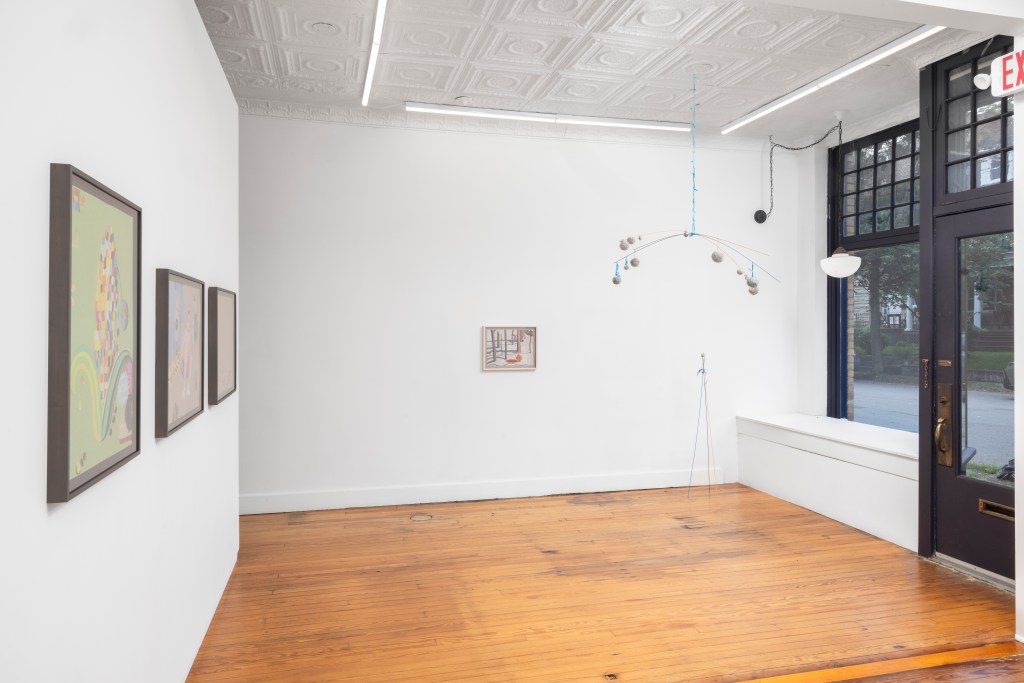
At april april, Montréal-based artist Alix Van Der Donckt-Ferrand’s Une Petite Cantate unfolds like a liturgy stitched together from gym sweat, sacred trees, corn kernels, and soft desperation. The exhibition, her U.S. solo debut, is tender and thorny, sentimental but not indulgent, proposing a strange and intimate world of objects that feel both personal and anonymous. The show comprises seven drawings, a mobile, and a music box that plays Barbara’s 1965 elegy “Une petite cantate”, a song of mourning that smolders rather than burns. Van Der Donckt-Ferrand borrowed the exhibition’s title from the song, which was written after the death of the French singer’s friend and former lover.

It’s an apt reference point for the show as a whole, which deals in layered emotion without ever tipping into melodrama. Une Petite Cantate holds its grief quietly. Van Der Donckt-Ferrand makes drawings and sculptural assemblages that move between the symbolic and the absurd, often in the same breath. Her work resists the cleanness of metaphor; instead, it proposes entanglements. A couple weightlifting in Leg day – or – La Fragilité de la Vie (2025) holds the same narrative weight as Wahta’ and Chêne (2023), modest depictions of sacred trees culled from a faux-finish product catalogue. The drawing Liaisons (2025) depicts a couple having sex behind a maple trunk, placing bodily intimacy at the edge of nature, kitsch, and privacy. In m u n d o d e c o l o r e s (2025), a kaleidoscopic cob of corn gives birth to a world. “In my drawing m u n d o d e c o l o r e s, there is a grain of corn that is a broken glass bubble and inside there is people having sex,” she explains. “It’s kind of hard to tell what is going on, but something (hehe) is insinuated.” Desire is present throughout Une Petite Cantate, but it’s rarely cleanly legible. There’s no climactic unveiling or thesis. Instead, the works pulse with an unstable intimacy; images and materials come close to saying something, then shy away. Van Der Donckt-Ferrand is interested in how concealment and doubt can live alongside precision and care. “As I constantly vacillate between doubt and certainty, I think concealment sometimes helps hide true beliefs and pass them as doubt,” she writes. Many of the works are physically small or materially understated; ribbons, fur, punch-card music rolls. There’s a confidence in her refusal to perform resolution.

Her approach to narrative is similarly resistant. “The impact of the drawing does not depend on you knowing the story,” she says. “Rather the contrary.” This slippage is part of what makes the work so affecting. The drawings feel storied, events are implied, relationships introduced, but nothing is fixed. “I am more interested in presenting a proposition of a cohabitation of things that might seem foreign to each other,” she continues. In that sense, Une Petite Cantate is a kind of fieldwork, cataloging configurations of elements and letting them coexist with as little intervention as possible. Van Der Donckt-Ferrand compares it to walking past the same corner every day and suddenly looking up to see a building for the first time. The work produces a similar sensation of strangeness arriving inside the familiar. The materials reinforce this. Her objects and drawings are deliberately modest: cane, wood, found imagery, fur, paper, pigment. The intimacy of her scale, similar to her choice to keep her studio in her home, feels essential. There’s a groundedness in her use of the everyday, and a resistance to the spectacular. She draws connections between her assemblage work and drawing, suggesting both are direct, accessible, and economically sustainable. “I like to see it in this practical way,” she says. But pragmatism doesn’t dampen the emotional potential. Her works unite “things that could be totally anonymous with things that are full of connotations.” This mix between symbolic and absent, both loaded and materially deadpan, allows space for a viewer to project, to reconfigure, and to pause.

There’s something spiritually inverted in the show that’s not irreverent exactly, but flipped. Alix places mythic or religious scale into banal imagery (corn, gym couples) and treats devotional materials (trees, maple sap tubing, fur) with a sense of subversion. A cerulean ribbon reappears across the drawings and sculptural elements, rhyming visually with sap tubing, plumbing desire into ritual. It’s a visual motif, but also a symbolic bridge between intimacy and infrastructure. She draws affinities where they don’t normally appear, and it’s in these unlikely relationships that the work’s emotional tone emerges, one that’s all at once fragile, comic, and grief-soaked.
There are resonances with other artists who deal in emotional ambiguity; Louise Bourgeois, Inuit drawing schools, even the distressed surfaces of Leon Golub, but Van Der Donckt-Ferrand’s clearest kin might be Liz Magor. “I like the way she is conscious of the narrative power of ‘things,’ and how she is not scared of it while also not indulging in sentimentality,” she says of Magor. “I think I make things more sentimental than she does, but I also have a somewhat distant relationship with the emotive or sentimental connotations and effects I want the work to have. I need things to exist outside of their romantic aspect.” That balance between affect and detachment, storytelling and withholding, feels like the driving force of Une Petite Cantate. Van Der Donckt-Ferrand’s education reflects the complexity of her practice. Though she attended Concordia and a preparatory art school in Paris, she identifies equally with being self-taught. “Self-taught people take life as a school and let knowledge come from outside institutions,” she says. That approach is embodied in her time working with Cree artist Floyd Favel on Poundmaker Cree Nation in Saskatchewan, an experience she describes as her “second education.” There, she assisted in researching oral traditions, traditional Cree architecture, and ceremonial practice. “All these encounters have taught me about passion for art, what is art, and have inspired me to keep searching for how to make the best art I can from different types of knowledge.” This approach to knowledge shows up throughout the show. Aesthetically, the works are disparate, collaged trees, music rolls, sex in corn, but they hum in unison. The artist isn’t looking to collapse differences, but to let them share space. The result is a kind of precarious harmony. “Maybe these things aren’t so different as they seem,” she muses. “They have things in common like gravity, the force of life and the force of death.” Une Petite Cantate offers a feeling of proximity, and of brushing shoulders with the nameable and the unnameable. It is a show about connection and disconnection, but mostly about the mess in between. Like the grain of corn with sex hidden inside it, it dares you to look closer, and then asks you what you’re really seeing.
Une Petite Cantate is on view at april april through August 23. Hours are 11am-5pm, Thursday – Saturday.
Tara Fay Coleman is an artist, curator, and writer committed to fostering critical dialogue in the arts.
 PETRICHOR
Leave a comment