by Adam Arthur
Have you ever watched a film where you simply wanted to concentrate on its mood and nothing else? This is how I felt, for example, about the classic horror film American Werewolf in London, or its much younger aesthetic cousin, the Black Mirror murder-thriller episode “Loch Henry.” These were productions where I held little interest in the plot or characters, or really anything but the environment. This, of course, brings us to the appeal of abstract cinema as an art form. Abstract cinema functions not just as a genre but as a medium. Specifically, it is a medium where mood is distilled into its purest form. This phenomenon was on clear display at Atmosphere + Auras, an environment-forward selection of short mostly-abstract films screened at The Mattress Factory on August 23, 2025. Atmosphere + Auras was curated by Benny Shaffer for the Mattress Factory’s Summer School: State of the Sky, organized by artists Luke Stettner and Calista Lyon.
The order in which the films were presented conveyed a highly intentional narrative arc: one that resembled a sort of aesthetic reverse Strip Poker. While the first films were naked of explicit meaning, the latter films gradually began to dress themselves in it. The first film, for example, Light, Noise, Smoke and Light, Noise, Smoke (Dir. Tomonari Nishikawa, 2023) portrayed grainy footage of fireworks deprived of the human activity that set them off. From beginning to end, the screen fills up with warm colors that resemble a primordial Big Bang or the explosion of a star. The celebratory context with which fireworks are typically associated in the human imagination is noticeably absent, leaving the audience to sit with their discomfort as they attempted to fill in the blanks.
The second film, Don’t Look Directly into the Sun (Dir. Kathy Rugh, 2010) continues this theme of environmental abstraction, while shifting into a palette consisting mainly of cool colors, occasionally pierced by a bright dot. While the film is summarized in the program as being about the sun as viewed from underwater, the style focuses on shifting lines and blots. The imagery less closely resembles swimming underwater on a sunny day than it does staring through a microscope at bacteria squirming and jumping around in a petri dish.
It is the third film, Tåke (Dir. Inger Lise Hansen, 2018), where the series of short films begins its gradual transition from abstraction into meaning. The film dwells on the theme of mist and fog in human and natural environments. Foghorns sound, giving a clearer sensory indication of human activity than in the prior films. However, the environments the film lingers over when the mist partly clears are desolate: ghost cities that resemble the post-apocalyptic world of Night of the Comet or the 2008 adaptation of I am Legend, but without any of the playfulness of the former or the emotional intensity of the latter. When the camera moves to overhead, panoramic views of natural environments, the audience will find the scenery breathtaking in its emptiness.

These are corners of the world someone might glimpse if they are scouting for film locations that call for somewhere uninhabited, if they are on a funded expedition with a team of geology researchers, or if they are producing a documentary for National Geographic. Even when the film shows rainforests shrouded in fog and mist, they are startlingly free of any human or animal activity, with not a bird in sight above the trees.
Without a doubt the strongest film of the bunch, Tåke is a resonant meditation on those parts of the world where it is possible for the adventurous and curious to travel, at the risk of a deeply emotionally harrowing sense of isolation. Here we take in a level of solitude that even Lionel Verney, wandering the depopulated countryside accompanied by a stray dog, would not think to explore.
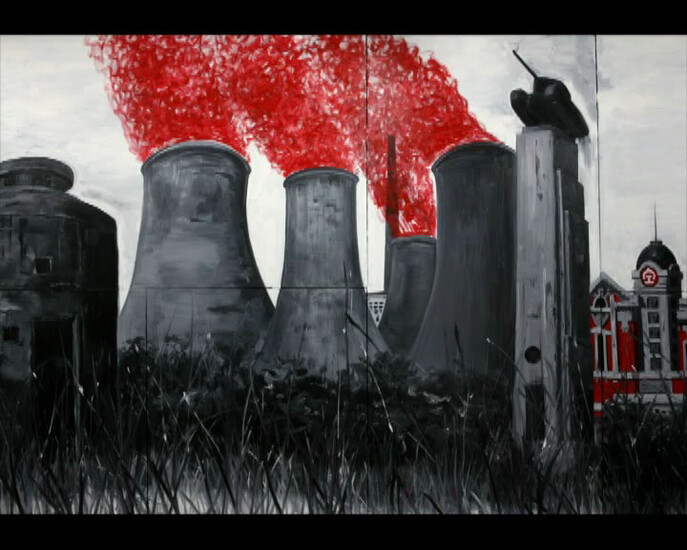
The transition toward more meaning-oriented films continues with Coal Spell (Dir. Sun Xun, 2008), a dystopian animated critique of the modern environmental history of the People’s Republic of China. The themes in this film are about as subtle as a brick. Unlike the previous films, Coal Spell features animals and occasionally people. Of those animals, they often take the form of fish that are shown as dying gruesome deaths due to nearby factory pollution. The smoke plumes from the factory are portrayed as bright red, an auspicious color in Chinese culture that also gives off the subtext of blood. A statue of Mao Zedong appears, raising his arms cheerily in a welcoming gesture as he looks over this scene of environmental catastrophe.
Like many artistic works with a critical bent that focus on Chinese political, environmental, and economic matters, this one finds its safest footing in criticizing the past rather than the present, particularly Mao Zedong’s rapid industrialization during the Great Leap Forward. This egregiously mismanaged example of centralized planning infamously led to millions of deaths, as chronicled in the historian Frank Dikotter’s Mao’s Great Famine. However, it is a more recent volume, Liang Hong’s bestseller China in One Village, that encapsulates the contemporary evolution of industrialization in China, an earlier stage of which (in 2008) Sun Xun’s film critiques, ending on a stark image of Vladimir Lenin.
While Coal Spell is sometimes comically brazen in its message to the point of making audience members roll their eyes, it can’t be said that anyone will miss the point. The film does rightly and implicitly suggest that, while China in the 21st entury no longer possesses a Maoist command economy, Chinese Communism still has much to answer for in the country’s environmental decay from its industrialization efforts.
While I was frustrated by the film’s lack of subtlety, it also spoke to a conclusion I have come to as a student of modern Chinese affairs: that a centralized political or economic system will not save the world from climate catastrophe and may even accelerate pollution and industrial accidents.
As someone who frequents creative circles in a major American city, I am often exposed to the folk belief that capitalism is at the root of human-made ecological disaster. The logical conclusion of this folk belief is that that the replacement of capitalism with socialism will save the Earth from the ravages of industrialization. The history of China, either under the Maoist command economy of the mid-20th century or under its more recent socialist market economy, indicates otherwise. Coal Spell, though an aesthetic work rather than a scholarly one, may hopefully lead its audiences down a path in which they come to the same conclusion.

The last film, Obscuring Power (Dir. Erin Mallea, 2023), draws environmental concerns closer to home. It is also the first film to feature either dialogue or live human beings, concluding the journey from abstraction to meaning. The director, Erin Mallea, alludes in the title cards to having been trained to read smoke plumes and documents environmental readings from smoke plumes at U.S. Steel plants in the Greater Pittsburgh area. She interviews several individuals, including someone who has tried to lodge environmental complaints but is overwhelmed by the specific verbiage needed to make such complaints and be understood; thus, power is “obscured” through language, per the film’s title.
Obscuring Power addresses how closely the coal and steel industries are tied to the Greater Pittsburgh area’s geographic identity. Pittsburgh’s identity as an energy production hub, for example, was front and center of a recent Energy and Innovation Summit at Carnegie Mellon University, held only a month ago. While this summit was controversial due to the attendance of conservative politicians such as Donald J. Trump and Dave McCormick, it also raised questions about what Pittsburgh’s role in environmental history will be in the future. While traditional means of energy production may boost the local economy and create working-class jobs, they also have significantly deleterious effects on the environment.
Fittingly, while this summit was occurring, I was across the ocean, representing a delegation of American students at another energy-themed event: a two-week seminar on Energy in the European Union at Masaryk University, in which I delivered a guest presentation on how the U.S. must balance the human security threat of climate change with the current presidential administration’s gung-ho posture on Energy Dominance.
While Energy is one of many battlefields on which the U.S. must take an assertive posture so as not to be chained at the ankle by Great Power rivals such as Russia and China, at what environmental cost will this pursuit of Energy Dominance come if we do not seek a transition to Green Energy? Obscuring Power brought this concern close to home, focusing not on the geopolitical or diplomatic big picture of energy production, but the way that energy production affects everyday lives: often by making the air harder to breathe.
All five films shown as part of Atmosphere + Auras dealt, in varyingly abstract and straightforward ways, with the theme of the environment and how environment shapes mood. While the first two films managed to create an abstract visual painting and the last two made a strong statement about the impact of human activities (whether politics or industry) on the environment, it was Tåke where Atmosphere + Auras truly found its voice. It is Tåke that functions as the brooch holding the collar together on Atmosphere + Auras. This film made the themes of the screening clear, urging the audience to explore a lifeless tundra and a vacant city partially obscured by mist, wondering what the world would be like without themselves (or any other sentient presence) in it.
Adam Arthur holds a graduate degree from Florida State University. He is the author of two poetry collections, Levers of Power and Sound and Substance. A transplant to Pittsburgh, he has lived in the area for three years and takes inspiration from his surroundings in his written work.
 PETRICHOR
Leave a comment