by Zach Hunley
All images courtesy of Brian Gonnella
~~~
Dear Readers of Petrichor,
This summer has been… a lot, no?
To bookend how I kicked off the season, I am pleased to provide another theory-laden essay/review on the upcoming solo exhibition of new work by street art icon Brian Gonnella — RED POP. Thematically, this show and my thoughts on it became an unexpected redux of my words for Aaron Regal’s AI-infused show back in June. The opening will take place during September 5th’s First Friday festivities, at PULLPROOF Studio on Penn Ave. in Garfield.
Gonnella’s show will be a perfect endcap to this scorcher of a summer, and I hope to see you there!
— Zach
P.S. Once again, special editioned zines of this piece will be provided :–)
~~~
Increasingly our reality feels chipped and cracked, as though the fabric of collective meaning is hanging on by less than a thread. I often ask why, despite having at least a small bundle of answers. Nothing seems to shake the entrancement that washes over me between the grotesque and mundane comprising my algorithmically attuned timeline. Losing control over our intake has become the standard — the forces of capital now shape our social interactions with one another in ways that are increasingly imperceptible. Everything real decays and feels tangibly, grotesquely unreal; meaning and sincerity slip through our fingers. Everything is an ad. Our spirits are being broken down. Our physical energy is being drained into our screens. It feels as though we are trapped.
What can be done? How can we get past this moment? What lies on the other side? Brian Gonnella’s new series of work — RED POP — directs us to peer through the mirror before insisting we break it.
Gonnella is an artist whose work commands attention. Travelling through the city’s neighborhoods, his murals are instantly recognizable. Irreverent, bold, dynamic, and political are all appropriate descriptors. Beneath the picture plane, or the surface of the cinderblock wall, lies a matrix of complex references melding accessible and easily recognizable pop cultural aesthetics with Marxist political thought. Gonnella’s work illuminates the inner machinations which buttress our role as consumers, citizens, and political agents within the imperial core — it also celebrates humanity and collective experience with a heavy (and healthy) dose of humor and barmy irreverence (lest the work turn rigidly didactic to a fault). Gonnella makes work that functions in spite of the forces it’s strewn from.
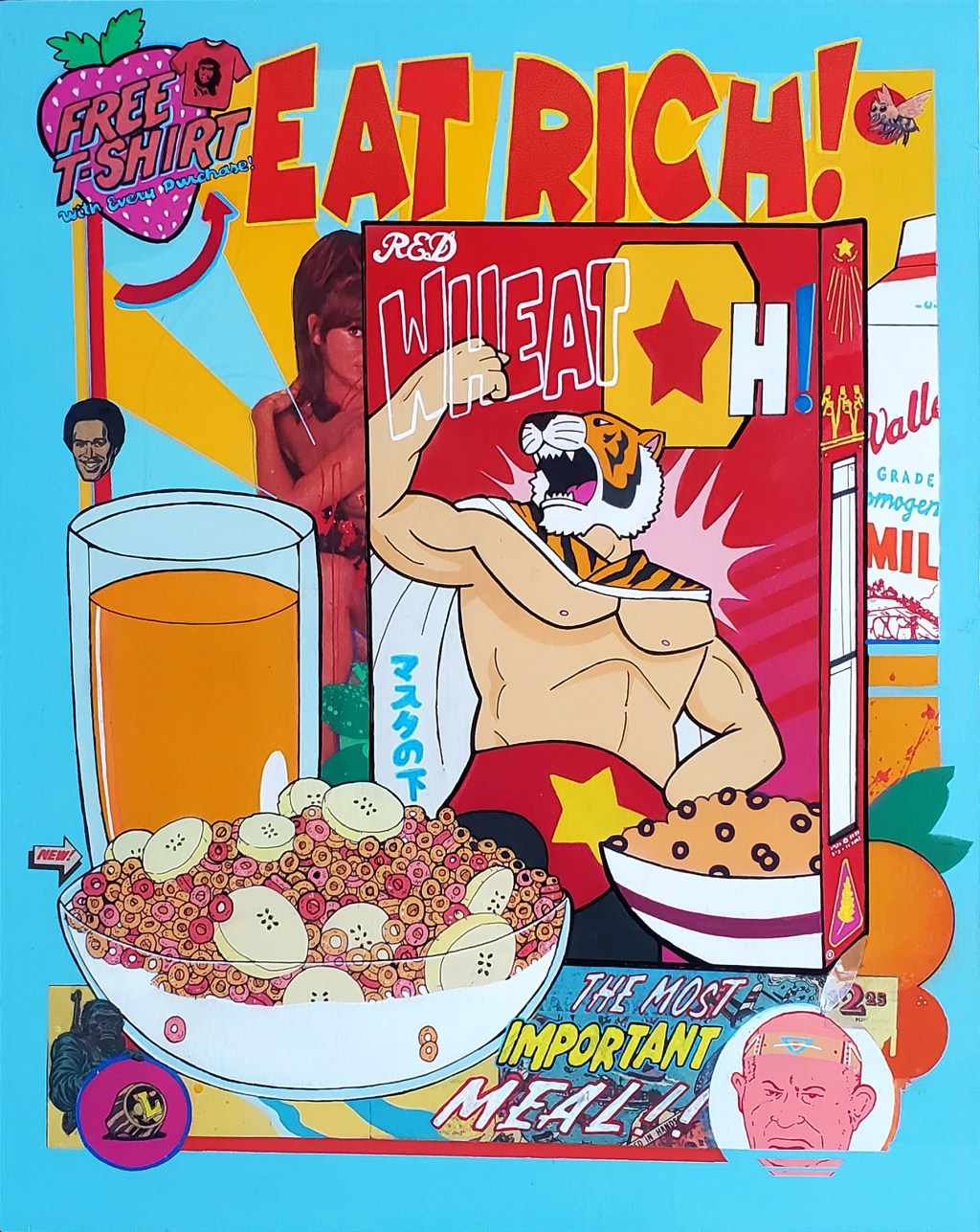
This exhibition marks the artist’s first new series of non-street art since 2023’s SOFT POWER. Whereas that series pieced together an iconographic tableau around globalized American fast-food chains, RED POP is comprised of comic-book-cover-like tesserae advertising any and all material matter signaling leftist political affiliation. These fabricated visuals warp the aesthetics of leftist identitarianism, rendering these signals down to their fallible essence. No longer badges of honor, they are ideological tools that have been reshaped to the artist’s ends. The images are dense and the import is vast.
I stood before them with incredulity as my eyes landed on one detail in disbelief before being jerked towards another, and another. The works have the same visual arrest as the frenetic chaos we see play out on our screens. Though cluttered and tumultuous, the reassuring presence of the human hand is felt, as is its conscious, methodical intent. Gonnella guides us to question ourselves and what he shows us in equal measure.
The primary series of fifteen multimedia works on panel combine elements of mass digital communication (TV, video games, the web browser) with food, consumer brands, sex, comic book superheroes, and plenty more — all projected through Gonnella’s trademark visual aesthetic which combines cartoonish character with anime sensibilities. When gleaned in concert, these works are pure eye candy; bright, saturated colors draw you in, and the initial spectacle of the work quickly gives way to intrigue and urgency. Cafe Red is as good a place to start as any — the barrel of the revolutionary’s gun blasts our way, their toothy and contorted expression signals caffeine-dependent madness — we’ve all been there…

The “WAKE UP! & GET IT!” slogan promulgates a similar “rise and grind” sentiment of corporate 9-5 culture. To be “ready for action,” we must first consume — not just any coffee, but the kind that reminds us we read the back cover of My Friend Che one time and ordered that t-shirt with his face on it back in undergrad. I’m tired as all hell from working six days a week… pour me another cuppa, please, I’m as ready as I’ll ever be.
If aspects of these works feel like parody, you would be correct. Gonnella crumples up salient elements of our consumer life and asks us what it would take for us to meaningfully and earnestly engage in the work of leftist political organizing — beyond the passive consumption of political imagery, beyond the empty signifiers, and beyond the capitalistic economic drivers that govern media. Those parts have become the most difficult to envision, to feel in a world of digital immediacy and entrenched hyper-consumerism.
It’s very easy to take a quick look at these works and want to identify with their elements, to be like hell yeah, I would absolutely buy Red Top ice cream, but a sincere engagement with the work reveals such a reading to be what is is — a plainly vacuous, empty replication of modes of consumption. What can we buy to show our solidarity? Can we consume our way to material liberation? Take Red Decks for instance; why have a sick skateboard with just one icon emblazoned on the bottom when you can have five!? I, too, love SpongeBob and Kentucky Fried Chicken, but it’s always a good idea to let the people know that you are a Maoist, too. You can always swap it for a different style at any time; everything is just aesthetics and vibes anyways. We consume what we hold to be at least a fragmented portion of our identity, what we want to be — this relationship is not symbiotic, it’s parasitic.

To return to some of the items I enumerated during the opening of this essay — interacting with our feeds feels as frictionless as ever, yet somehow these interfaces insist on more of our energy. The shift across platforms to algorithmic moderation, combined with an endless scroll, to being “for you” rather than by you, has resulted in a lack of active choice and agency, and has transitioned us into a mode of online behavior that is highly passive — we’ve become “users” in the abject sense of the word.
We demand less of our platforms, as if we have much of a choice; the platforms demand more of us. This was always the goal. Business models for these multinational corporations had no choice but to extract increasing shareholder value from the data they derived from our usage. But now we truly are trapped, held in what author and political theorist Mark Fisher coined, and journalist Yasha Levine recently extrapolated, The Vampire Castle.
Fisher conceptualized the Vampire Castle (VC) in his 2013 essay which centrally interrogated the modes of leftist infighting on social media platforms, namely Twitter (R.I.P., or good riddance), and how easily we become subsumed, within capitalist cyberspace, in moralistic purity testing — at the cost of class consciousness. Within the towers of the VC “class has disappeared, but moralism is everywhere, solidarity is impossible, but guilt and fear are omnipresent – and not because we are terrorized by the right, but because we have allowed bourgeois modes of subjectivity to contaminate our movement.”1
Levine brings this idea to our present digital reality, positing that our devices and our interfaces themselves are, by design, vampiric in their syphoning of our energy and political will. When the leader of “the free world” and the billionaire bankrollers clinging to his cankles are all social media addicts, we are faced with a reality wherein “All politics in our world have become trapped in the Vampire Castle… All of it preventing us from coming together.”2
This is the crux of Gonnella’s work in RED POP — the aesthetics of our politicking in the landscape of techno-capitalist realism is little more than a verisimilar simulacrum, a false representation of something true and sincere, a mythic veil that abuts our ability to see a future beyond its confined, illusionary backdrop.
If the panels in this exhibition are to be a series of advertisements, COINTELPROism is the machine producing them. The searing carmine of this piece radiates a hellish heat — a simmering, blistering pulse. Using that familiar Che Guevara t-shirt as a backdrop, Gonnella drags and drops the front side to the foreground, letting the contents of the ideological, metaphorical cornucopia spill out into view, reconstructing the history of the capture of revolutionary ideals by the market and nefarious forces within the State.
In this thesis piece we see, amid many, many others: rows of single-family homes sliding down a tube for consumption by a very hungry computer (which feels like not only a clear nod to the housing crisis, but a literalization of utility resource inequities in communities falling prey to the install of AI data centers in their small towns); a grotesque face strewn from John Carpenter’s They Live (1988; a very fitting inclusion); an FBI hat hovering over a Guy Fawkes mask (signaling most readily the notion of controlled opposition); and the Vampire’s Castle, with a literal vampire, broadcasting its beckoning signal — they no longer have to hunt for blood, we freely bring to their plate. Overseeing all the chaos is the folk horror icon, the Wickerman, already ablaze, its head replaced with a TV displaying the MTV logo (I still want my MTV, man). From within the raging effigy we see the contorted, tortured faces of ourselves; some reach out to take selfies at the end of the world, most scream in anguish. We’re all in this, together.

The heart of this body of work is the image itself, taken as a pellicle for transmitting ideology, for diffusing meaning. This graphical, metaphysical friction sparks meaning and purpose in even the tiniest details of Gonnella’s work. Scholar Anna Kornbluh’s recent writing on immediacy3 in our culture shines light on how we navigate our increasingly image saturated terrain — we don’t. When the platforms we see the world through zap the mediative gap between when we see and what we think and believe, what we observe becomes merely replicative of the systems they are drawn from. We feel we are “doing” politics simply by expressing ourselves. Everything has to be spontaneous. We see it. We identify with it. We consume it. We want more of it. We want something new. We want something better. We want it now. No critical mediation, no temporality — just instant transmission. As a result, futurity is fading away.4
To close with Guy Debord, his 1967 treatise The Society of the Spectacle is a prophetic and spiritual binder to Gonnella’s work in this new series, as well to the critical thinkers highlighted above. Why is it so hard for us to look away? Why is it so painful to engage otherwise? Debord writes: “The spectacle presents itself as a vast inaccessible reality that can never be questioned. Its sole message is ‘What appears is good; what is good appears.’ The passive acceptance it demands is already effectively imposed by its monopoly of appearances, its manner of appearing without allowing any reply. The tautological character of the spectacle stems from the fact that its means and ends are identical. It is the sun that never sets over the empire of modern passivity. It covers the entire surface of the globe, endlessly basking in its own glory.”5
Gonnella’s work is not beyond the spectacle, but a prescriptive — not replicative — spectacle itself. “Ideas improve. The meaning of words plays an important part in that improvement. Plagiarism is necessary. Progress depends on it. It sticks close to an author’s phrasing, exploits his expressions, deletes a false idea, replaces it with the right one.”6 We may be trapped in the labyrinth of the Vampire Castle for the foreseeable future, but Gonnella’s RED POP gives us the self-critical kick in the ass we need in order to live beyond its precarious, cracking walls.
Notes
[1] Mark Fisher, “Exiting the Vampire Castle,” OpenDemocracy, November 24, 2013.
[2] Yasha Levine, “We All Live in the Vampire Castle Now,” NEFARIOUS RUSSIANS, June 9, 2025.
[3] Anna Kornbluh, Immediacy, or The Style of Too Late Capitalism (Verso, 2023).
[4] Michael Burns, “How Immediacy Changed Culture (with Anna Kornbluh),” July 14, 2025, https://www.youtube.com/watch?v=pOOG72fquSM.
[5] Guy Debord, The Society of the Spectacle, trans. Ken Knabb (Bureau of Public Secrets, 2014), 4-5.
[6] Ibid., 110.
—
J. Zach Hunley (they/he) is a Pittsburgh-based modern and contemporary art historian, critic, administrative professional, photographer, collector of things, and proud father to a senior guinea pig. With a keen observational eye, they use their writing as a means to refract their deep appreciation for formal aesthetics through a socially engaged lens. They hold an M.A. in Art History from West Virginia University, Morgantown, WV, and docent for the Troy Hill Art Houses.
 PETRICHOR
Leave a comment