
by Briana Bindus and Tori Casarella
This fall, three international style writers, muralists, and street artists stepped foot in Pittsburgh for their first time — and they left their marks on the walls of Bloomfield, Homewood, and Garfield.
The artists flew into Western Pennsylvania for a 10-day residency curated and organized by Hemispheric Conversations: Urban Art Project (HCUAP, pronounced “hiccup”). Since 2016, HCUAP has prioritized cross-cultural engagement between street artists from Spanish-speaking communities, local and abroad, and Pittsburgh’s locales.
The 2025 residency brought two graffiti artists from Spain, Harry Bones and Musa71, along with a muralist from the Philippines, Venazir Martinez, to engage with Pittsburghers and their communities. The collaborators, Caitlin Bruce, Max Gonzales, Shane Pilster, and Emma Riva decided on the theme of “Entangled Histories: Urban Art and its Diasporas,” due to the complex, shared cultural heritage of the artists’ home countries.
Harry and Musa traveled into Pittsburgh together and collaboratively worked on the Homewood wall during their residency. Harry and Musa met about 10 years ago and have since combined their art styles on numerous walls, including a 2023 “Com a Casa/Like Home” exhibition. Both artists grew up in post-Franco Spain, a political landscape that shaped their experience with artistry and the symbols in their street art.
Harry, originally from Sabadell, Spain, started his journey in graffiti art back in 2001. His work fuses graffiti art and lettering, illustration, and chromatic themes. Harry has worked across a wide range of disciplines, including fashion, movie sets, book covers, and advertising. He curates a semi-regular newsletter for fans to follow, with updates on his art and other opportunities.
Musa, a Barcelona native, first dipped her toes in the street art scene back in 1989 and has since painted countless walls with her emotionally-charged colored graffiti letters. Though Musa’s street art centers around traditional graffiti, she is interested in how she can “push the boundaries” of typical street art. Though she has been involved in graffiti art for over 35 years, Musa has recently expanded her reach through a blog and a podcast, “Breaking the Rules,” which explores the history of graffiti in Spain. Musa posts some podcast episode transcripts in English on her website.
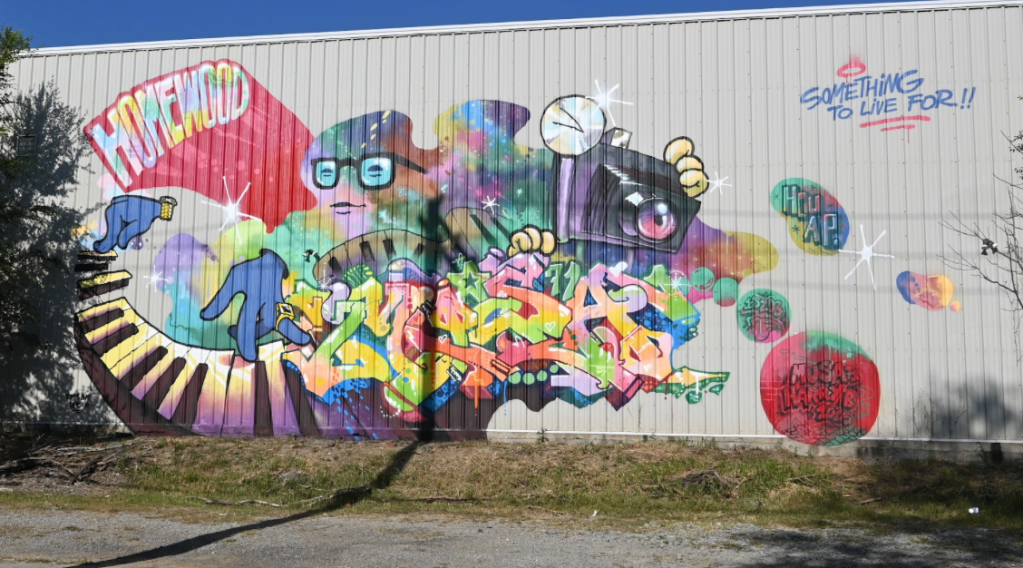
If you look closely at the Homewood wall, located at 6815 Hamilton Avenue, you can probably notice where each artist contributed: Musa’s lettering and artist name pop out in the bottom right while Harry’s galaxy collage shines through in the top half of the painting. The artists worked together to ensure they truly “entangled” their artistic histories with Pittsburgh’s, in keeping with the residency’s theme.
The Homewood community is evidently incorporated into their mural: “Homewood” is written in the top left corner; the Homewood zipcode, 15208, is featured in a bubble on the right; the large camera in the top right is representative of Charles “Teenie” Harris, who extensively photographed Pittsburgh’s Black communities and had a darkroom in the basement of a Homewood home, which Musa and Harry learned during a conversation with CMOA archivist, Charlene Foggie-Barnett. The piece’s title, “Something to Live For,” draws from a Billy Strayhorn song, commemorating the musician’s Homewood roots. By using their own styles and combining it with local elements, their wall captures and solidifies the Homewood identity for local residents.
Venazir’s work similarly ties together community and identity, no matter where she is painting walls. A street muralist and visual anthropreneur from the Philippines, Venazir’s signature artist mark is a “red thread” that appears in all of her murals — including the Bloomfield wall at 4501 Liberty Avenue.
For Venazir, the red thread is a symbol of intersectional narratives between human traditions, cultures, memories, the landscape, and environments that shape them. The thread is part of a larger initiative, the Hilabana movement, which Venazir founded in Baguio City, Philippines in 2018. Hilabana, which means “woven path,” is representative of the Filipino diaspora — including cultural pride, resilience, and the shared history between people and the places they live.
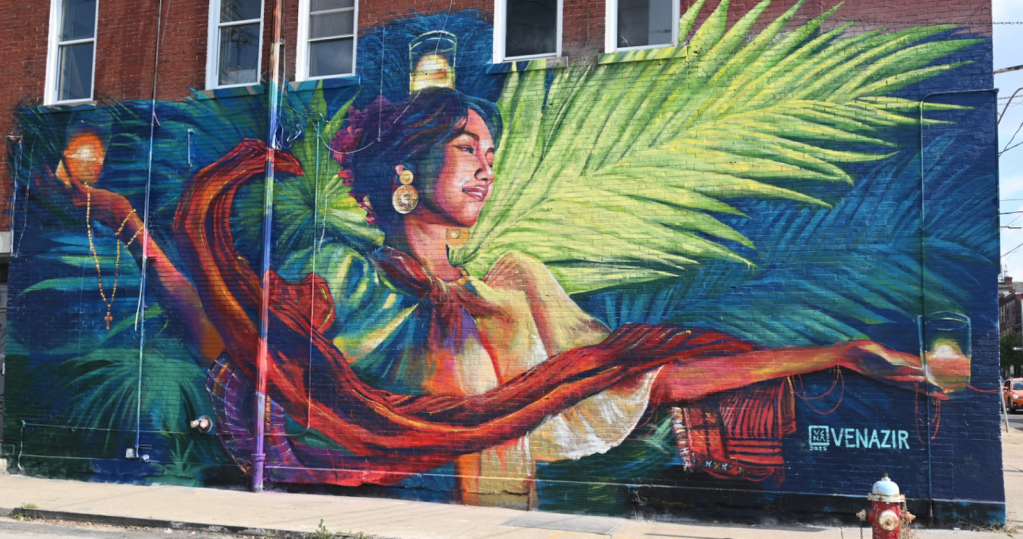
Venazir’s pride in her culture is clear in Bloomfield. If you were to drive or walk down Liberty Avenue, you might notice Venazir’s “Pandaggo Sa Ilaw” mural on Ella Street, painted on the side of the Tobacco Outlet: A vibrant image of a woman dancing the pandanggo sa ilaw, a lively Filipino folk dance that uses light to simulate fireflies. Pittsburgh Filipinos make up only a small percentage of the overall city population, but Venazir’s mural reminds other community members that they are here and a part of Pittsburgh’s larger identity. By placing imagery of a cultural dance in Pittsburgh, Venazir is creating everlasting threads between the Philippines and Pittsburgh
Over the course of their weeklong residency, the artists worked daily with spray paint, lifts, paint cans, and more — all on top of the early September heat. Yet, the residency’s opportunities extended beyond the wall: Each artist participated in cultural site visits, led an artist workshop at the Carnegie Library of Pittsburgh’s East Liberty branch, presented their work at an artist talk in the Andy Warhol Museum, and finished by painting one last wall in Garfield during a Community Paint Jam over the weekend of September 13th. Venazir also led a figure drawing and color theory workshop at the Filipino American Association of Pittsburgh in West Mifflin.
Over their first weekend, the artists and HCUAP collaborators traveled to art scenes across Pittsburgh to spark inspiration and learn about the surrounding community. They visited the Vanka Murals in Millvale, the “Ruins Project” in Perryopolis, the University of Pittsburgh’s Cathedral of Learning Nationality Rooms, and the Carnegie Museum of Art. Venazir was excited to see the Philippine Room in Cathy, with her culture as the primary focus, though Musa and Harry remarked the room was more of a generic, vacation-style room than traditionally Filipino. Musa and Harry’s inspiration sparked during a conversation with CMOA archivist, Charlene Foggie-Barnett, where they encountered “Teenie’s” photography to tie into their larger mural.
During an artist talk at the Warhol, each visiting artist presented portfolios of their previous work, discussed the meaning behind their work, and participated in a panel discussion. The talk concluded with audience questions, where one of the attendees asked the artists how they engage with political messaging in their work and if they confront any apprehension in doing so. “Art is always political,” Venazir said. “No matter how you frame it, it will always be political.”

Musa also noted the politicization of her street art, despite her rarely interacting with such topics whilst painting. “It was political when there were no woman painting in the streets; it’s political now that there are not a lot of womans my age painting,” Musa said. As a 54-year-old female artist in a male-dominated culture, Musa argued that representation in art is part of what makes it political, and her participation is a form of such representation — whether she’s in the U.S. or not.
Over the weekend, the visiting street artists collaborated with local, Pittsburgh-based street artists in Garfield with a Community Paint Jam. The group of artists and local residents made a collage spelling “Garfield,” where between one and three artists worked on each letter. Many of the letters paired a mentor artist and a younger artist together — each apprentice ready to learn from a more seasoned painter. Along with the resident artists, the other participating artists included: Andrei Arboleda, Scott Brozovich, Jerome Charles, Brian Gonella, Ashley Hodder, Atiya Jones, Kuwame Kinsel, Emily Paige, Shane Pilster, and Cara Rose. The final letter, “D,” was left to community attendees, who had the opportunity to leave their own mark on their community walls. Max Gonzales outlined the letters and taught artists — new and old — the ins and outs of spray painting.
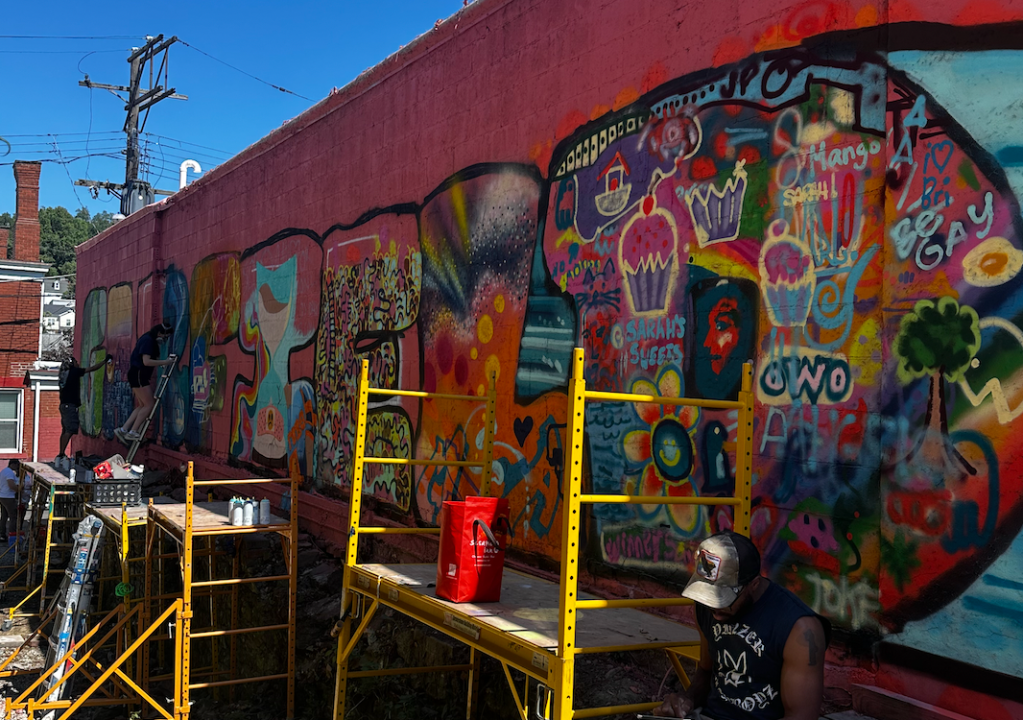
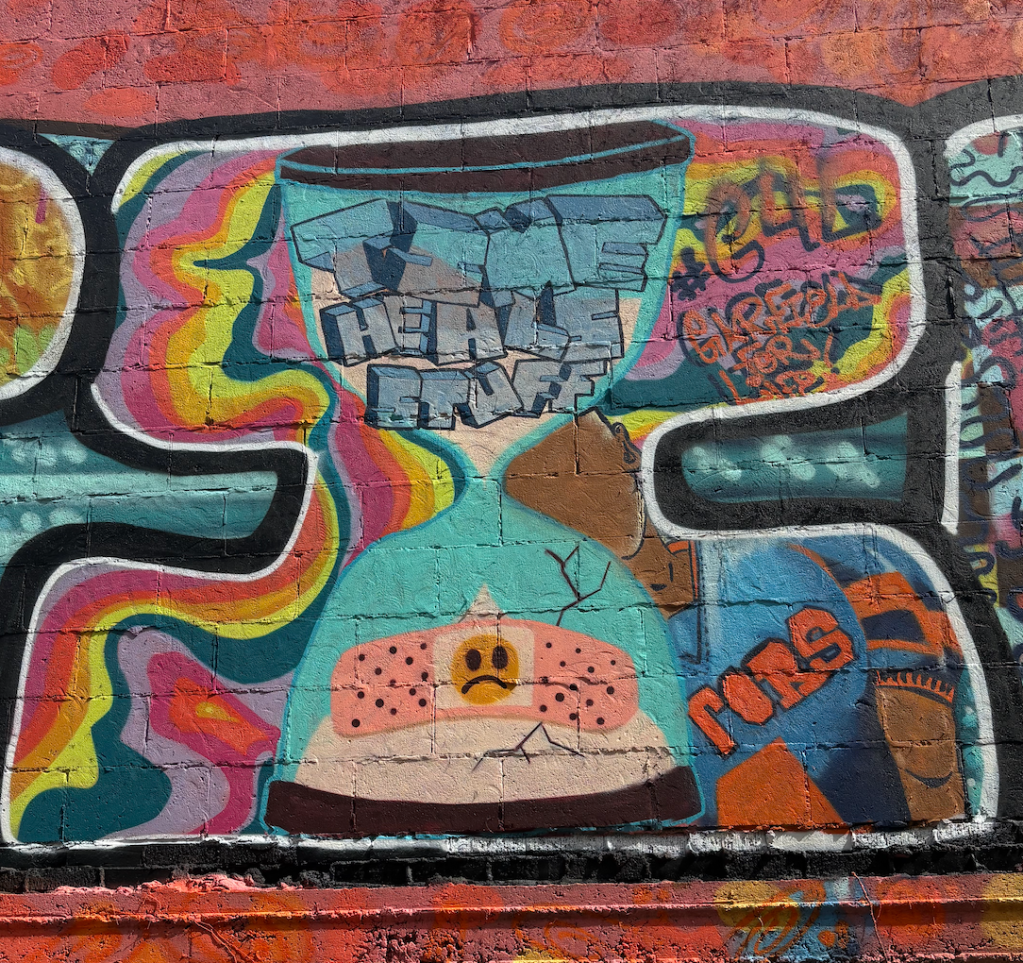
Each artist had different images within their letters — with overall goals of energizing a previously blank space, challenging themselves artistically, or representing their identity. Most artists held the Garfield community in the center of their art, using the neighborhood culture as inspiration for their mural. Kuwame Kinsel, for example, thought it significant to include a Garfield Gators jersey as an homage to the neighborhood’s youth football team. This image, as well as stylized letters reading “Garfield for Life,” are painted in a bold orange within the letter “I” — no one can miss these references. The artists felt it was important for Garfield residents to feel honored by the mural — this space is reflective of Garfield’s residential community, not just for natives but for people passing through the neighborhood as well.
Approximately 30 community members came to interact with the mural. While some were just learning how to spray a paint can, others had participated in graffiti art before; the more experienced community members often asked the artists about shading or color theory, while the newcomers were welcomed with basic advice. Regardless of their knowledge or skill, all that visited had the opportunity to participate equally and gain a better understanding of street art.
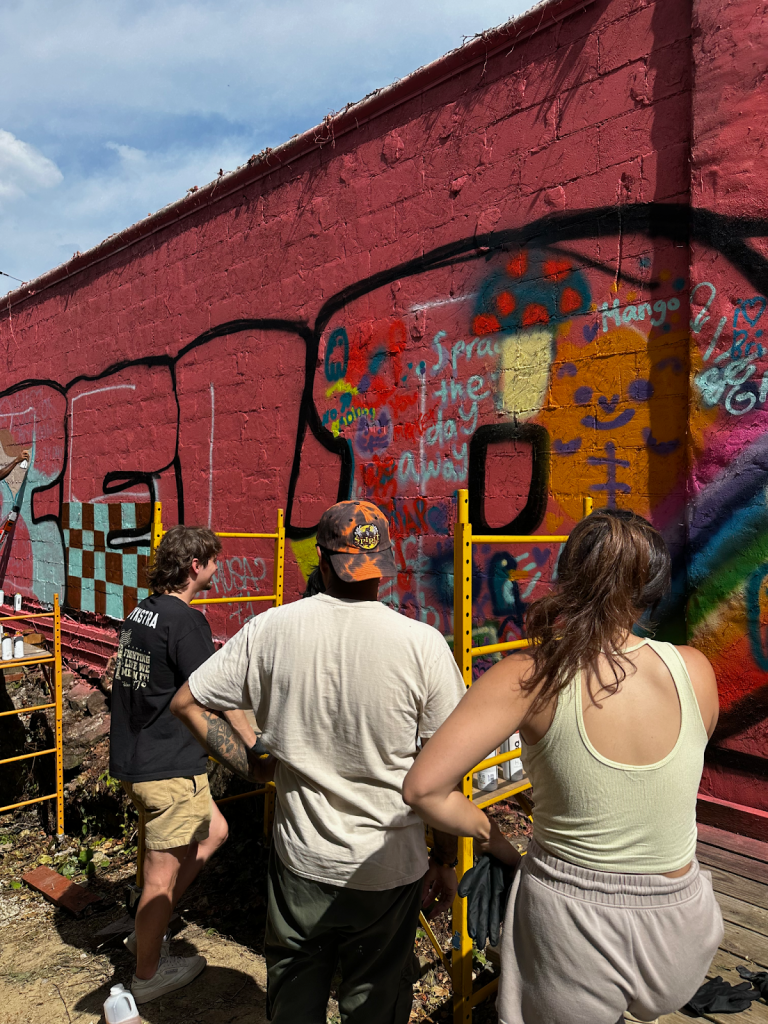
Street art wouldn’t exist without a community to view it. Despite common apprehensions towards graffiti and street art, HCUAP’s visiting artists found themselves as part of the community — not disruptors of it. Venazir, who has traveled to cities across the U.S. in recent years, described the people she’s met during her city collaborations as “supportive” of her art, even during American political tensions. Musa and Harry felt the same towards Yinzers, who responded to their graffiti art-style with open arms. At their Homewood site, a Westinghouse high school art teacher brought their students to view the wall and chat with Musa and Harry themselves. A student and young artist felt inspired by their work, noting how they want to create art in a similar way.
Through their murals, these artists entangled their histories with local Pittsburgh communities, the theme that was at the heart of HCUAP’s residency: These walls were not just for the artists to express themselves but for Pittsburghers, from all walks of life, to resonate with spaces designed for themselves and their community.
~~~
Briana Bindus is a senior B.Phil candidate in English literature at the University of Pittsburgh. Through her double-major in communications, Briana is a research intern with HCUAP. Briana is passionate about reading, writing, and interdisciplinary representation through art, literature, journalism, and politics.
Tori Casarella is a senior English Writing Non-Fiction and Communication Rhetoric double major at the University of Pittsburgh. Tori also has a Law, Criminal Justice, and Society minor and plans to transition to law school post-graduation; her ultimate goal is to advocate for underrepresented groups in a future career. Tori enjoys reading and writing all types of written expression, especially memoirs, and engaging in passion projects, which her role as HCUAP’s research intern allows for.

This month’s articles are produced with support from the Frick Pittsburgh in conjunction with their landmark exhibition The Scandinavian Home: Landscape and Lore. Get cozy as the seasons change with David and Susan Warner’s collection of paintings, tapestries, and sculptures from around the Nordic region. Tickets now on sale.
 PETRICHOR
Leave a comment