by Shawn C. Simmons
Cover photo by Chris Uhren.
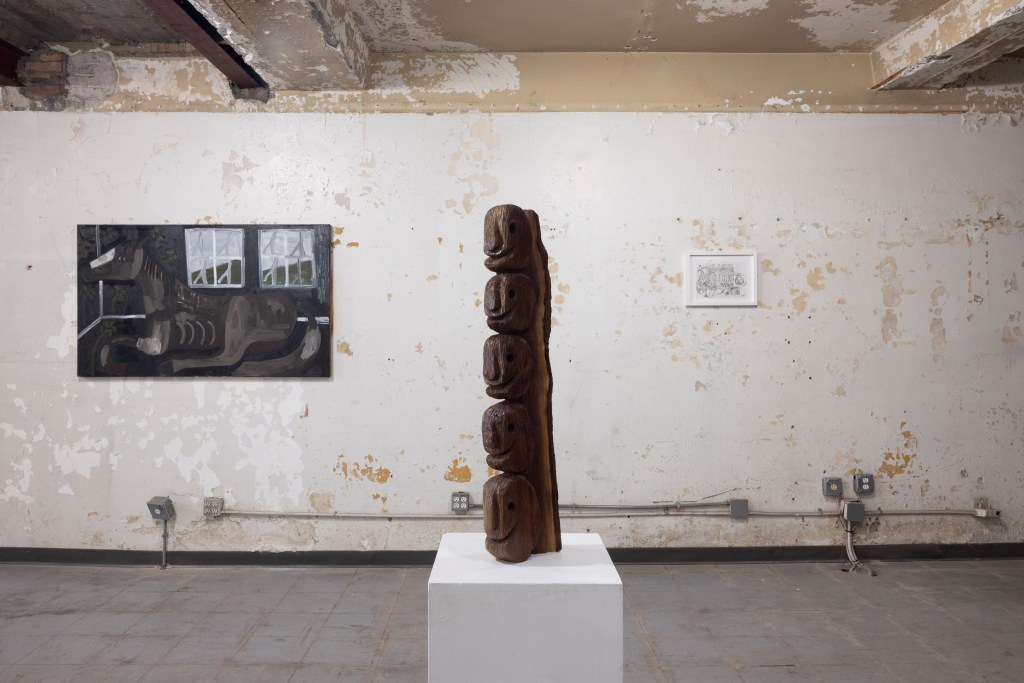
Left: Bradley Sizemore, filled with bleach, 2025. Oil on canvas, 36 x 60 in.
Center: Hunter Potter, stack ‘em, 2023. Black walnut, 36 x 9 x 3 ½ in.
Right: Sophia DiRenna, So Long, 2023. Graphite on paper, 9 x 12 in.
By late October, the body often feels like a relic—stiff in the cold, aware of its seams. The air thins, breath turns briefly visible, and the world seems to exist in a state of remainder as leaves collapse underfoot and daylight fades too soon. It’s a fitting prelude to Odd Body, a three-day exhibition installed in the first floor of the vacant Sauer Building downtown.
Co-curated by Lexi Bishop and Bradley Sizemore, the show gathered ten artists whose works dwell on the “remnants, artifacts, and suggestions of bodies” rendered in various media. Presented in a historic building being converted to residential use, its partial renovation exposing beams, pipes, and sky, Odd Body blurred the line between structure and organism. The building itself became another body in transition: skeletal, porous, and still breathing.
Bishop and Sizemore began with a selection of artists based in both New York and Pittsburgh whose work carries a shared interest in material presence. As the roster took shape, a theme began to emerge on its own: bodies, or more precisely, the traces they leave behind. What linked these works was a sensitivity to surface and residue, an intuition that the body might be most legible when only partially visible.
Installed in the raw, drafty openness of the Sauer Building at 804 Penn Avenue, the show took on the character of its surroundings. The cracked plaster, the unlit corners, and the faint scent of sawdust all seemed to belong to the same material vocabulary as the artworks themselves. The show’s provisional quality, on view for a single weekend before the site’s renovation resumed, gave it the air of an apparition. Several works gave the impression of having been excavated from the space rather than brought into it, a rediscovery of what had always been there.
Severin Moore’s Halloween Island (2025) greets viewers with a strange, uneasy charm. Against a pastel seascape streaked with clouds and winged forms, a woman’s profile dominates the frame. Her teeth are bared in an exaggerated grin, her limbs twisting at impossible angles so that her legs seem to jut upward behind her head. The warped perspective feels borrowed from a dream or a story retold until its details start to shift.
Moore’s brushwork is steady and deliberate, his palette subdued in order to hold sand, water, and skin tones together in careful tension. At first, the scene appears almost cheerful: a beach, a smile, a sunny day. But the longer you look, the more the figure seems to tilt toward something off-kilter, her expression caught between delight and strain. Moore’s blending of humor and unease sets the tone for a show preoccupied with how the body can be both familiar and strange
Nearby, a small table displayed the last remaining copies of J.R. Holtz’s Created for You by the Hands of Holtz (2021), a 20-page full-color zine produced by Printed Matter in an edition of 200. Holtz, who passed away last year, was a beloved fixture of the Penn Avenue arts corridor in Garfield, known for his vivid glass paintings. The zine reproduces many of these works alongside notes, sketches, and small gestures of humor and warmth. It reads like an extension of Holtz’s tactile world, a paper reliquary of his presence. To pick it up is to feel a certain intimacy, the weight of something made for a community and left behind in their keeping. Its inclusion here extends the exhibition’s dialogue beyond the its other, acknowledging the body as both creative force and ephemeral trace.

Rachael Starbuck’s Measuring the distance as if it were the essence of being close (2021) occupied one of the building’s narrow vestibules—those in-between zones that blur public and private, inside and out. An elongated form was hung well above eye level, long cords spilling onto the floor in careful tangles. At first glance, this appears to be a garment, but up close, its surface betrays the illusion: it is made of layered latex house paint, built up until the pigment becomes substance. The once-liquid material has hardened into its own skin, permanently holding the shape of draped fabric.
Starbuck’s process, color-matching to “faraway blues,” then allowing the paint to thicken through time, turns household material into something uncanny, a proxy for skin that can no longer move. The forms look as if they should sway in the draft, yet their rigidity denies that motion, a tension that gives the work its quiet charge. These suspended shells of clothing feel less like absent bodies than like the idea of closeness solidified: an intimacy that has hardened, refusing to yield.
Bradley Sizemore’s cold girls (2025), one of two oil and acrylic paintings executed on the surface of dried gourds, continues the exhibition’s fascination with metamorphic bodies. The gourd, once pliant and organic, now serves as a convex support for delicate portraiture: faces and limbs contoured to the object’s curves. Painting on such a surface recalls earlier devotional traditions (Byzantine icons painted on wood, or Mexican retablos on tin) where the substrate carries spiritual weight. But here, the living origin of the material lingers. The painting’s subtle cracks and irregularities remind viewers that this body once grew from the ground, breathed, and dried.
What unified the ten artists in Odd Body was not a shared aesthetic but a common sensitivity to matter: an understanding that bodies—human, architectural, material, or otherwise—are porous, temporary, provisional structures. The materials varied widely: glue molds, ceramics, glass paintings, graphite drawings, photographs, oil and acrylic on found supports.

Wall: Bridget Quirk, Hot Talk, 2024. Oil and woof on canvas, 9 x 12 in.; Bridget Quirk, My Mirror, 2024. Acrylic on canvas, 14 x 11 in.; Bridget Quirk, Small Play, 2023. Acrylic and fabric on canvas, 8 x 8 in.
The space didn’t so much frame these works as host them; their varied forms felt attuned to the building’s own state of becoming, its cold air and temporary quiet. Within the limits of editorial space, it’s impossible to give each artist their full due, but collectively the exhibition made a case for the body as process rather than object, something continually taking and leaving shape.
To see Odd Body in such a place was to glimpse Pittsburgh’s creative ecology at work. Artists here have long moved fluidly through the city’s vacant and in-between spaces, filling them for a time before the next phase of use begins. The Sauer Building fit that pattern perfectly, its unfinished walls and drafty air seeming to breathe with the works themselves. The exhibition came and went, as temporary as the site that held it. Yet it also unfolded within a familiar cycle of transformation: the same kind of old commercial building now destined for upscale housing, a reminder that creative reuse and redevelopment often share a fragile border. Odd Body made that tension visible, if only for a moment.
Any trace of the show has already vanished from the site. The philosopher Elizabeth Grosz describes the body as defined by its radical openness to the world, always exchanging matter and meaning with what surrounds it. Odd Body enacted that principle at the level of exhibition-making through porous exchanges between bodies, artworks, and space.
The title Odd Body captured both tone and method. There was humor and discomfort in these works, a sense of things half-finished or half-decayed, but also tenderness in the recognition that even in fragments, the body persists. The show’s grit amplified that sensibility. Like Holtz’s zine copies arranged on the table, the exhibition itself became a gesture of touch, a handmade offering that lingered just long enough to be felt.
Odd Body, co-curated by Lexi Bishop and Bradley Sizemore, ran from October 24-26 at the historic Sauer Building in Downtown Pittsburgh (804 Penn Avenue).
Shawn C. Simmons (he/him) is a Pittsburgh-based art historian, educator, and writer.

This month’s articles are produced with support from the Frick Pittsburgh in conjunction with their landmark exhibition The Scandinavian Home: Landscape and Lore. Get cozy as the seasons change with David and Susan Warner’s collection of paintings, tapestries, and sculptures from around the Nordic region. Tickets now on sale.
 PETRICHOR
Leave a comment