
by Karie Luidens
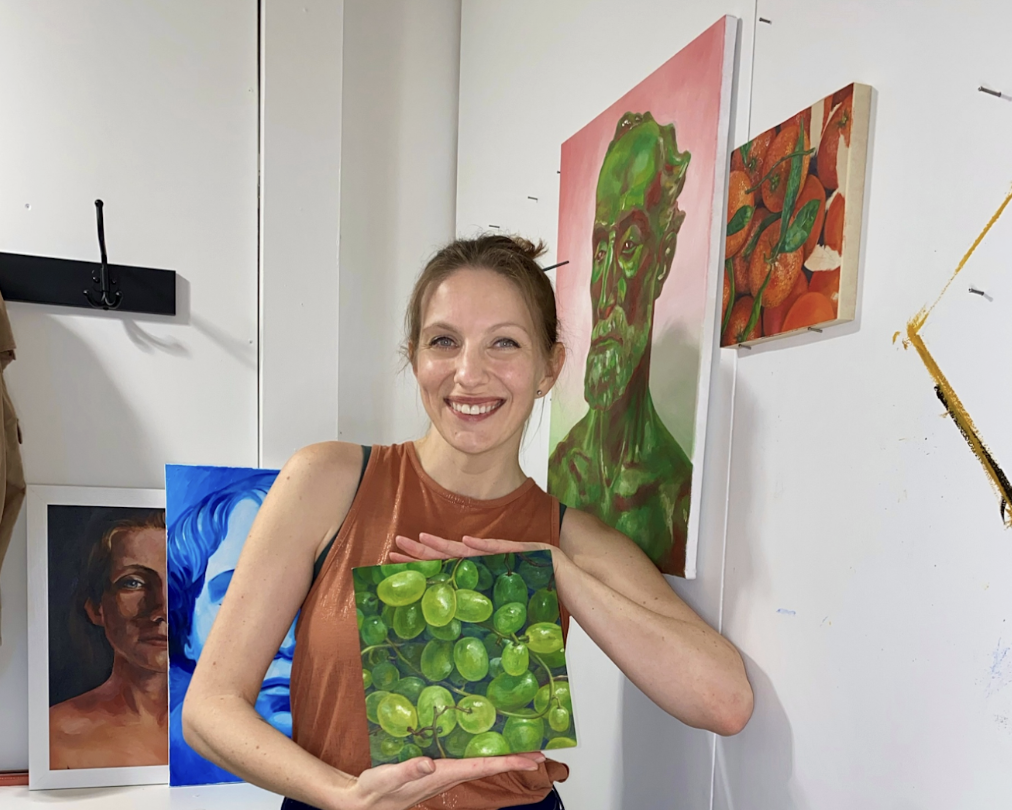
Photo: Work in progress by Karie Luidens
I have to admit, I went into reading the below essay by Karie Luidens a bit of a Taylor Swift skeptic. But popular things are popular for a reason, and Karie’s writing and her artwork take Swift’s music seriously as an art form. Part of Petrichor’s ethos is to push not just readers but myself, as an editor, to think differently, and I appreciated the parallels Karie drew between Swift and Whitman that, like she alludes to, made me roll my eyes for a second. But it’s worth interrogating why we feel this way when we react to statements like that and what it says about associations with high and low culture. Swift inspiring another artist’s art is a wonderful thing. This essay accompanies Karie’s show, open to the public this weekend – ER
Crack open a first edition of “Leaves of Grass” and you’ll be greeted by direct eye contact from the poet himself. Walt Whitman not only commissioned this portrait for the book’s frontispiece, he was very deliberate about how the steel engraving portrayed him. The young writer stands in a jaunty contrapasto with one fist on his hip, his collar loose around an open button, the brim of his hat askew. Before readers even reach the first line of verse, they sense what kind of man they’ll be dealing with.
Or do they? In writing my master’s thesis on “Leaves of Grass” years ago, I observed that there is a “profound distinction between Walt Whitman the poet and Walt Whitman the persona, the voice who self-consciously narrates his poetry.” I explained how the flesh-and-blood man—the one who died in 1892 very much aggrieved by dark years of war and national upheaval—had chosen to craft a “more wondrously freewheeling” version of himself to immortalize on the page. The carefully careless image in that frontispiece presages a carefully careless voice throughout the ensuing poetry.
Thus, when we discuss Whitman, we must be precise: which Whitman are we talking about?
A century after the sun set on Whitman’s lifetime, the American literary scene was lit by a new rising star in the person of Taylor Swift.
If you just rolled your eyes or raised a brow, hear me out.
Like Whitman, Swift is a poet—a lyricist whose pen has flowed since she was just a child. (Unlike many popular singers whose hits are composed by unseen teams, Swift has always written her own music. Her eponymous debut album includes a song that she drafted when she was only 13.)
Like Whitman, Swift’s writing has been received in her own lifetime with a mix of adulation from some and snobbish dismissal from others. (Critics have offered similar complaints about each of these poets in turn: they write with voices that are too earnest and wincingly intimate, subjects that are too emotional or sensual, verse that is too free. Yet other reviewers and scholars have embraced precisely these attributes as evidence that they are quintessentially American creatives and emblematic of their respective eras.)
And like Whitman, Swift has demonstrated a fierce attention to the persona she crafts for her audience. After all, every album cover serves as a modern-day frontispiece, allowing the artist to meet her audience’s eyes directly from the moment they pick up her work.
This brings us back to our original question, adapted for the current moment. When we discuss Swift, which Swift are we talking about?
This is the question that drove my own artistic process over the last year. In addition to being an erstwhile Whitman scholar, I’m a Pittsburgh-based oil painter and, more recently, mixed-media artist working in everything from resin and vinyl to knitting, beading, embroidery, and more. My latest project: developing an art exhibition that explores Swift’s lyrics through a literary lens.
I began studying Swift’s work in late 2024 because, everywhere I turned, people were talking about her record-smashing Eras Tour. How could one pop star have so thoroughly captivated the planet? I’d heard her music in the background over the years, but I wasn’t familiar with her (folk)lore. Curious, I started to dig in—and before I knew it, I’d fallen down the rabbit hole.
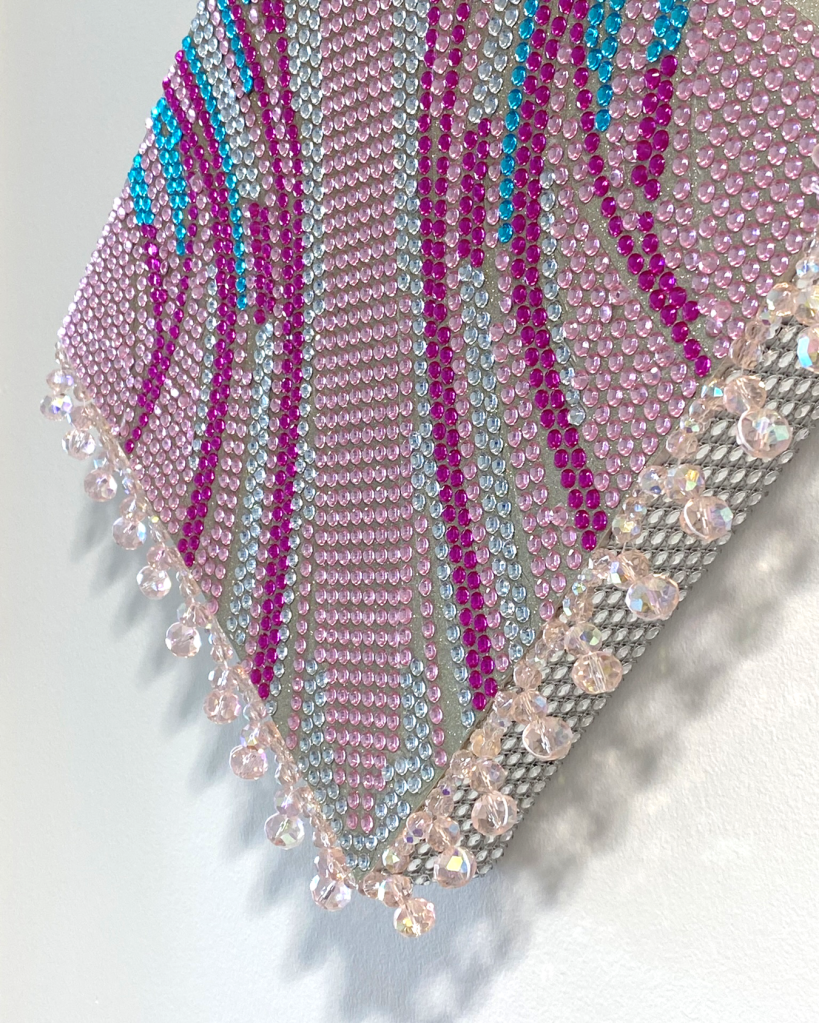
I soon discovered that this celebrity, who I’d seen as a bejeweled stage performer, is first and foremost a writer. She crafts stories with every song she composes, regardless of the genre. In fact, she’s crafted her entire career into one long, winding, ever-unfolding story.
With Whitman in mind, I began to parse the evolution of Swift’s lyrics and her own narrative arc as a character within them. I learned how she has deliberately shifted between musical genres and aesthetics at various points in her career. I noted specific metaphors, images, and themes that thread between two decades of text like an invisible string, tying disparate albums into a coherent whole. I observed how her literary persona, like Whitman’s, uses humor and hyperbole to amplify whatever kernel of truth she seeks to express from poem to poem.
Or rather, her literary personae, plural. Swift strategically adopts a different persona on each of her twelve studio albums, arguably on each individual song. Does she contradict herself? Very well then, she contradicts herself. (She is large, she contains multitudes.)
As a result, there are many ways to approach Swift and her oeuvre. As I created art for this exhibition, I chose to focus on the threads tied to celebrity and how it changes a person over time. The resulting series of artworks traces a narrative arc from a young Swift—that 13-year-old who first put pen to page—to the savvy showgirl who has come to dominate the global music industry.
Thus far I’ve emphasized the parallels between Whitman and Swift, but here they diverge. After all, times have changed since “Leaves of Grass” rolled off the presses in 1855.
Whitman was able to control not just the text that he printed but precisely what portrait accompanied it. The roguish engraving in his book was based on a daguerreotype, an early predecessor to film photography that required copper plates, mercury vapor, and painstakingly long exposures. That singular, carefully crafted image was all his readers saw of Whitman, leaving them to judge him primarily by his writing.
In contrast, Swift is constantly exposed to more camera flashes than most of us will experience in a lifetime. Her every gesture or micro-expression is documented, then analyzed for clues about her romantic relationships or mental stability. Every feature of her body has been critiqued, with online speculation alternating between eating disorders and imagined pregnancies over the years. From tabloids to Tumblr memes to Twitter feuds, Swift has been the object of relentless scrutiny for the better part of her life.
Where Whitman could dictate his public image, Swift is at the mercy of paparazzi each time she steps outside—and often that attention on her image ends up eclipsing her creative accomplishments.
Those camera flashes take us to the opening lines of her 2014 song “Wonderland,” which depicts how media attention warps one’s personal life like a funhouse hall of mirrors:
Flashing lights and we
Took a wrong turn and we
Fell down a rabbit hole
And that, in turn, takes us to my upcoming art exhibition, We Found Wonderland.
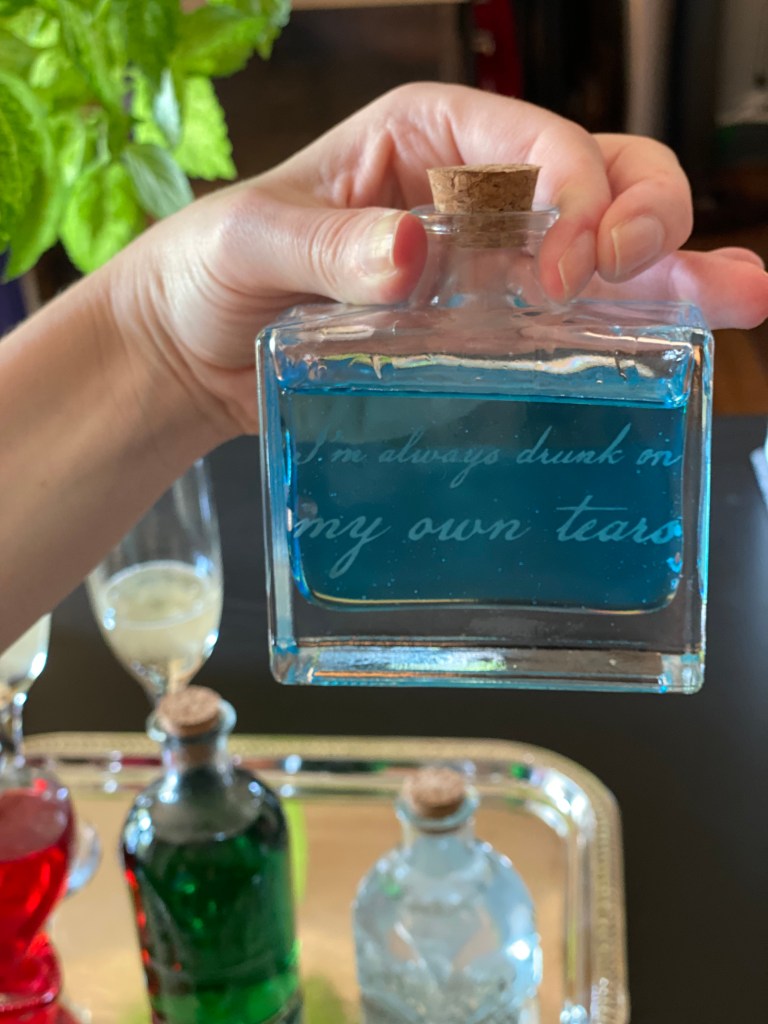
In developing this show, I wanted to interrogate Swift’s poetry with the same seriousness I brought to my thesis on Whitman’s Leaves of Grass. However, since Swift works in an era saturated with imagery—since she is so very strategic about the aesthetics of her albums, and yet so unable to control how the media will portray her in the world beyond—it felt only right to do so not just through the written word but through a wide array of visual mediums.
The subject of Swift’s own celebrity surfaces time and again in her lyrics through various metaphors: lights that reflect or refract, glitter or blind; altars and cages; precious jewels or simply sequins. At times, she embraces her role as a mere illusionist or mirrorball, performing choreography on a tightrope for our entertainment.
At others, she wistfully pines for the days when, “before I learned civility, I used to scream ferociously” (one might say, sound a Whitmanesque “barbaric yawp”). Ultimately, she depicts her own fame as a wonderland of equal parts beauty and terror, bright lights and dark forests.
In naming my show after both her dazzling rush of a song and the topsy-turvy children’s tale, I invite the gallery’s visitors to join Swift—or rather, Swift’s multitudinous personae—on a journey into those forests.
The journey will take us past potions and poisons, Cheshire Cats and playing cards, fool’s gold and gilded canvas. We may enter with that original question in mind: which Swift are we seeing? But along the way, a new question arises from the words she’s written: in the end, in Wonderland, will we all go mad?
…
“We Found Wonderland” is a mixed-media art exhibition that reimagines the lyrics of Taylor Swift through the lens of Alice’s Adventures in Wonderland.
Ketchup City Creative
612 Main St, Pittsburgh
December 6 – 14, 2025
Gallery hours and more: karieluidens.com/wonderland
Karie Luidens (rhymes with “guidance”) is a writer and artist with roots in upstate New York and West Michigan, but over the years has also lived and worked in Rennes, Lille, Seattle, Albuquerque, and now Pittsburgh.
 PETRICHOR

Leave a comment