by Olivia Wick
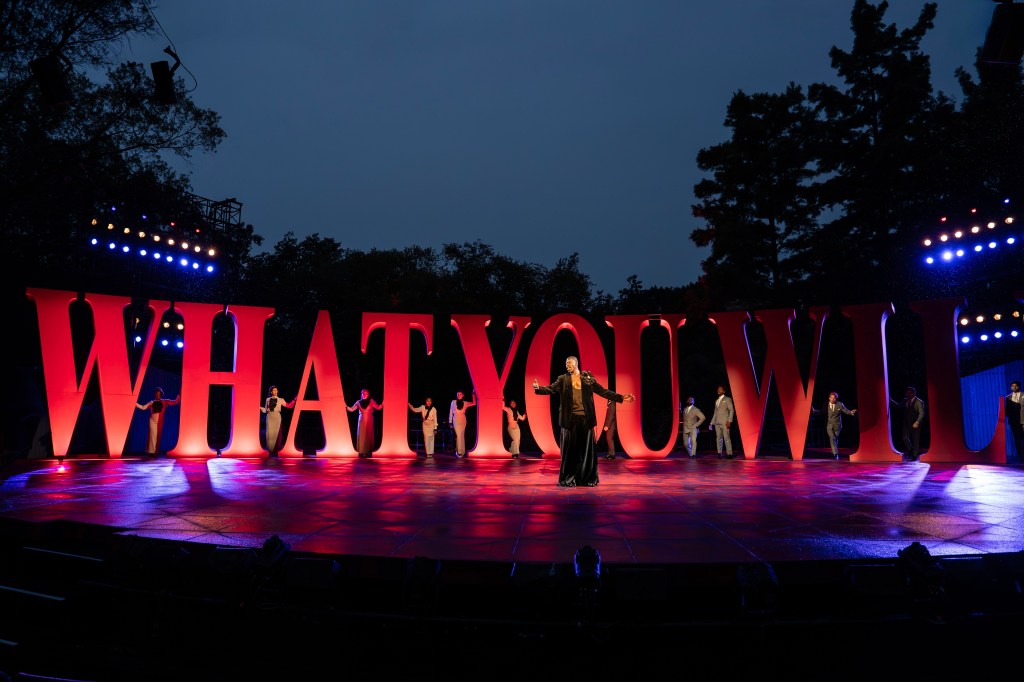
The sun finishes setting over the stage, the set before me is bare except for a backdrop of lush greenery and towering red letters spelling “WHAT YOU WILL,” and I feel an excited buzz as I wait for my favorite play of all time to begin. An angelic voice rings in my ears as the words “All the world’s a stage” echo throughout Central Park. At least, this might be what I would say had I actually been there.
Instead, I watched The Public Theater’s production of Shakespeare’s “12th Night” from the comfort of my living room thanks to the Public Broadcasting Service (PBS). Lupita Nyong’o as Viola expertly walks a tightrope between a lovesick feminine identity and an accidentally too charming male disguise through my tv screen. I can rewind and rewatch Peter Dinklage’s beat-perfect, stick-in-the-mud Malvolio as he attempts to woo Sandra Oh’s alluring and confident Olivia. The best part though? I can watch it over and over again.
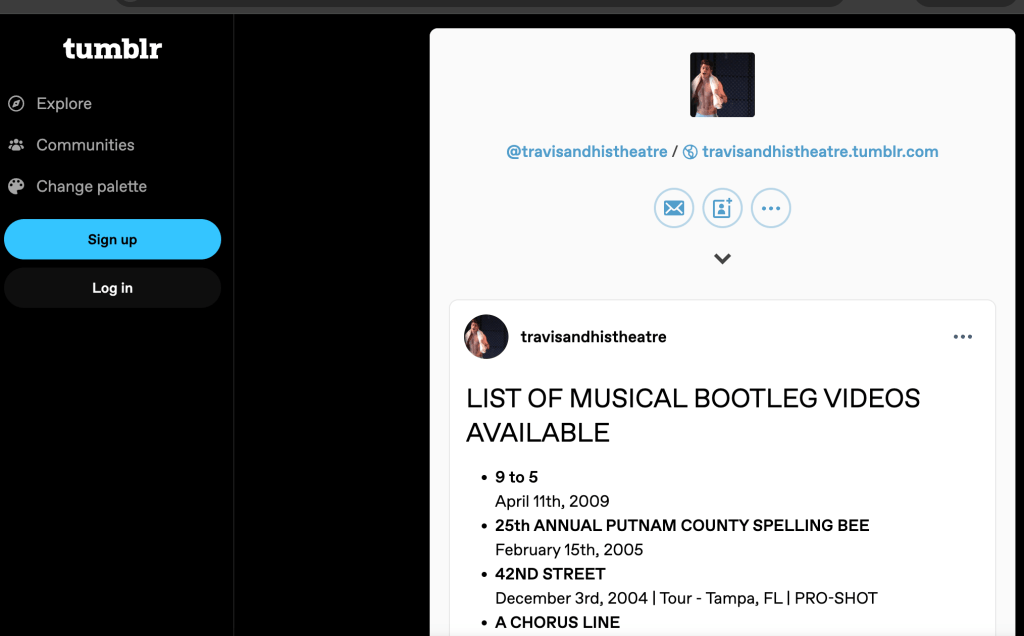
The concept of watching taped theatre for free is nothing new to me. I grew up on theatre YouTube in the 2010s when every illegal bootleg was called a ‘slime-tutorial’ to bypass copyright filters. I never had the money or means to travel and see the most popular new shows, so these bootlegs are a theatrical lifeline to me even to this day. And I know I am not alone. These videos can get thousands, even millions of views.
In their series “Great Performances,” PBS takes this tradition to the next level, and provides free streaming access to high-quality recordings, showcasing professional theatrical productions, concerts, ballets, and more. The most recent episode is none other than Shakespeare’s chaotic comedy of romance and trickery Twelfth Night, directed by Tony-Award nominee Saheem Ali. This is no regular production of The Bard’s most topsy-turvy play– this is a star-studded spectacle staged at the famous Delacorte Theatre, home of Shakespeare in the Park in New York City. This is professional theatre in its top form, and a once in a lifetime chance to see. A chance that PBS is now giving everyone.
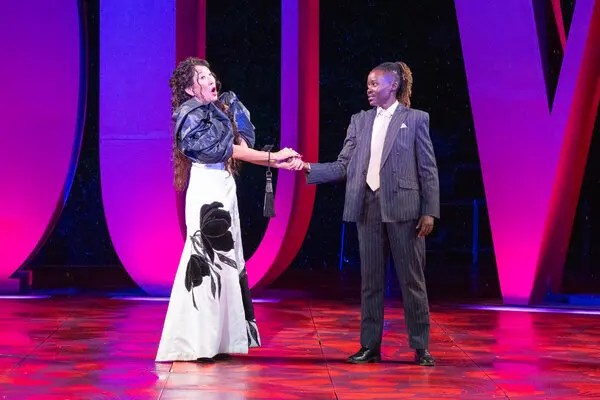
Following a shipwreck in a foreign land that separates her from her brother Sebastian (Junior Nyong’o, real-life brother to Lupita), Viola joins the court of Duke Orsino (Khris Davis) in disguise as a boy named Cesario. Orsino quickly grows close with Cesario and tasks him with wooing Lady Olivia on his behalf. Despite her own affections for Orsino, Viola as Cesario goes to Olivia to plead Orsino’s case. Unfortunately, Olivia ends up falling for Cesario instead, leading to an increasingly tangled relationship web, resolving only in the play’s final moments. With a side plot involving Olivia’s household wreaking havoc on Malvolio’s life for the crime of being annoying, this performance is a non-stop chronicle of lives being turned upside down and inside out.
Ali’s direction takes a centuries old script and makes it fresh for a modern audience, with fight scenes being staged as boxing matches, drunken revels of Sir Toby (John Ellison Conlee) and Andrew Augecheek (Jesse Tyler Ferguson) now including bongs and Duolingo, beat-boxed attempts at wooing, and the queer subtext between Sebastian and Antonio (a nonbinary actor that goes by “b”) is staged as blatantly as romantic.
The production also incorporates Swahili into the script, with many of Viola and Sebastian’s lines being in a mix of the original English text and the Swahili translation. It’s a beautiful choice that enhances the storytelling by giving the connection between Viola and Sebastian one beyond the connection of being twins: the connection of a shared culture in a strange new land. It’s truly stunning work, and I feel invigorated as a theatre-maker just watching it, wanting to get up on the stage with them and be a part of the magic they are creating, and I am only able to experience this because of a recording.
Not everyone has the means to enjoy professional theatre. Prices for Broadway are at an all-time high, and unless you’re lucky enough to live near New York, travel and hotel costs can add up quickly. Professional theatre outside of New York offers similar problems, and the further away you get from a big city, the harder it is to find professional theatre. Many theatres also do not offer adequate accessibility measures. Aisles are too narrow, seats are crammed too close together for comfort, and some buildings are just downright impossible to get inside.
Theatre etiquette also requires minimal disruption from the audience, which isn’t always possible for some patrons with disabilities. Relaxed shows with eased audience guidelines that allow for patrons to get up and leave their seats or make noise if they need to do happen, but they are not common and rarely advertised. With so many financial, physical, and geographic barriers in place, streaming remains one of the only viable options for many to see popular performances. However, most shows never get a professional recording, so illegal streaming is the only option left.
David Horn, executive director of “Great Performances,” is well aware of the issues in accessibility as well as audience demand. He recently told Playbill, “We do realize how important it is, when things are so expensive, shows are so expensive to see—that we can provide [viewers] the option to be able to see something they never get a chance to see in their community, or on any other channel…Especially for free, that’s important.”
But it’s not just audiences that benefit from having recordings of performances. In an era where American theatre feels more restricted than ever, with actions such as the Trump administration’s major cuts to the National Endowment for the Arts (NEA) affecting theatre companies nationwide, companies need to understand just how vital these recordings can be in maintaining not only accessibility, but maintaining the survival of theatres as a whole.
NEA cuts aren’t the only thing affecting theatres nationwide. The shut-down at the beginning of the COVID-19 pandemic caused many theatres to live-stream their performances, but with restrictions now lifted and theatres struggling to see audiences return.
Here in Pittsburgh, we can see how the shut-down has taken its toll, with the city’s three major theatres—Pittsburgh CLO, Pittsburgh City Theatre, and The Pittsburgh Public Theatre—considering a merger to combat rising costs, low attendance, and other issues born out of the shutdown. Since the shutdown, Pittsburgh Public Theatre (PPT) has made initiatives to start streaming their shows, with a subscription package Streamland (currently only available for educators) that distributes educational materials and recordings of their professional shows.
Post shut-down, PPT also released livestream tickets of Sarah Porkalob’s “Dragon Lady” in 2024, indicating a potential future for more live streamed shows in the future. While this stream was not free, it provided an additional avenue for people to watch the show, and an additional stream of revenue for the theatres themselves.
Despite the precarious situation of the city’s main theatres, recent reports show that the demand is still here in Pittsburgh, with numerous productions adding performances to their runs to meet up with audience demand. If adding performances is possible, then selling live-streamed tickets for more shows doesn’t seem like an impossible dream. A live stream ticket option for any of these sold-out shows would no-doubt bolster ticket sales for these theatres, while simultaneously increasing the reach these productions have and growing the audience for these theatres even more.
For right now, streaming theatre in Pittsburgh isn’t commonplace, but lockdown era strateges and PPT’s small but growing streaming track record show that it’s not a facet of Pittsburgh theatre to be forgotten just yet. I look forward to the day when I can buy a livestream ticket to a sold-out show in Pittsburgh, but until then I’m going to rewind Twelfth Night and pretend I’m in Central Park again.
Twelfth Night is available to stream through PBS until Dec. 31.
Olivia Wick is studying film and media, theatre arts, and writing at the University of Pittsburgh.

This month’s articles are produced with support from the Frick Pittsburgh in conjunction with their landmark exhibition The Scandinavian Home: Landscape and Lore. Get cozy as the seasons change with David and Susan Warner’s collection of paintings, tapestries, and sculptures from around the Nordic region. Tickets now on sale.
 PETRICHOR
Leave a comment