by Ellie Kannel
It feels impossible to escape consumerism. Influencers stuff social media trends down our throats, the bright and colorful advertisements of the internet rarely giving us room to think for ourselves. The Associated Artists of Pittsburgh’s recent exhibition “But Wait, There’s More!” creates a quiet and reverent space in our noisy, capitalist fueled life, where the abundant physical things we purchase turn into art displays. For this multimedia exhibit, on from Sept. 6 to Oct. 24, curator Heather Hershberger brought together six contemporary artists from the Pittsburgh area. It was host to oil and acrylic paintings, screenprints, a quilt, and two video displays which loop on small televisions.
Ice House Studios space felt like a well-lit warehouse (which I mean in all fondness). Exposed concrete floors showed signs of past exhibits and visitor footprints, an exterior wall to the right had partially exposed brick, and the ceilings showed electrical cords and ventilation vents. Several foot long gaps between the temporary walls and the ceiling left staff member Isaac Pleta’s voice floating as he talked to a coworker. The gallery is not messy, but it s a bare vessel for the art which can come and go in each exhibition.
This space lent itself well to the theme of “But Wait, There’s more!” The gallery’s reminiscence of a warehouse—a space I associated with the creation of goods— worked to further the comparison of goods vs production and of the presences of capitalistic structures. Hershberger wrote in the introductory wall text that “The exhibition is a reminder that the capitalist experience surrounds us, then and now, and offers space for perspective to shift,” further cementing that theme.
The two works which most caught my interest were “Backing Cards” by Paul Mullins, and “Incidentally” by Quaishawn Whitlock. Mullins’ work features 18 oil paintings on small canvases, which mimic the cardboard pieces that are used as packaging for small items like figurines. This representation of the produced good is juxtaposed by Whitlocks’ wall on the opposite side of the gallery, which is more reminiscent of the process of production itself. Against the exposed brick, Whitlock has the entire wall to display his screen prints, collage pieces, and other mixed media which are framed inside of screenprint screens themselves.

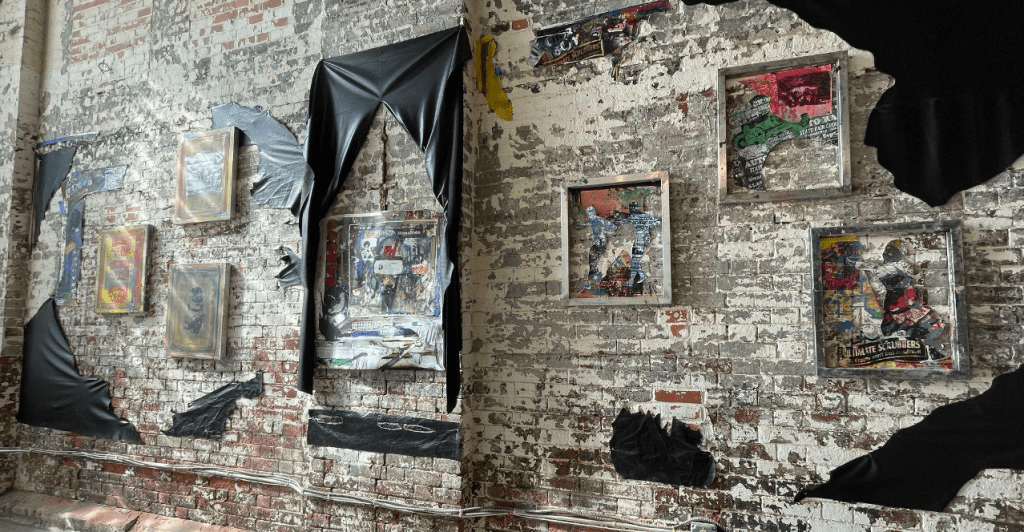
The comparison of these two works is what I imagine Hershberger means in relation to “perspectives shifting.” The merchandise we grow up with and continue to surround ourselves with throughout our lives undeniably brings us joy. The exhibit does not offer an answer as to if we should stop loving those things because it puts money into the pockets of the rich and powerful who sell those items. Nor does the exhibit necessarily shame us. The exhibit, instead, offers a space to simply contemplate.
Aside from the compelling colors and figures of the art, I find myself leaning in close to notice minute details. Blaine Siegel’s works are particularly interesting in these details, as his canvases are large pieces of worn-down cardboard, with nails punched through into the walls as the mode to hang them. This materiality makes me think of the countless Amazon packages that have been recycled in my own home, but also how unnatural it feels for a work of art in a contemporary gallery to be created on a (presumably) pre-used scrap of material. The art being on this material gives the cardboard more power than it usually would have, while also making the art seem less like a commodity (as art can often be in certain white-cube contemporary galleries).

As I leave, I am faced by one of these nail hung works, Siegel’s skeleton figures in “Burn Too Bright Double Silver.” For all visitors, this is the last work they would see. The skeletons seem to contemplate me, and in my last moment in the exhibit, I feel hyper aware of my own presence.
Although “But Wait, There’s More!” is no longer open, it inspires conversations we should all be having, even without the inspiration of art immediately around us. Hershberger and the artists urge us to be more aware of how we live in and surround ourselves with consumerism lifestyles– discourse which will likely not be leaving society quickly. What I most appreciated about the exhibit was how it felt almost conversational. Personally, it is hard to feel as though I am actively fighting consumerism cycles when capitalistic systems are so strong, and only getting stronger. This exhibit does not echo any of that harsh pessimism, but creates space for deep reflection through the representation of familiar icons and items, all with the enjoyment of being surrounded by contemporary art.
Ellie Kannel is the Art History Club president at University of Pittsburgh. Kannel is a junior and is double majoring in English literature and museum studies. Her favorite artist is Dale Chihuly.

This month’s articles are produced with support from the Frick Pittsburgh in conjunction with their landmark exhibition The Scandinavian Home: Landscape and Lore. Get cozy as the seasons change with David and Susan Warner’s collection of paintings, tapestries, and sculptures from around the Nordic region. Tickets now on sale.
 PETRICHOR
Leave a comment