by Dominique Seneca
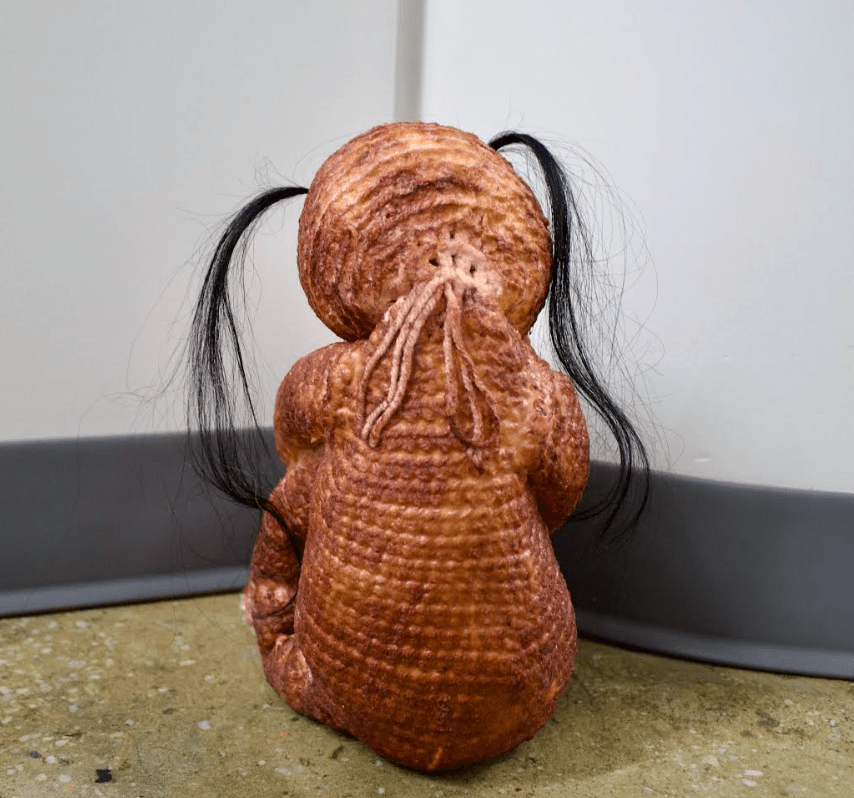
Cover image: Ophelia Arc, “Calicifed Self-Victimization,” yarn, dye, latex, tulle, thread and artists hair, 9” x 6” 11.5.” 2025.
I think we can all agree 2025 was a horrible year. I’m not trying to make a definitive statement, but, subjectively, I didn’t have a good year, and I don’t know anyone who did. Maybe, like, 50 Cent or Taylor Swift, but I don’t know them personally, so I can’t vouch for them.
2025 marked the beginning of Donald Trump’s second presidential term, a barely survivable economy, and the longest government shutdown in American history. The absolutely horrifying rise of A.I., and its impact on our mental stability, the job market, and environmental ramifications. All while the unthinkable violence continues in Ukraine and Gaza. For goodness sake, we lost David Lynch in 2025.
To narrow our attention solely to the art world: A day hasn’t gone by without me thinking of Koyo Kouoh’s unexpected passing ahead of the 2026 Venice Biennale, but I feel like, in the throes of old school museum heists and Trump’s relentless crackdown on America’s arts and culture, her death was left out of a larger discussion of what the future of curation might look like. Tariffs caused gallerists to recalculate or flat out close and we lost pioneering artists like Dara Birnbaum, Mel Bochner, and Raymond Saunders.
I’m often left wondering, with the death of these greats and complete shift in how we consume information: What even is the art world trying to say anymore? Do we still need a curator’s perspective? What can be done?
Trying to make it all make sense, I’ve been thinking back to a seemingly insignificant moment almost a decade earlier. The turning point happened during an Introduction to a Museum Studies class. My cohort and I were nervously making small talk, and in walks my professor with what would walk in with what would become my Trojan horse.
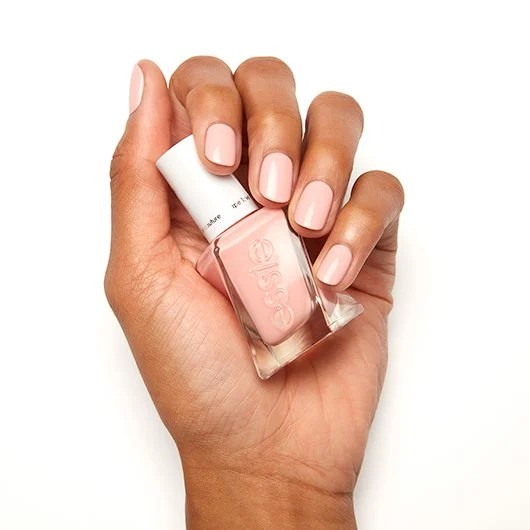
The distinct square-shaped bottle of an Essie nail polish is pulled out of their briefcase, a sheer pink hue aptly named “Couture Curator.” A classic icebreaker to alleviate the uneasiness in the classroom and incorporate how a career in the arts was becoming more viable. Of course, I don’t think my professor thought when they brought a $9.99 bottle of nail polish that one student would still be meditating on it 10 years later, but I can’t help wince when I sit down at a restaurant and the waiter tells me the chef “curated” a selection of dishes for the evening.
Or, when I meet someone new in the creative field, I’m more irritated than excited at the possibility of collaboration because I groan at the Instagram follow notification when I see a bio that says curator along with a cluster of buzzwords like “Thinker,” “Strategist,” or “Creator.” I can’t see another museum exhibition where the institution recontextualizes its collection in a never ending cycle of a snake eating itself.
Perhaps I’m just being too negative, but as I submit my 108th job application to round out the year, I can’t help but wonder what it means for my career that the hookah lounge down the street from my building is “curating vibes”?
There’s a worthy argument to be had when other writers analyze what exactly a curator does; many authors like to point out the word’s Latin origins, “cura,” meaning “to take care. However, I feel the domino effect of technology’s evolution, late-stage capitalism, and the rise of social media. The profession had long strayed from caretaker of treasures to the person who shapes the meaning of the artist’s vision before the 2020s.
Most people would argue that the growth of hyper-individualism in Western Society is the problem, and it is, partly. Hyper-individualism cannot be separated from the evolution of technology and the rise of social media. From the 1980s, with insane fitness fads and perfectly crafted leotards to match the image. The pure consumerism of the 1990s and early 2000s showed us who were the haves and have nots. Who had Beanie Babies, which kid had parents willing to wait in line for the Nintendo Wii, and so on.
By 2016, with Youtube, Instagram, and Twitter (No, I’m not calling it “X”), I had plenty of classmates who aspired to be content creators. On social media, Identities are built around products and a set of aesthetics. To try to summarize, late-stage capitalism and overconsumption are the perfect cocktail for hyperindividualism.
The art world did the same. Exhibitions slowly shifted away from linear narratives and fixed categories. It became fashionable to discuss if an exhibit used wall labels or not. It was trendy to know curators names and instagram accounts. Museum Studies degrees were on the rise. The freakin’ nail polish.
I think our recent fixation on 2016 is because we’re still desperately trying to cling to a period before social media became our dominant way of communication. Let’s not forget, 2016 is the start of Trump’s first presidential term. It wasn’t the “Obama Hope era” by any means.
I don’t think we’ve fully addressed the COVID-19 pandemic either, and the ones who do talk about it feel like a secret society of people who talk like crazy people on street corners. We witnessed how society handled a global threat to our existence and came to the conclusion: “If they don’t care about me, why should I care about anything else?” Curators were once defined as overseers of souls in a parish. Can you imagine that today?
I understand that curators are under enormous pressure from all the aforementioned things mentioned before, but in turn, exhibitions have no longer become about the artist(s) and the very word “curator” becomes a catch-all term used in an attempt to elevate a brevity of superficial nouns.
If we’re only looking at things from an individualistic point of view, trying to find a niche subject in art to stand apart from the thousands of others in the same position, it becomes a self-indulgent argument of “How can I make this about me? And to what extent will I go just to get my point across? And will it be at the expense of general logic or literacy?”
I don’t know how to fix these problems, but at the very least I’m trying.
If I meet an artist whose work I’m really interested in, I’ll send them a book on a topic related to their practice. I’ll go see an exhibition on a day that’s not the opening or the closing, and I wrote this. I’m certainly worried when the time comes for curators and historians to look back and see us as passive spectators, but I’m trying. Just please don’t send me your latest Substack essay.
Dominique Seneca is an independent curator. Her most recent project was Akudzwe Elsie Chiwa’s Divinity/Femininity at 937 Gallery at the Pittsburgh Cultural Trust. She was a Curatorial Fellow at the Guggenheim, a research assistant at the Westmoreland Museum of Art, and a curatorial intern at the Andy Warhol Museum.
 PETRICHOR
Leave a comment