by Connor Sites-Bowen
Photos courtesy of Rich Pell
“Licking the Wound” exists in a context – Celeste Neuuhaus is the 2026 Artist in Residence at the Center for Postnatural History, a project dedicated to documenting the human relationship to every other species on the planet. It is part of a calendar of performances over the coming year, called In Observance, tuned to the natural seasons. This intersection of ritual and art and natural science appeals deeply to me.
Rich Pell, who runs the Center, was a professor of mine, and I’ve been at the Center for many different performances and events. I am a deep student of Pittsburgh’s history, both human and non-human, and I am as dedicated to the ecological neighbors as I am to the cultural ones. Our sycamores are magnificent, we have a blessing of woodpeckers, and our spring flowers are sublime. Ms. Neuhaus’ performance cycle is in tune with those same forces, set to the calendar of warming soil and lengthening days.
Where’s that global warming? was a facetious, ignorant billboard I saw during this winter’s climate chaos. We’re swimming in it. Change is all around us. Our solid institutions melt into air. The present moment is a scalpel cutting people out of the future. What are the creatures we might become to handle these times? Which of your many selves will win out as the governor of your behaviors? This work asks you, the audience-participant, what kind of creature you aim to become.
Celeste Neuhaus is a witch. Her spells are allusive and alliterative. She’s tantric – she is in tune with the land, this local Pittsburgh place. She speaks to natural forces the way a wise woman speaks – on behalf of, inhabiting the role of, embodying the best of. She’s not imperious, she’s a firm container, cementing together the voices of her community. On an artistic cruise-performance last year, when she threw a metal collecting bin over the rail and took strange life forms from the muck of the Ohio River, she spoke directly to the river, appealed directly to the river to allow such interaction. They are known to each other. She brings these neighborly relations into her performances.
“Who Killed Cockrobin” was the folk song at the center of another Neuhaus work, Mother of Exile, where she was a Mother of Climate Orphans, a living statue of liberty. That English folk tune presents a pagan, bio-abundant funeral process, with ‘all the birds of the air’ sighing and sobbing by the end of it.
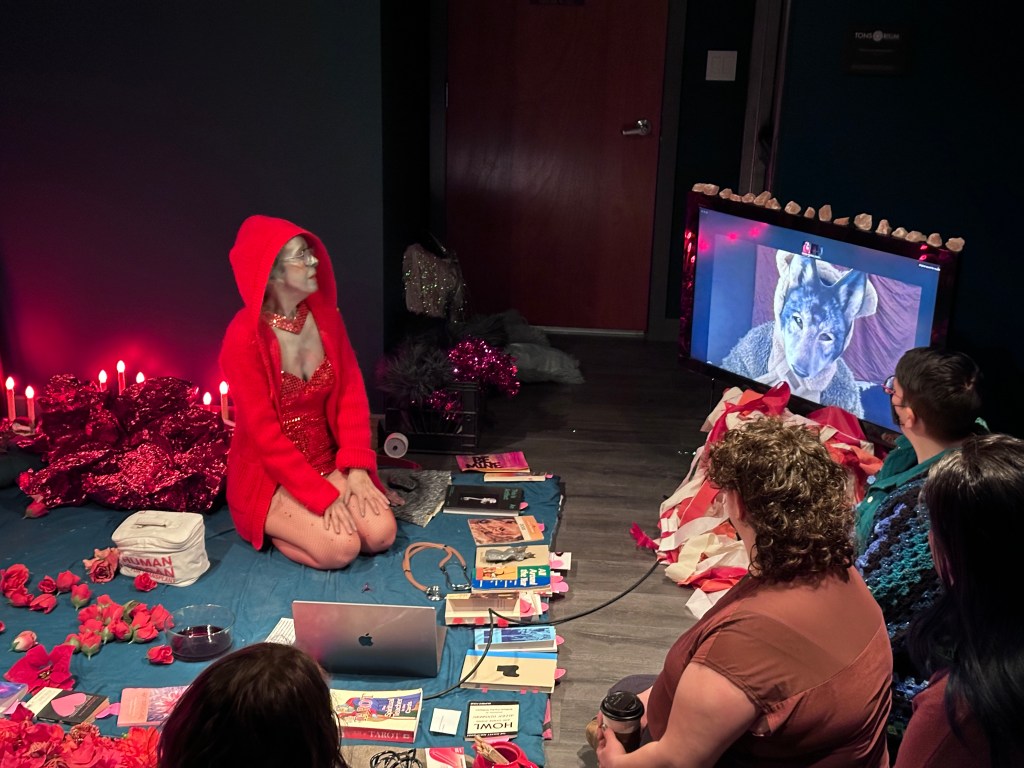
“A Beautiful Day in the Neighborhood” was how this Licking the Wound ritual opened, poignant because her collaborating artist from South America could not safely perform in person, but instead appeared virtually, in a loving television altar ringed by Himalayan salt crystals. A redeployed ICE force was recently spotted on Pittsburgh’s North Shore. Luci, Ms. Neuhaus’ collaborator, was by necessity, audience as well as participant.
To hear sung this song of harmony, tolerance, and affection, in Mr. Rogers’ own neighborhood, and being televised to safe, but distant loves, brought the deep pain of the current moment to the surface. These exigent circumstances added improvised poignancy and reality, bringing the audience closer to the emotional process of the work.
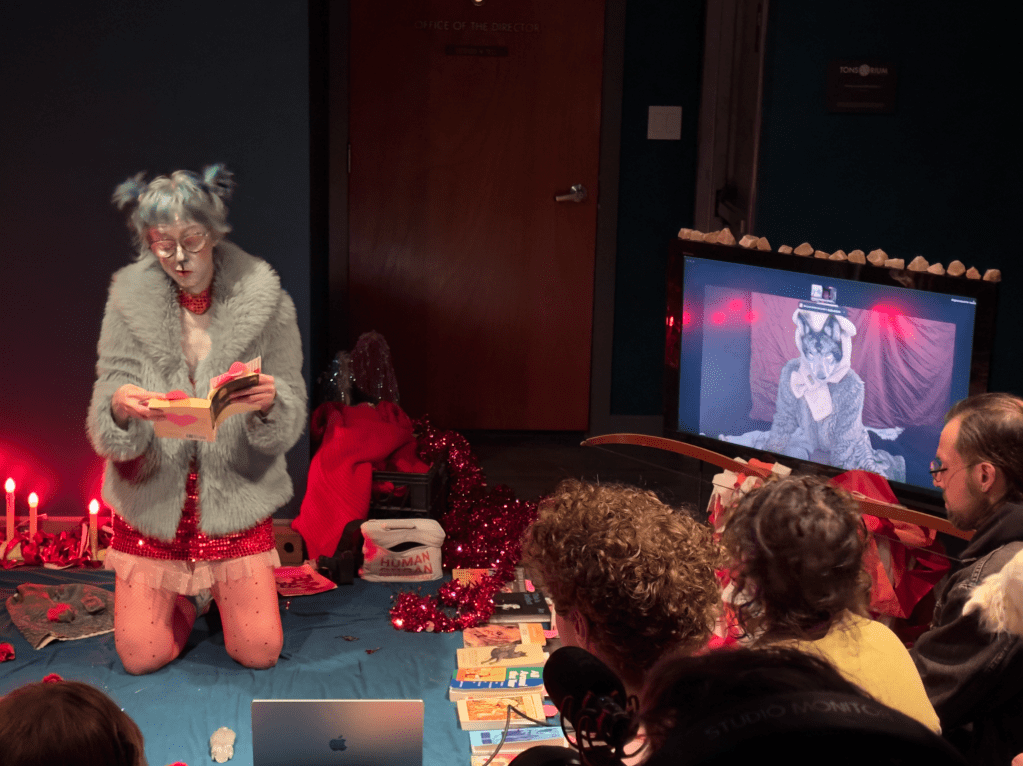
It was disarming, too, to see Ms. Neuhaus dressed in a red hooded cardigan,(a hybrid of Mr. Rogers and Little Red Riding Hood) silver body paint, and the button nose makeup of a wolf or cute small dog. Her hair, a mix of green dye and silver roots, had matching tints for each outfit in the performance, which moved from the red sequinned minidress and attached collar to a grey-green faux fur jacket, to very little at all, to a green faux fur vest, to a grey faux fur pelt.
Quotes and reading flew fast and thick from a stockade of literature, passages marked with enormous valentine hearts. Red tea (red wine?) was poured into a bowl and licked, as was heavy cream.
She quoted from the Center’s own This Is Not an Artifact (book), noting the leash as the oldest relating-tool that holds us humans fast to another species. It predates the yoke (oxen), the saddle (horses), all of those agricultural instruments.
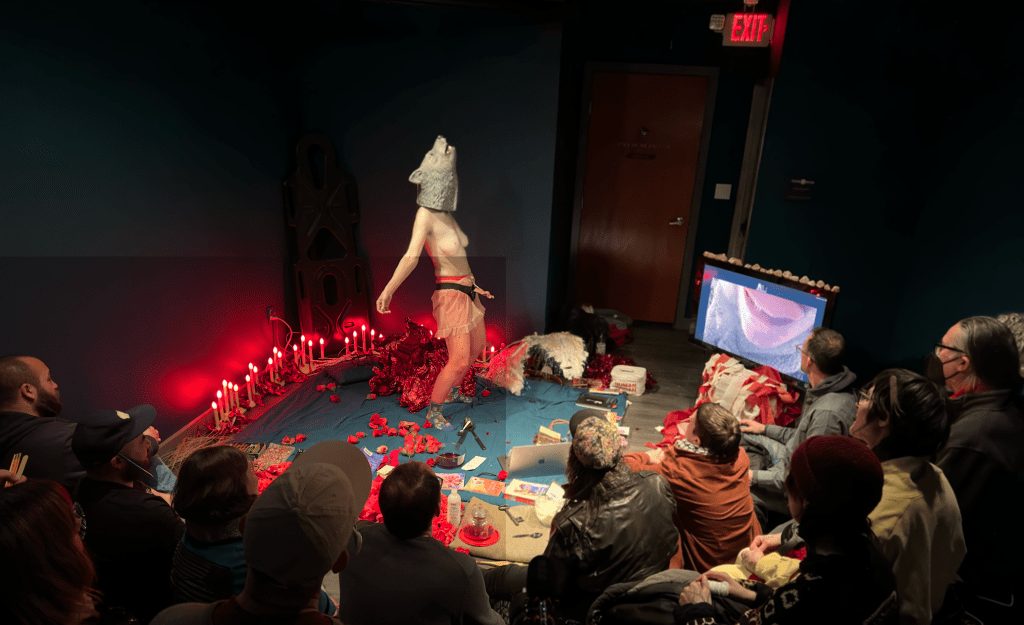
We participated, too. The audience passed around coals of knowledge, the bowl of creme, and we received very light lashings in the manner of Lupercalia.
In catabasis, the mythic ritual voyage underground which a soul must go through to develop, hope and knowledge are supplied by attending spirits, magical wolf-lizard-men whose coals of hope and understanding are returned and returned to the humans who need their inspiring warmth. We are not alone in our task of facing this terrible, real world. There are species beyond humans who care for human continuity, who keep our light for us when we don’t. Lupercalia is an ancient memory of that mutual aid, and so Valentine’s Day is too. Rome’s founders were raised in exile, by a mother from another species, a she-wolf. The lesson I take: we cannot access divine favor without our fellow planet-residing species.
These activities were foreplay of a kind, but they were also play, the way dogs and wolves play in a group setting. Gestures for the sake of gesture, of grand acting. Howling to get the howls out.
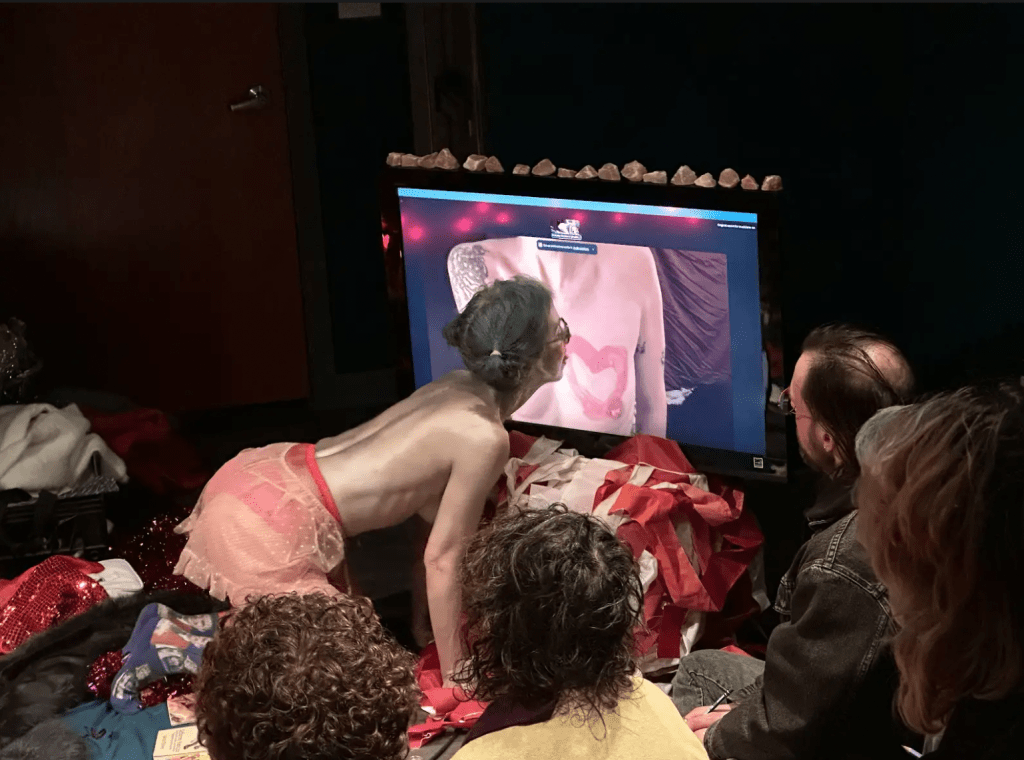
There was a section of the performance I thought of as ‘Sexy Tuunbaq’, where the artist donned a plastic wolf tongue strap on, doffed her top, and put on a vertically oriented rubber wolf mask, gyrating with an intensely long canine neck like an impossible arctic terror, licking the TV screen while her silver-screen back rippled in the theatre lighting of the ritual space. Intimate telepresence is awkward, adorable, a game of trying. “You’re teasing me” she says as she kisses glass with rippling light beneath it, Luci’s image flattened to the screen.
The other audience-members I spoke with after the show were all sensitive to the human-dog-wolf equivalency which was posited – they all had dogs at home, and studied their behavior. I watch my own little brown dog from Johnstown (Tucker Davis!), and saw in this performance by Ms Neuhaus the overlapping of mammalian patterns in behavior. We all wish to sniff a flank, to bring the tongue close to many kinds of cheek. We want to swim in each other. The canine genome might be a Swiss army knife, but we wield the corkscrews and nail files of dogdom like paint brushes, collaborating to create behavior that is not wolf-like, or human-like, but more gentle and pure than either. Polite behavior in public spaces. Aggressive dogs must leave. If only our political institutions maintained such civilized rules.
The Center for Post-Natural History has, in its decade, documented the human hijacking of the blindly captained ship of evolution. Licking the Wound takes the narratives documented in the center and brings them to an examination of the present: how are we relating to the now? What repair can be done post-haste? We left the space looking inward.
Ms. Neuhaus’ performance cycle suggests that the Center is not just an institution looking back at what humans have done to our fellow creatures. It is looking forward, too: this is Post-Natural culture in the offing.
Celeste’s next performance in the series In Observance is Hatching the Plot May 4.
—
Celeste Neuhaus (she/they) is a multimodal artist and witch who constellates art, ecology, and healing through the alchemical materiality of sculptural objects and installations, imaginal assemblages, performance videos, and guided interactive rituals.
To support healing the grievous effects of living within interwoven systems of oppression and biodiversity annihilation, she generates experiences that incite transformation through colorfully revealing the often subconscious interdependencies between the somatic – psychological – political – ecological – cosmological.
Living with chronic illnesses her entire adult life serves as a tenacious catalyst for Celeste’s intensive research into a spectrum of healing modalities and their corresponding cosmologies. The fruits of these inquiries, along with her devotion to several lineages of ancient magical practices continuously shape the forms of their work.
Her polysemic offerings have been encountered in museums, magic temples, vacant lots, tree farms, art galleries, riverboats, salt flats, rooftops, and fields of wildflowers.
The Center for Postnatural History is, since 2008, the world’s only museum dedicated to living things that have been intentionally and heritably altered by humans. While humans were once mere participants in the evolutionary process, we are now a primary force shaping it, from the indigenous origins of agriculture to genetic engineering. Such profound transformation necessitates public education, awareness, and dialogue, which PostNatural provides through exhibitions, workshops, collaborations, and multimedia content.
Luciana Arias (b. 1988, Buenos Aires) is an Argentinian-Mapuche-Italian Butoh performer, somatic researcher, improvisation conductor and composer working in intersections of dance, sound, visual arts, staging and costume. First learning Bellydance and Tango as a child, they later attended the National University of the Arts in Buenos Aires, studying in Choreographic Composition with a major in “Expresión Corporal Dance”.
Connor Sites-Bowen is an author and illustrator in Pittsburgh, Pennsylvania. A Field Guide to Newtopia, his current project, is an illustrated gazetteer of 36 utopian biomes. You can find his newsletter at https://www.connorsb.com/dispatches
Links:
 PETRICHOR
Leave a comment