by Emma Riva
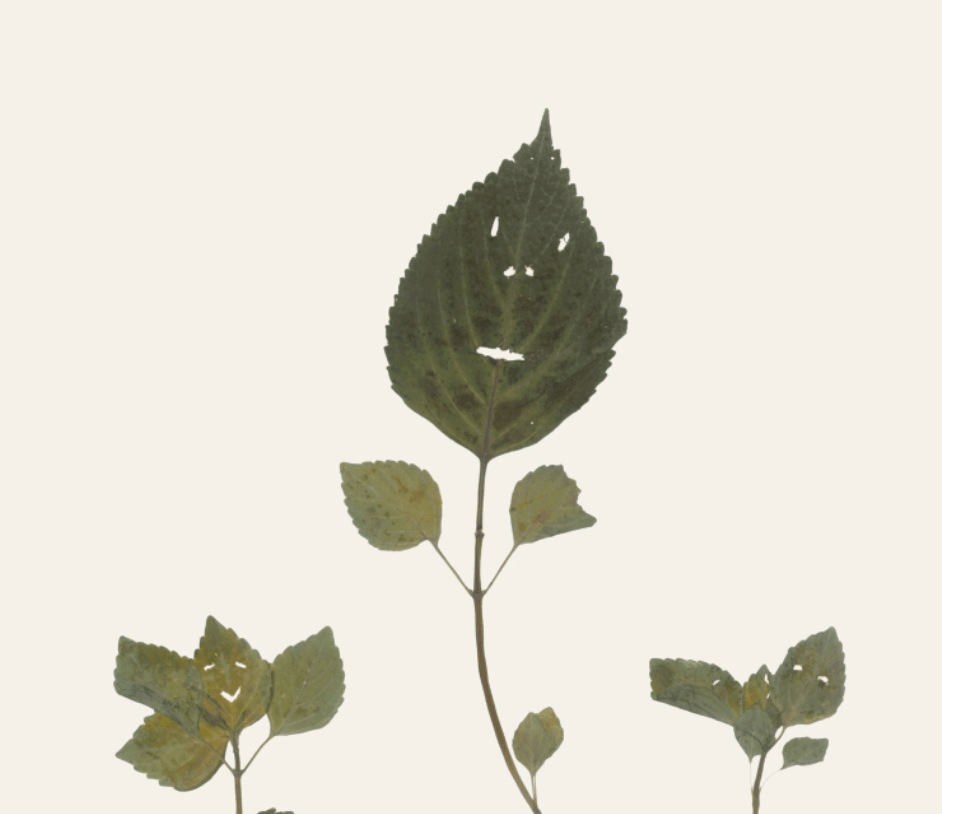
Cover image: Cropped still of Ginger Brooks Takahashi, Exsiccata Diaspora: Perilla, folio #8, perilla leaf chine colle with wheatpaste powder, 2025; Courtesy of the artist; Photo: Zachary Riggleman.
The Carnegie Museum boasts the title of the first American museum dedicated to the art of its time. Andrew Carnegie took inspiration from the Venice Biennale when coming up with the Carnegie International, the worldwide survey of contemporary art opening this May in its 2026 iteration. Imagining someone of Carnegie’s wealth and power investing in the arts feels almost quaint in 2026. Robber barons of his era had their money in tangible goods like steel and real estate—today, robber barons’ billions bounce around the ether as ephemeral 1’s and 0’s making more money on themselves.
“Every International opens onto a changed world,” Carnegie Museum of Art Henry J. Heinz II Director Eric J. Crosby said at a press event earlier this month. The 2026 Carnegie International, titled If the Word We arrives in a different art world from its 2022 predecessor. The previous Carnegie International, Is it morning for you yet? was posed as a question. This one is a fragment of a statement, perhaps allowing viewers to fill in the blank.
The International is Pittsburgh’s art event of the season. It’s the art world’s 2026 NFL Draft. Richard Armstrong Curator of Contemporary Art Liz Park, Curator if International Art Ryan Inouye, and guest curator Danielle Jackson have built out a robust, multi-site program that will undoubtedly be well-attended. If the Word We has a focus on care, memory, and collaboration—a necessity in a world that feels unable to extricate itself from cycles of violence and division.
My concern as a critic, lover of museums, and former museum employee, is that museums are not only for people in the art world. Yes, the International draws in bigwigs and academics. But it stays up for people in Pittsburgh to look at every day. Children make up huge percentages of museum audiences. Some museumgoers are encountering works of art in person for the very first time. Museums are not commercial galleries. While they are not exactly public spheres and do have entry fees (a whole other discussion), they are not private, either.
If the Word We seems to know this, given that it’s spread its programming across multiple sites including the Children’s Museum, the Kamin Science Center, and the Thelma Lovett YWCA in the Hill District. The curatorial team mentioned that they saw the International as an effort between “thought partners”—the title comes from a converstion with artist Haytham el-Wadany. “[If the Word We] is less of a theme than an invitation,” Inouye said to press.
Guest curator Danielle A. Jackson brought an interest in performance and human-centric work that I feel will serve the International well. I’m particularly excited to see the performance that Brooke O’Harra will put on at the Thelma Lovette YWCA. Jackson stated that she likes to feel “the rhythms of a city” where she is working, and her presence brings a fresh vision to the International.
“We’re moving away from ‘people need museums’ and towards ‘museums need people,’” Programs Director of Education and Public Programming Dana Bishop-Root said. “Our publics bring their research and their lived experience into the space.” This was one of the most thought-provoking statements made at the International’s press talk, because it gets at central questions about what a museum’s role is in a world where information is so saturated. The reality is that museumgoers, even ones without any art background, probably have seen a painting before, where in the past information wasn’t as readily available. The museum has to adapt how it contextually presents information to match how people consume it.
But while it is true that museums need people, museums also have a responsibility towards people, because people do need museums and arts education in order to live full, rich lives. If arts organizations do not frame themselves as necessary and stand up for the merit and importance of what they do, the world around them will deem them unnecessary. The Carnegie has nurtured the talents of the likes of Keith Haring, Andy Warhol, and Raymond Saunders. In a mid-size city like Pittsburgh where it is the only place to see a Francis Bacon or a Louise Bourgeois, it has a particular responsibility to its guests. Museums are places of aesthetic and moral consistency in confusing times.
I appreciate that this International is shooting high with programming all throughout its run collaborating with the Pittsburgh Art Book Fair and the Carnegie Museum Film Series. My hope for it is that it brings in more museumgoers that do not already know about the International and its programming.
It’s easy in the art press or in arts administration or curation to feel a sort of fatigue around words like “creative placemaking” or “living archives,” but imagine looking at the International with the fresh eyes of someone just learning what art can do. Imagine the excitement of seeing that performance or sculpture can be as hallowed as two-dimensional painting, or really acutely feeling the suffering of someone far away through a work of art, rather than numbingly scrolling past it on an algorithm. That is, ultimately, what projects like the International can provide. That’s worth investing in.
—
The 59th Carnegie International will feature 61 artists from around the world, the full list of which is available here. It is organized by Ryan Inouye, Danielle A. Jackson, and Liz Park, the Kathe and Jim Patrinos curators of the 59th Carnegie International, the upcoming edition will engage contributors and partners across Pittsburgh and around the world, transforming the museum’s programs, partnerships, and spaces in imaginative ways. Works will be featured at the museum and four partner institutions—including the Children’s Museum of Pittsburgh, Kamin Science Center, and Mattress Factory, as well as at the Thelma Lovette YMCA in Pittsburgh’s Historic Hill District. The exhibition runs from May 2, 2026–Jan. 3, 2027
Emma Riva is the founder of Petrichor Magazine.
 PETRICHOR
Leave a comment