by Melinda Laszczynski
This article was originally published by Glasstire, the nonprofit online publication for art in Texas, on March 31, 2026. You can read and subscribe to Glasstire at glasstire.com.
“Why Pittsburgh?”
This is what another artist said to me in a bar when I was telling him about my upcoming winter break plans, attending a residency at Pedantic Arts. As someone who was born in Pittsburgh, my automatic reaction was to defend my birth city. I grew up in Cleveland, Ohio, and am used to all of the Pittsburgh jokes. I’m also used to defending Houston, and Texas in general, especially when I am up north. Most people are somewhat familiar with Dallas, but when I explain what a strong art community Houston has, and how many galleries and museums and opportunities exist, I’m usually met with surprise.
Admittedly, when I moved here for graduate school in 2012, I had no idea what Houston was really like and was working under the assumption that I’d move back home after the program ended. Instead, I found confidence in my work and an incredible community of friends and peers and have been here for twelve years. Similarly, many folks I spoke to in Pittsburgh ended up there by chance — usually moving for a (now ex) relationship — loved the city and stuck around. During my time immersed in Pittsburgh, I noticed striking similarities between my current adopted home and my childhood one. Both deserve more credit and notice, not only for the work coming out of these places but also for their viability as a place to build a life as an artist. Below are some comparisons between two places I call home.
Pollution

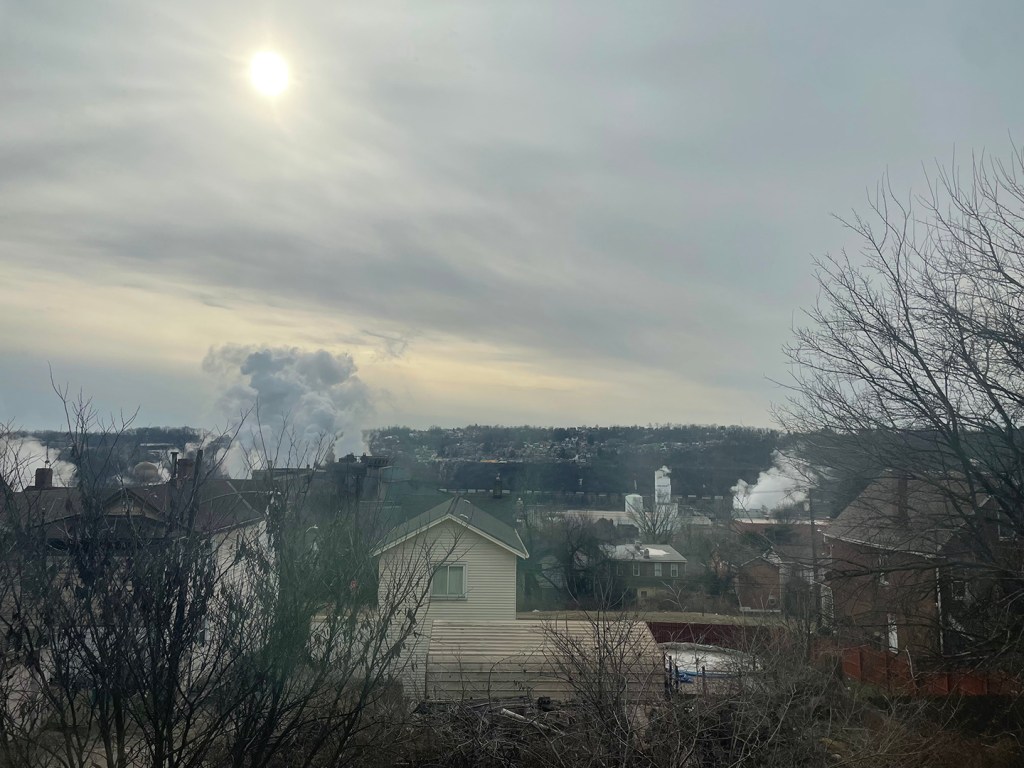
Industry permeates both Houston and Pittsburgh, providing a backdrop of ominous skies and a particular smell. My husband grew up in Baytown, a cancer cluster in the city, and I’ve driven past the refineries many times. When we lived in the East End, we didn’t plant things directly in the ground because of contamination. Oil is a strange bedfellow of the arts in Houston, as it funds so many of our opportunities. Steel haunts Pittsburgh in a similar way.

One of my favorite site visits in the city was to General Sisters, a collective based in North Braddock founded by Dana Bishop-Root and Ginger Brooks Takahashi. As we sat at a table drinking mugwort and nettle tea from the garden, a cloud from a nearby steel factory was visible through the window, breaking through the clear winter sky. Our conversation centered around healing and resistance, and the magical use of plant properties to repair the soil. Nettle draws contaminants up through its roots and “grows where people need it,” a beautiful way to think about how we can respond to communities and the environment. We ended our visit by reading the poem “The Morning After” by Etel Adnan, a reminder that we are far more than ourselves, even though capitalism resists our connection to and need for the earth and one another.
(Side note: Brooks Takahashi is also a participating artist in the 59th annual Carnegie International another reason to visit Pittsburgh soon.)
Iconic Rappers
I was joking with another artist recently about how maybe the pollution is why we have so many artists, which of course extends to music. It’s hard to think about Houston and Pittsburgh without thinking about DJ Screw and Mac Miller. The influence of each on the culture of their respective cities is profound. Each started making music at a young age (DJ Screw at 12, and Miller at 15). Although they both died tragically young, (DJ Screw at 29 and Miller at 26), each left behind an amount of albums — some released posthumously — and unfinished work that rivals what one could hope to make in a much longer lifetime. DJ Screw continues to influence contemporary artists. Houston artists El Franco Lee II and Carlos Mendoza have painted DJ Screw, and the Contemporary Arts Museum Houston hosted an exhibition centered around him titled Slowed and Throwed: Records of the City Through Mutated Lenses in 2021.

Mac Miller’s legacy extends beyond music to the sober community and those struggling with mental health and addiction. Tribute murals and landmarks are scattered throughout Pittsburgh. As a huge Mac Miller fan, I had to visit the iconic Blue Slide Park, even though it was snowing and my blood has thinned out considerably since moving south. I also had an amazing reuben sandwich at Frick Park Market, where Miller hung out and worked as a teenager. The owner of the market was happy to show us around the building, which includes a map with pins marked from where fans visited from all over the world, which got so full that there are now two maps.
City Layout

When I moved to Houston, I was terrified of driving on the highways and would only take side streets for at least a year. Similarly, I find myself gripping the steering wheel through Pittsburgh, traversing through tunnels, over bridges, and insanely steep roads. The infrastructure of Pittsburgh was designed before cars, leading to a lot of confusion and frustration trying to navigate around. Both Houston and Pittsburgh have a complex, meandering layout as communities are sort of patched together like a quilt, each with a unique feel. Lawrenceville is to Montrose as Squirrel Hill is to The Heights.

Water plays a big role in the division of each city. Houston has its bayous, Pittsburgh has three rivers. Seeing the contrast of city and nature, a visual jumble of mountains, industrial buildings, the water, and deer never gets old. It’s a feeling I get sometimes driving around the Allen Parkway, remembering that there is accessible green space, with the hustle of downtown in the background. One odd thing about Houston is the lack of zoning laws; restaurants, houses, businesses and industrial sites can all exist on one street. Galleries and art spaces are spread out across both Houston and Pittsburgh, making an evening of openings an adventure through neighborhoods and terrain.

While Houston loves to tear things down, Pittsburgh is great about preserving architecture and reclaiming spaces, particularly for art. I made ceramics at open studio sessions at Union Project, a former church complete with stained glass and a sanctuary space. Brew House Arts, a former distillery in the Southside, now hosts artist studios, a residency program, and a gallery. The reclaiming of spaces that were once community hubs is also a bit disruptive in a way that unrestrictive zoning laws can be. There is something about this chaotic, rambling layout, and the grittiness of it all, that is attractive as an artist. In both Houston and Pittsburgh, I am constantly passing empty storefronts and thinking, “That would be an amazing gallery space!”
Experimental Spaces & Artists
The experimental energy of Pittsburgh feels like Houston in The Joanna era: lots of artist-run spaces and artists taking risks. Romance Gallery, located in a former cardiologist office, was exhibiting a collaborative exhibition of paintings and sculptures by Sasha Miasnikova and Zora Moniz installed throughout the rooms and front desk area. April april, a space in Wilkinsburg with the sweetest storefront (and gallery dog), was showing brushy, soft paintings by Owen Westberg that hovered between abstraction and dreamy representation.

The most wildly poetic thing I saw was a performance by Emerson Voss, a composer/artist-in-residence at Bunker Projects, down the street from Pedantic. By appointment, in an unassuming black tent, the materials of the piece were milk, a subwoofer, confetti, sound, noise-cancelling headphones, and blue dye. Immersed in the headphones, I watched the milk dance along to the vibrations of the music, composed of layered sounds and the repeated phrase, “What is the difference between light and love?” As the sounds and milk/dye/confetti became more dense, I was transported both to my past and to a space outside of myself.
Another notable performance was by Kimberlyn Bloise at Blankspace, a single-family home turned project space and print shop run by Joey Behrens. Bloise’s ceramic musical instruments were played by family and friends, and the audience was encouraged to play the instruments after the performance. It was an intimate and almost spiritual experience, particularly within a house undergoing renovation with peeling walls and worn floors, its history laid bare.

I was reminded of a recent exhibition of works by New York-based artist Sivan Lavie in Houston at Stinson House, a home gallery in the city’s Third Ward run by Nick Stinson. For the opening of Lavie’s Ice Cream on the Tip of My Tongue, ice cream was served and visitors were asked to write memories about ice cream. Austin-based artist Jana Whatley combined the writings into a poem in front of the audience, while dye and dairy drippings were poured into a bowl onto an overhead projector, swirling into a live visual of our jumbled musings on ice cream. There is something so nice about one-night-only events like these, especially in our current times — a collective experience meant to be just that, experimental and in the moment with one another.
People & Community
When I was applying to graduate programs, one of my professors recommended Houston and told me it was important that the place I ended up in had a strong art scene. This (and cost) is how I selected the University of Houston over the Maryland Institute College of Art (MICA). He was right, and I immediately found Houston to be full of opportunities, interesting artists, and arts organizations. Houston is large enough that there are communities within the art community and almost any artist here can find their people. Gallerists and artists alike are friendly and circles aren’t closed.

Pittsburgh has a similar hospitality. Maybe it was because we were artists-in-residence, but everywhere we went, my cohort was welcomed with open arms. Everyone was so nice! Artists invited me to their studios and gave me gifts. Most importantly, they held real conversations about their work and experiences. Networking can feel schmoozy and icky, and I am way more interested in exchanging ideas and talking about materials than the dog-and-pony-show conversations that often happen in the art world. The older I get, the more important genuine connection becomes.
In Houston I have found artist friends that would both (and have) driven me to the hospital in an emergency and visit the studio to talk about paintings while working on a show. We share critique and we share meals. These relationships are critical to sustaining oneself. Artists, especially painters, romanticize isolation. But we need the energy of others, access to art spaces, and dialogue to produce good work that pushes forward. Houston and Pittsburgh are both still relatively affordable and have enough space to make this happen.
Thank you to everyone at Casey Droege Productions for the opportunity to immerse myself in the art world of my first home. A special thank you to my cohort and friends, huiyin zhou and Erica Quinn, for being such a wonderful mini community for those weeks of dinner parties, neverending soup, treks through the snow, and deep conversations about dreams.
Melinda Laszczynski is an interdisciplinary artist working from a painting and collage background. She often uses found materials and objects, like lenticular prints, and is partial to the shiny, bright, and absurd. Her studio practice is playful, tactile, and reflective of contemporary experiences. She currently lives and works in Houston, Texas and was raised in Cleveland, Ohio.
Instagram: @mlaszczynski
This month’s articles are generously supported by Lewis Hine Pictures America at the Frick. Discover photography’s radical capacity through May 17. Tickets now on sale.

 PETRICHOR
Leave a comment