by A.J. Vitiello
Editor’s Note: You may notice that this is not about Pittsburgh, but about a post-Soviet city on the other side of the world. However, there’s a connection between the post-industrial and the post-Soviet that has always interested me. Both exist as parts of a conversation about things that used to be there, about past glory and the gore behind it. A.J. Vitiello happens to be living in Georgia, a post-Soviet country in the Caucasus mountains, and I asked him if he’d be interested in writing about some art there for Petrichor. Part of the goal with Petrichor is to broaden the conversation about art in the city—and I’ve certainly learned a lot from A.J.’s piece and his travels. I hope you do, too.
– ER
“Kunsthalle Tbilisi is delighted to present Patterns of (In)Security, a collaborative exhibition featuring the works of Sabine Hornig and Tamuna Chabashvili. Hosted in partnership with Gallery Artbeat, the exhibition delves into evolving social and political perspectives within the constructed environment, with an emphasis on the window as a mediator between the public and the private, the visible and the concealed.”
The description continues with its pseudo-intellectual word vomit that no one has time for. I’m here in Tbilisi not on assignment, but traveling and working remotely, two years after a Trans-Siberian railroad trek that coincided (in most untimely fashion) with Russia’s invasion of Ukraine. My college friend asked me to visit Gallery Artbeat and write down my reflections, but I’m not well-versed in the art world, or art writing, for that matter.
A short walk from my Airbnb, I come to a building that was once regal¾probably a consulate for some nation nobody’s heard of in the 20s¾but is now chipping, shedding its skin and decomposing, with white clumps of plaster littering the hard floor. It is open and abandoned. I passed this entrance two days ago on my way to a digital-nomad restaurant called “Breakfast Is.” I distinctly remember noting it; in fact, I took a picture of the entrance because at that time it looked so random and enigmatic to me. Never would I have guessed this to be the home of a brand new, bourgeois art gallery.
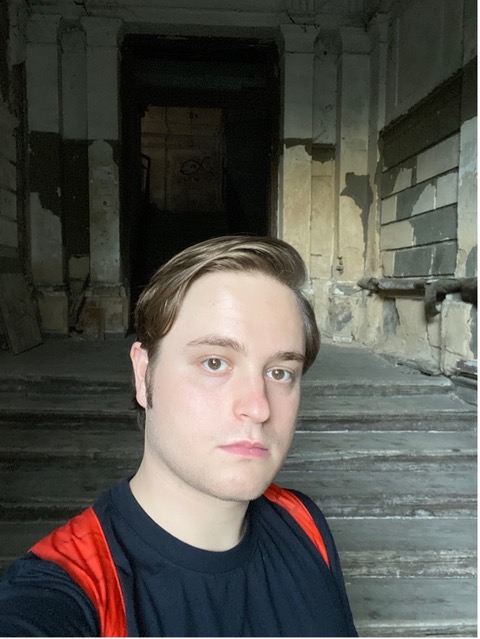
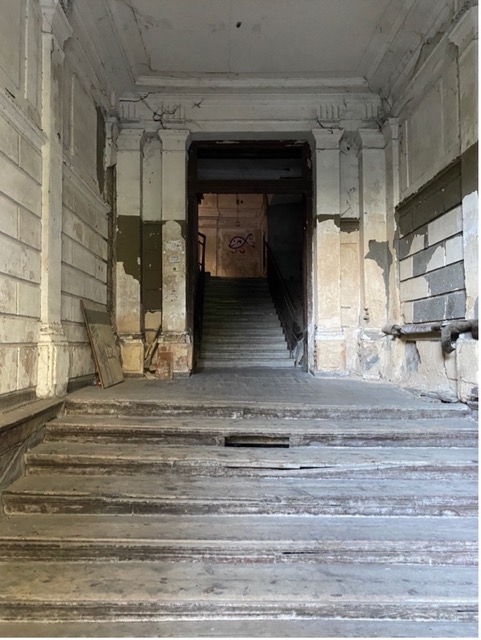
I am excited to know about something that other tourists don’t, and I think my friend must’ve sent me here for a reason. Ascending the wooden staircase, as dust particles, illuminated by a crack in the ceiling, swirl without ever falling, I have no idea where the exhibition is.
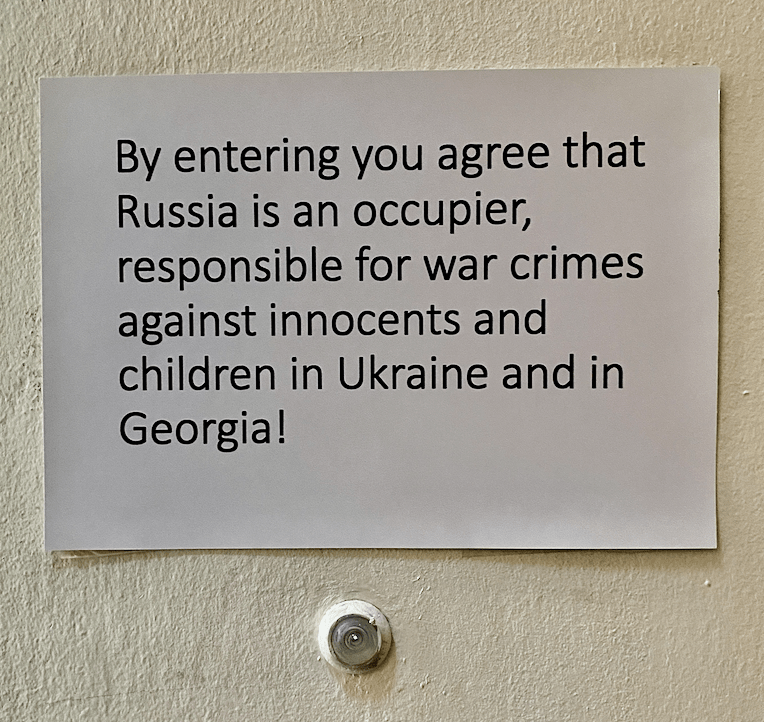
A lamented piece of paper on the leftside door displays a message. “By entering you agree that Russia is an occupier, responsible for war crimes against innocents and children in Ukraine and in Georgia!” Obviously, this it. I enter.
There are no art-goers in this place. I hear a woman’s voice, talking in Georgian. She must hear me in the lobby, because another door to a small closet opens and I am greeted by a young, hip attendant with lip piercings.
“Hello,” she says in English.
“I’m here for the opening,” I say, forgetting what it’s called. “Inverted Window.”
“Would you like some information?” She hands me a print-out and recedes to the closet, rejoining her conversation on the phone.
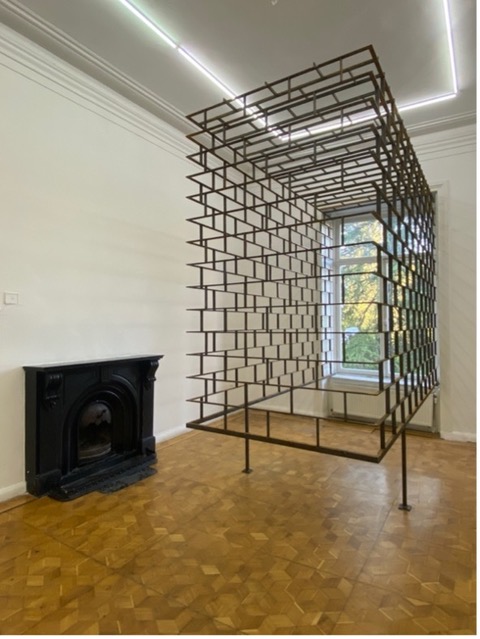
I enter the first room and the first word that comes to mind is penetrative. The metal, rectangular block thrusts inward from the window, bringing with it all the city’s dirt and ideologies. It feels like an intrusion, as I imagine myself living here, trying to enjoy the high ceilings and black fireplace. I am hyperaware of my individuality¾the physical space which I occupy¾thanks to the boisterous creaking of the wooden floor at the slightest tiptoe.
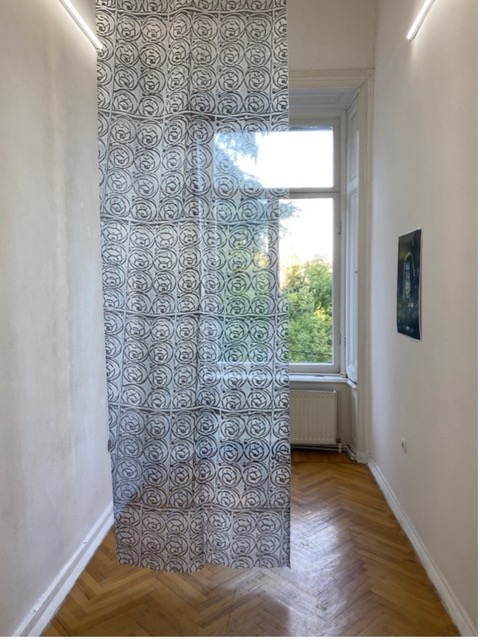
I enter the second room and see a greyish blue patterned curtain, positioned in the center of this smaller, narrow corridor. It hangs several feet in front of the window, and closer to the left wall so that the window itself is split, as if someone only wanted to allow half the light in. I walk forward and now I’m in the limbo area, the space between the curtain and the window. I’m both out there, and in here. I’m both myself and the city.
I think about whoever built this window, what they would think if they found out that, in 2023, their design would be used as part of an art installation by a woman who received her fine arts degree from the Netherlands. I find that the occupier in this instance is not Russia, but is the artist herself, occupying this house of old. She’s playing with fabric, resorting to the same tactics as the terrorist nation to claim a space that is not hers, as hers, and impose her own ideology there.
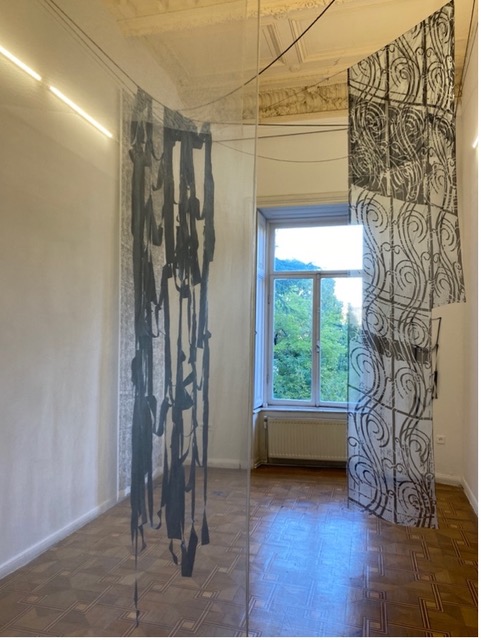
The third room is the most confusing. There are several curtains hanging all over the room, in different positions. Some of them are see-through. Some of them are blue and in tatters. Ukrainian textiles. They are tied together by a string in a spiderweb across the ceiling. I notice the rope is ultimately tied to the window, or the grille, the final barrier between myself and out there.
My inclination is that she is trying to point at different layers of inner space as the self moves outward, towards Pavle Ingorokva Street. The only one I can’t figure out is the mysterious, unassuming black curtain against the wall. Could it be that even in the private realm, in the most personal corners of our minds, we put up walls against our walls?
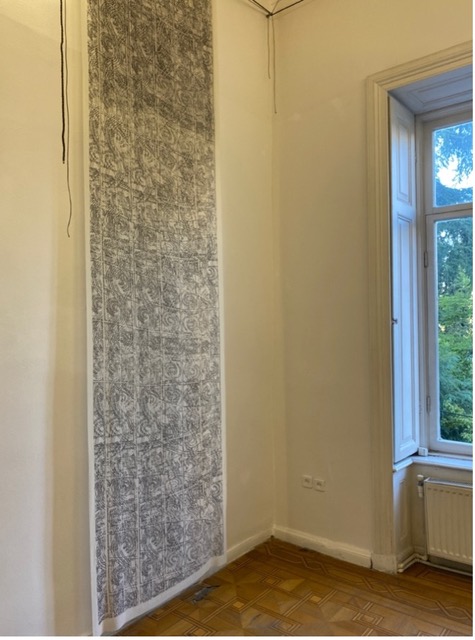
The cool thing about this installation is that I can touch the art. Well, I’m sure I’m not supposed to, but nobody’s watching. In New York or Amsterdam, you’d get arrested. But I’m not stupid like the tourists you see online who like to climb and break things or throw tomato soup at portraits. Instead, I gingerly brush my fingers against the fabric, which is much softer than I expected. I am so conscious of my seclusion, because inside the gallery, there is no one here. There are no cameras that I can locate; the cameras here and in Russia being more intimidating and rectangular than the round, cutesy cameras you see in the states. All I can hear is the sound of my breathing, engines sputtering outside, and the rapid Georgian being spoken by the attendant on the phone with her dad or boyfriend in the lobby.
I’m feeling restless and exit through the massive doorway of the third room and scan the bookshelf outside the lobby, where the attendant is chattering behind a half-cracked door of her own. There’s one black zine about architecture and punk attitudes in Tbilisi that I’m interested in buying, because for me, books make the best souvenirs, despite being the most inconvenient thing to travel with as a solo backpacker.
I knock. The attendant comes out, still on FaceTime, and says she has to check the price. I wait for two minutes and she returns to tell me that this zine is not for sale. Then, I ask what else is in this building, intrigued by the dingy, dilapidated staircase which I summitted to enter. She tells me there are apartments, but if I go straight there is a nice sitting area.
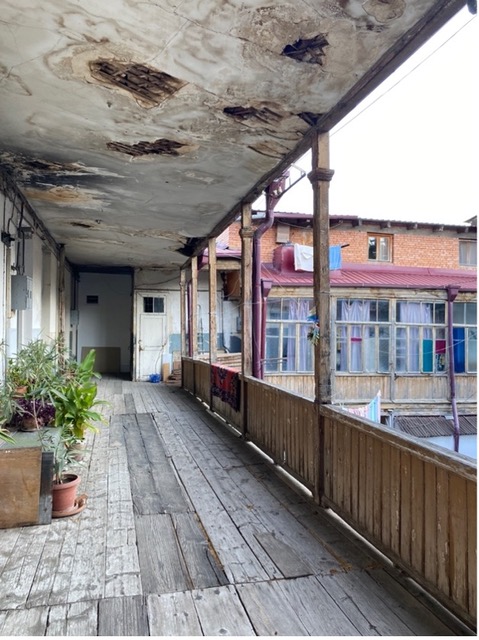
I disobey as soon as she retreats to her private desk and climb the stairs. The balcony is picturesque. It is a work of art to itself, petrified in the present. There is nobody. The ceiling is rotted by mold and threatens to collapse. Clothes hang out to dry on the line and the gutter is painted purple. A dachshund chases its tail in the courtyard, playing among the potted plants, which I assume ghosts must water when no one’s looking. The balcony exists directly under the hillside funicular and TV Tower, the phallic landmark that is to Georgia as the Eiffel Tower is to France.
Taking leave, and starting to creak once more down the stairs, I hear the attendant. She’s sitting on the landing now, on FaceTime. This is definitely a boyfriend. I smell cigarette smoke. I consider turning back, because I don’t want to get in trouble, but what would I do up here? I simply pass her and she doesn’t register me and I catch a glimpse of the bearded man on her screen. I am totally fine. I recall what this Moscow punk on Grindr said to me, when I messaged him that I was nervous to be rejected from Bassiani, the techno nightclub in a basement swimming pool with a notoriously hard door. “You overestimate Georgians,” he said.
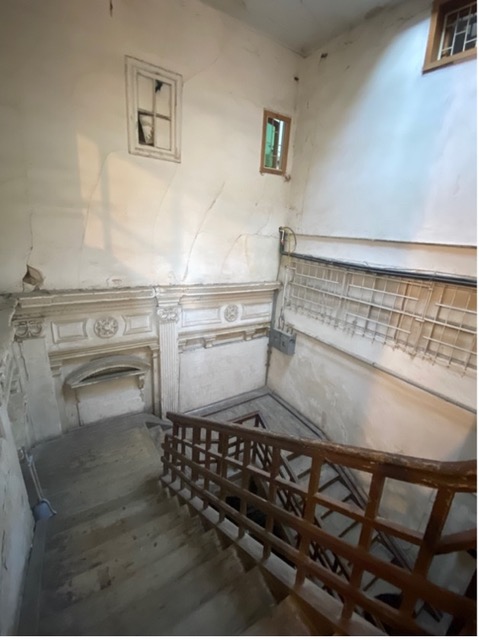
I arrive on the ground floor and sit on a dirty, concrete bench because I don’t want to go home yet. I want to stay inside with my thoughts before plunging into the lawless, government street where anything could happen. Upstairs, the attendant is still arguing on FaceTime with her boyfriend, whose manly voice I can hear from her iPhone on full volume.
The screen, I realize, is like a window, penetrating the private space with what’s public, intruding on and occupying not only her aloneness, but mine. Normally, I’d wish they’d both shut up, but the noise takes me out of my mind, which often threatens to stop me from existing NOW and truly experiencing life’s greatest moments. “Your mind is not yourself,” I’d read in graffiti in one of many underground passageways in Tbilisi. But who am I? I am not this city. I must remember I am a guest.
The Russians, too, are guests here, but they wander with an air of predisposed authority. Two Muscovites, clearly, well-dressed with chiseled jawlines, stop at the entrance to the gallery and question the abandoned level as I had done two days ago. They see me sitting on the bench and take a picture of the exterior wall. “Come in,” I say in English, even though it’s not my house. They scurry off.
I go outside to check the wall and see what was so interesting for them to photograph. There is a plaque, in Russian, which I screenshot and enter into Google Lens for translation: “In this house, from 1931 to 1948, lived a composer, Mikael Tariverdiev.”
What would he think about this installation? What fears and insecurities tormented him in the late hours of privacy, when war in Europe sought to shake these walls and bring them down?
I like to think he kept the windows open.
A.J. Vitiello is a Brooklyn-based writer and producer. A graduate of The New School and Columbia University, his work explores themes of religion and homosexuality, as well as the intersection of technology and traditional storytelling. When he is not traveling or in New York City, A.J. splits his time between Connecticut and Rhode Island.


Leave a Reply