
by Adam Arthur
Editor’s Note: The Carnegie Mellon University International Film Festival (CMU IFF) is the only film festival organized and run by students in Pittsburgh. The film Adam saw, Irena’s Vow, is just one of the many CMU IFF has put on over the years—including Hidden Letters this year, a film about the secret written language of women in ancient China.
On December 10th, the fourth day of Hanukkah, the Carnegie Mellon University International Film Festival showed Irena’s Vow. The film is a 2023 Polish-Canadian co-production based on In My Hands: Memories of a Holocaust Rescuer, the memoirs of Irena Gut Opdyke. The film relates Irena’s story of helping a group of Jews hide from extermination in Nazi-occupied Poland. In so doing, Irena often relies on a rare but impressive pair of traits: cleverness and a strong moral core.
Shortly before the film screening, I had the honor of speaking to Zipora Gur, the founder of the nonprofit Classrooms Without Borders. She related to me her mother’s tale of survival as a holocaust survivor. In my conversation with her, she took an encouraging tone towards the film; I had walked in expecting something despondent and depressing. I was told, however, that this film was a story of inspiration and hope.
As one of the event hosts, Kate Lukaszewicz, pointed out in her opening remarks, that was very much the center of the narrative. It was therefore fitting to show the film during Hanukkah, which in the Jewish tradition celebrates keeping the flames of hope lit in the midst of oppression. It was also fitting, she remarked, to show the film in the midst of current events, with the majority-Jewish state of Israel shocked into war by the 10/7 Hamas terror attack. Although this is a situation that is also quite grim, the takeaway from Irena’s Vow ought to be that no dire situation is without hope. The hope in the film does, not, however, exist without a gut-wrenching portrayal of the banality of evil.
This is certainly the case in the story of Irena, a Polish Catholic woman who is impressed into domestic labor by occupying Nazi forces. During her period of servitude, she is tasked with managing a group of Jews who are forced to serve as tailors under a Nazi officer, Major Rugemer. Irena is initially oblivious to their plight as potential victims of genocide – assuming that, they, like her, are merely laborers drafted into the role of household servants. It is when Irena hears a conversation between her employer Major Rugemer and his cruel younger colleague Rokita that she realizes the grim truth. Rokita is the most blatantly evil character in the film – an establishing moment shows him stomping a baby to death in front of its mother while the troops under his command dispassionately look on.
This scene is more than effective at building tension. So too is another sequence in which Irena witnesses the mass hanging of a group of Polish civilians who have sheltered Jews from the Nazis. Both of these scenes avoid gore or graphic depictions of death, instead relying on sound effects and a shot of Irena’s reaction to convey their message.
At the core of the film is a discussion of autonomy. Irena is given no choice but to serve Major Rugemer; he later coerces her into a sexual relationship with him that she can not reasonably break off from or escape. The Jews Irena protects are at her mercy, and often come close to being deprived of their selfhood, safety, and life. The most important expression of this theme in the film occurs in a discussion among the Jews Irena protects about whether a pregnant woman among their number should have an abortion; everyone except the pregnant woman is vocal about their choice. Irena eventually encourages her to speak up and choose for herself.
Another effective feature of the film is the acting. The characters clearly inhabit their roles, even the less sympathetic ones such as the villainous Nazi officer Rokita. The audience gets the impression of someone who – under the pretext of ideology – is simply drunk on holding the power of life and death in his hands. Major Rugemer, meanwhile, is portrayed as a complex character motivated by nationalism and by his near-religious belief in that stereotypical German value, efficiency. A rational-minded character, there exists a clear tension in his interactions with the more rabid and dangerous Nazi ideologue Rokita. Another standout performance is delivered by Andrzej Seweryn in the role of Herr Shulz, an affable German butler who cautions Irena to keep her head down. It is by heeding his advice that Irena is able to successfully keep up a poker face throughout much of the film, knowing that doing so is a matter of life and death.
The end of the film was followed by an interactive presentation by Irena’s daughter, Jeannie Smith. Jeannie Smith related a story of how her mother visited an inner-city Los Angeles school riven by racial tensions between students. The students, Jeannie recounted, found themselves united and with a more hopeful outlook after hearing Irena speak. After Jeannie’s speech about her mother to the film’s audience, a menorah lighting ceremony took place. The ceremony was officiated by Cantor Toby Glaser of Rodef Shalom, who accompanied it with a brief musical performance on guitar.
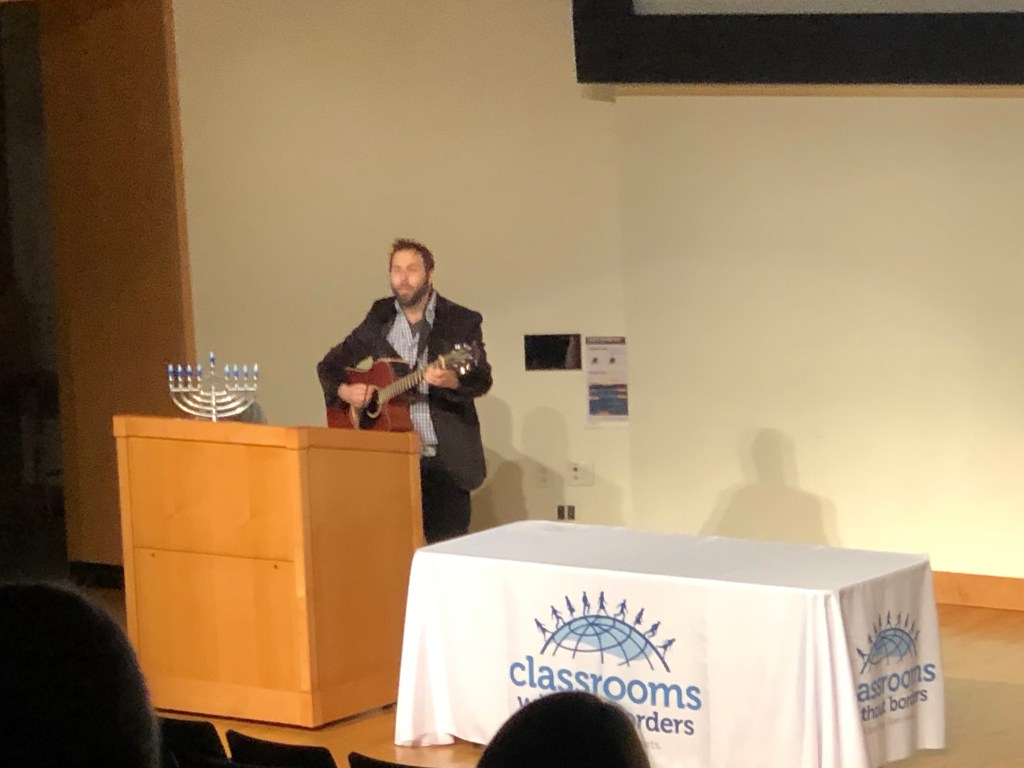
What was perhaps telling about the event was that the audience were largely older, the crowd forming a vast sea of grey hair. This is concerning in that the film had a message that younger people could benefit from hearing, particularly given the continuing relevance of learning about the holocaust. A poll from YouGov, in collaboration with The Economist, revealed that one out of five young Americans do not believe the holocaust ever happened. The implications of this are startling, particularly given the recent rise of far-right nationalist parties in Europe, such as Germany’s AfD and the PVV in the Netherlands. That these parties engage in scapegoating of immigrant and minority groups not dissimilar to the tribalist rhetoric espoused by Fascist dictatorships of the 20th century ought to be cause for concern for anyone picking up a newspaper.
With that in mind, Irena’s Vow is worth a watch as a reminder to never let such a toxic and potentially deadly discourse take hold again. Although that reminder is sometimes grim, the story – like the story of the Maccabees holding on to a cruse of oil that lasted eight days – is ultimately one of hope.
Adam Arthur holds a graduate degree from Florida State University. He is the author of two poetry collections, Levers of Power and Sound and Substance. A transplant to Pittsburgh, he has lived in the area for three years and takes inspiration from his surroundings in his written work.


Leave a Reply