by Dani Lamorte
A distorted square luminesces, glides toward me three feet in the air. It contains the vague and rebellious image of a being.
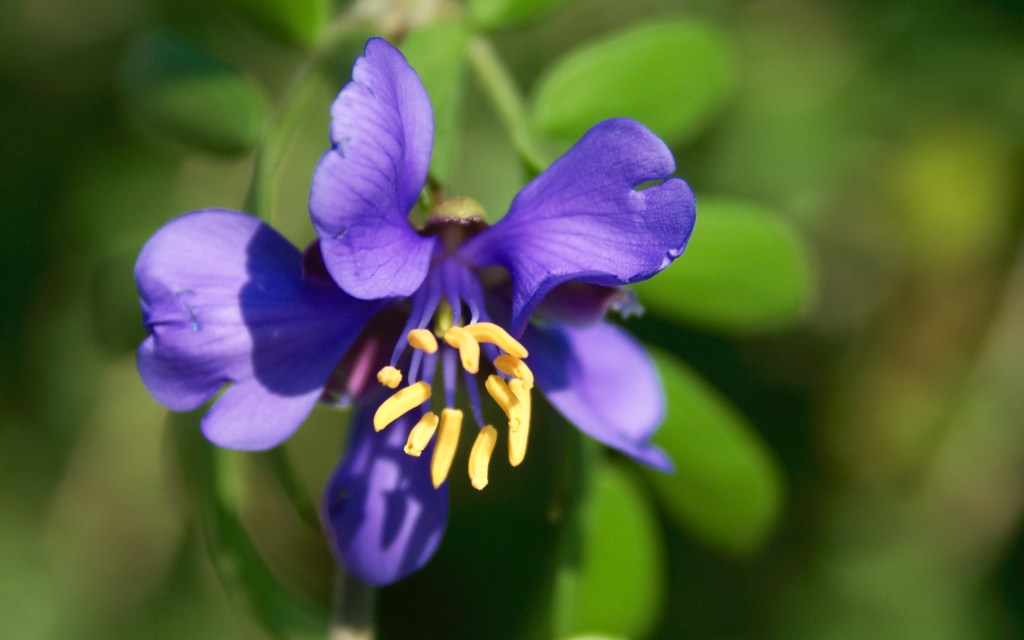
“I found a Dani,” Jason says, showing me a blurry iPhone photo of a plant. Beneath the photo is a caption, provided by a plant recognition app:
“Guayacan (Guaiacum coulteri)”
I am an adherent to the mirror. No matter what it shows me, I go back to find out what I think others know. I go back to see what does and does not change, to find myself up against the reality of the body which is me. A mirror, polished to an infinite sharpness, says things directly. A mirror makes possible warped, stereoscopic, double-exposed images.
The plant Jason has found, Guaiacum coulteri, has almost nothing to do with me. Though two specimens grow in Tucson, where I lived for seven years, I’ve never seen one. What we share is a family name: Zygophyllaceae. For the past two centuries centuries, botanical taxonomy has sorted plants into families by detailing the reproductive parts of flowering structures. The Joneses have six stamens and a superior ovary; the Smiths have three, inferior. More recently, genetic sequencing has been used to determine who’s relating to whom. Guyacan is presently grouped with other tropical and warm climate-inhabiting plants in the family Zygophyllaceae, first recognized by Robert Brown in 1814. The name, which translates from Latin to ‘joined leaf,’ is taken from the genus Zygophyllum, identified by Linnaeus in 1753. Nothing fell off the ark pre-sorted. Knowing what one creature has to do with another is an ongoing project, maybe a struggle, certainly a fixation.
No botanist has ever found me in spring, full of purple bloom and holding time in a dry forest. Never my joined leaves were seen, pushed by hot breezes and swatting at pollen-seeking bees. I am not the Zygophyllaceae that’s snipped and pressed between drying papers, shelved greedily in a herbarium cabinet. I am @zygo.phyll.aceae—an Instagram handle once chosen to hide me, in the public realm of Instagram, from potential employers. For those who pry and pay, I offer no mirror, but an artist’s sketch of a person trying to be a thing.
Though I’ve never seen the Guyacan tree in person, its relatives were among my favorite plants in the Southwest—creosote (Larrea tridentata), Arizona poppy (Kallstroemia grandiflora), and puncture vine (Tribulus terrestris). Potted versions of the first two, both considered native to the Sonoran Desert, are easily purchased from Tucson greenhouses. The last family member, puncture vine, is an ‘exotic’ from other parts of the world. It’s rare this side of the Mississippi, faring much better in sandy West Coast soils. Puncture vine grows low to the ground, in a fringe of small leaves on hairy stems. Among the leaves are sunny yellow flowers, no more than a third of an inch wide, with five petals. The flowers are pollinated by insects, though the plant keeps “the option open” for self-pollination. Flowers, as is their lot, become fruit. In this case, they become a “small, thin-walled one-seeded dry indehiscent fruit,” known as an ‘achene.’
Hissing, found at the center of ‘indehiscent,’ is heard when one of these achenes meets an unshod foot. Two sharp prongs on the achene’s exterior puncture flesh, opening space for blood and bluster. Like chestnut casings, the achene of puncture vine bloodies a summer morning walk. Not all plants are fawning grasses, slipping underfoot. The more I repeat the word ‘indehiscent,’ the adjective for a fruit which does not crack open to release its seeds, the more it sounds like ‘indecent.’ The fruit is indecent, untoward. This plant has grown above its station.
Puncture vine achenes amassed in the rubber soles which walked my Tucson driveway, caught on towels fallen from the line, and flattened my bike tire (though I wasn’t using it anyway). Alongside the vines grew that other member of Zygophyllaceae, Kallstroemia grandiflora—Arizona poppy. Their leaves vary a bit in size, but not enough to notice at first glance. Arizona poppy’s flowers are larger and orange. In the gravel patch next to our apartment, I let the two grow together in a large mat of yellow, orange, and green. Why did I let this plant, which made me scream and bleed and hiss, grow wide and bright?
Puncture vine is my punctum vine, is a plant which is lodged in me. It’s a detail of place and time which, though others find the plant loathsome and noxious, holds my attention. It could short-circuit the meaning of the whole desert. ‘Punctum’ is Roland Barthes’ term for a minor detail in a photograph which, to the viewer, seems to become the entire photograph. It is a personal sense, but nothing as solid as a ‘meaning,’ which has an accidental charge—perhaps an interplay of formal properties, psychological specters, and associative happenstance. The punctum punctures, maybe through the photograph and certainly through the viewer.
Barthes writes, “[the punctum] is what I add to the photograph and what is nonetheless already there.” (emphasis in the original, 55) Surrounded as I was by saguaro and barrel cactuses, all those ha-cha-cha, Lone Ranger, Western ghost town, cowboy boot and piñata hat-symbolizing plants, I ought not to have felt so compelled to keep puncture vine growing in my garden. Other parts of desert life should have held my attention, convinced me to see an orderly image of the desert. For precisely that reason, perhaps, puncture vine could cut through me. In showing me a photo of (something purported to be) Guyacan, a photo of something in Zygophyllaceae, Jason brought into focus the punctum of my everyday desert vision. The app was wrong but I didn’t want to tell either one of us, because the truth had nothing to do with it. Here was an image of me finding an image of something inside and outside me; a momento or souvenir of a plant I think of daily, see never, maybe never saw clearly in the first place.
Open an app or a guidebook, or ask a friend with cut-off shorts, and they can point you to the plants of Pittsburgh’s everyday image. These are the plantain and goldenrod, mulberry and chicory, burdock and dead nettle. We have no puncture vine but surely something could pierce through, all the same.
I described puncture vine to another friend, Adam, and wondered aloud what might take the place of puncture vine in Pittsburgh soils. Having never seen the plant, and going off a hasty description I offered between spoonfuls of mango sorbet, Adam said—and said he doesn’t know why it comes to mind—“honeysuckle.” There are several varieties of honeysuckle growing here, but he probably has in mind something like Lonicera japonica, a variety which spreads along the ground and spills over retaining walls. L. japonica is, as the species name might suggest, an Asian variant which is often planted in gardens. It has been described as ‘invasive.’ Honeysuckle is also known by the name ‘woodbine,’ which it shares with another vine from Japan: Japanese, or Boston, Ivy.
I see Boston ivy outside my kitchen window, slipping up the long arms of yew shrubs and seeking out the canopy of a juniper. The ivy’s ground-level leaves are small, comprised of three toothed leaflets joined at the center with a red dot. By a process known as heteroblasty, the leaflets fuse into a single leaf as they process sunward. Before this fusion, the leaves are oddly similar to another plant growing amongst the yew and juniper—Toxicodendron radicans, or poison ivy.
Poison ivy is a plant and a disease, or something like it. You can see poison ivy in a forest, then have poison ivy as a condition. The urushiol contained in all parts of the poison ivy plant is an oily mess that smears across passing flesh and fur. In humans, but not in other animals, poison ivy’s urushiol can produce an allergic reaction. The reaction is miserable enough that we have a preventative rhyme: “leaves of three, let it be.” Like any rhyme, it catches passersby. Boston ivy’s unfused, immature leaves look like poison ivy’s young leaves. Every day, I walk towards the yew and try to determine which tripartite plant might touch my ankles, whether or not I will react. The poison of poison ivy will not kill me, but it distresses me all the same. It turns me inside out. A bird eats the ivy’s berries; I get a rash. Nature is not for me.
What meets the eye or skin is not a Pennsylvania before honeysuckle, an Arizona before puncture vine, but an everyday photosynthetic fracas of mistaken identities and latecomers. They are the subject of the image of this place, and the subject displaced by the green punctum.
Elsewhere, which is here, an image recognition app is fantasizing the annihilation of climate, of predictable zones of distribution. Things are found living in very specific nowheres: a patch of Sonoran Desert in North Park, a single wave from the Pacific hovering over a Papermart in Robinson Town Centre. Here is a geography of the plant which punctures through, which impresses onto us something everyday.
Dani Lamorte is a Pittsburgh-based artist working in performance, video, and photography.


Leave a comment