
Editor’s Note: Earlier this week, i once again rode the Pennsylvanian and was reminded of this essay I wrote in 2022 for a Substack post. It was sort of odd to read in hindsight. I cut some things that are no longer applicable or felt fluffy, but in many ways my existential anxieties feel the same.
The fact that the Pennsylvanian leaves at 7:30 in the morning means you wander onto it bleary and waiting for the announcer to bark that the café car is open so you can get some more coffee. As it makes its way out of Pittsburgh, it flanks the aging Rust Belt homes and convenience stores that make up the outer East End neighborhoods of Wilkinsburg and Edgewood, and then begins its ascent into the mountains. The sunrise filtering through the leaves feels so crisp and pure. Greensburg, only a forty-five minute drive from Pittsburgh, is quaint and residential. When the train reaches Latrobe, home of Mr. Rogers, an anachronistic motel and a family-owned Italian restaurant flash by out the window.
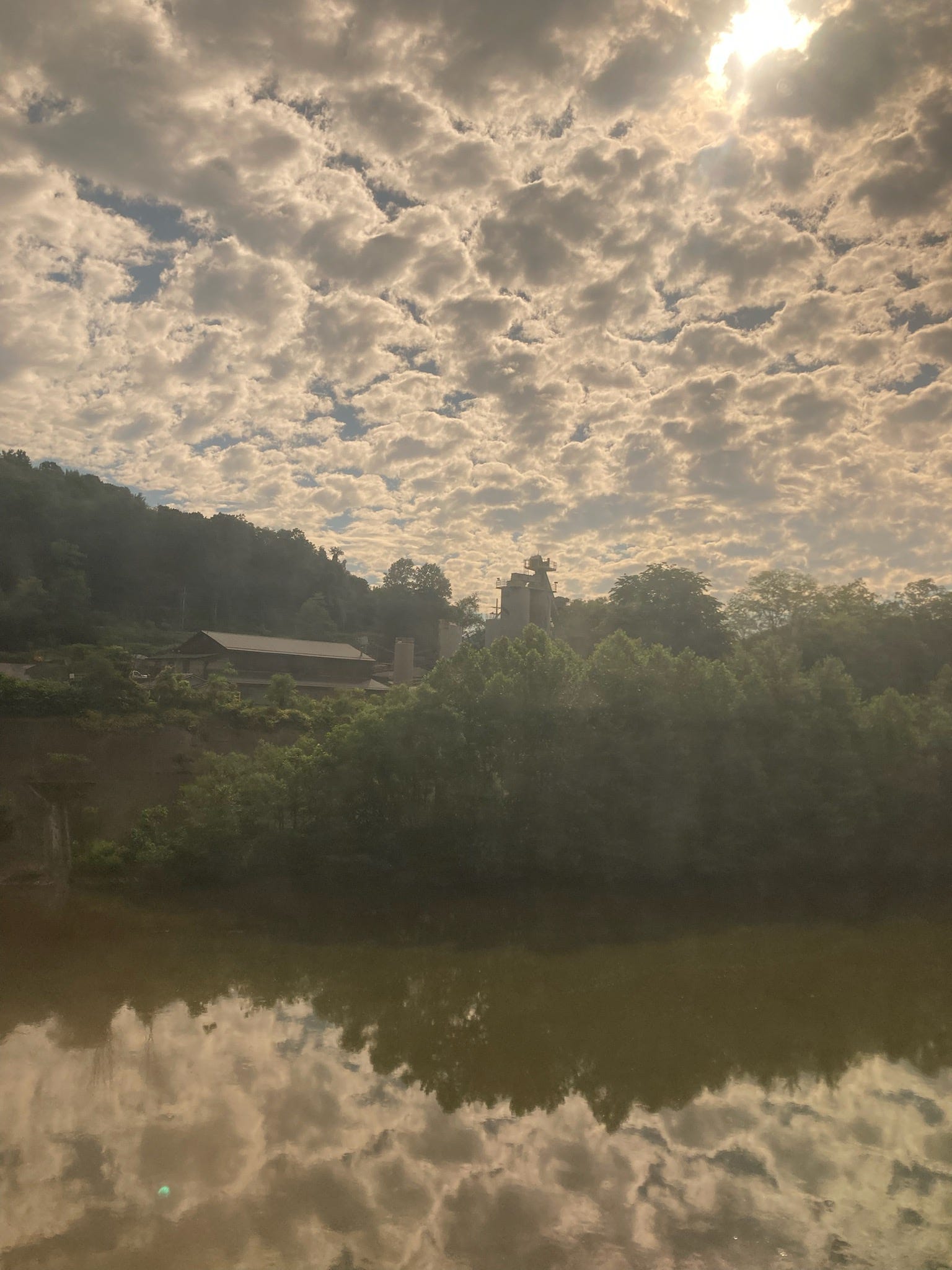
By the time you get to Johnstown, you start to see an aesthetically bizarre combination of greying smoke stacks and the golden spires of Eastern Orthodox churches, all against the backdrop of deciduous Appalachia. Many have listened to Mitski’s album Laurel Hell, but few know that it takes its title from a phenomenon in the forests of Appalachia where laurels grow so thickly that hunters or hikers can meet their demise trapped in them. The forest on the Tuscarora Mountain looks like it could contain laurel hells. I’ve taken this train in every season by now, and the brown leaves in the autumn are a gorgeous golden turmeric color, but this time of year, everything is lush and green and overgrown. The train chugs along a grey-green river. This time around, I saw one lone man fly-fishing in the middle of one of the rapids, but other than that, the first five hours or so of the journey are devoid of human life. The café car usually opens around Johnstown, and the Amtrak coffee is always better than I expect, rich and bitter.
The Pennsylvanian is unique among Amtrak trains in that it has its own built-in tourist attraction: The Horseshoe Curve. Between Johnstown and Altoona, the train worms around the engineering marvel that allows for passage through the mountains and forest of central Pennsylvania. This time around, the conductor reminds everyone on board that the Horseshoe Curve was built by laborers who spent six years on it and got paid twenty-five cents an hour. It’s easy to be dismissive of stories about things like the Erie Canal or the Horseshoe Curve, but they’re a reminder that work used to take a lot longer than it does today. When I took the Amtrak this time, the Horseshoe Curve was mostly blocked by colorful freight cars. I still got up and stood in the vestibule to watch it go by.
Altoona has an enormous Catholic church, and whenever I pass it by I think about a time I was coming back to Pittsburgh from New York and texting with a friend who grew up Catholic about Confession as research for a manuscript. I happened to be passing Altoona on the train, and my friend sent me a link from the Catholic Diocese of Altoona. Very weird and serendipitous.
After Altoona, Tyrone, a town I forgot the train stopped in. Its streets are lined with American flags and the faces of local veterans. Huntingdon, on the Juniata River, is a sleepy mountain town—I remember one of the very first times I took the Pennsylvanian, on my way back from my book launch, a young man sitting behind me attempted to ask the conductor where we were but didn’t seem to know how to say it in English. I’d heard him speaking Haitian Creole with his seatmate, so I tried my luck: Excusez-moi, parlez-vous le français? Nous sommes en Huntingdon. Le prochain arrêt est Lewistown. It turned out that worked, and we struck up a long conversation.
He was on his way to Pittsburgh to change to the Greyhound to Columbus to attend Ohio State, and was eager to tell me about himself and his life. We had a long conversation in a combination of French, English, and Spanish about language and values, and he showed me a bunch of Haitian Creole music videos. On the Pennsylvanian, before you’ve passed through Harrisburg and into the eastern seaboard where things like how you look and where you went to school seem important, everything feels simpler and quieter and it’s easier to look at a stranger and imagine you could start up a conversation. Lewistown, after Huntingdon, is the last place you’ll see a Sheetz instead of a Wawa to buy cheap candy and coffee on this ride.
Another river, the Susquehanna River, which is so wide it could easily be mistaken for a lake. Enormous rolling hills overlook the silver river, and at its side sit beach houses with shiny Ford F-150s parked in the driveway. Harrisburg and the surrounding Pennsylvania capital region mark the divide between western Pennsylvania and eastern Pennsylvania. After Harrisburg, where all the smokers get off the train and stand morosely on the platform, the train takes a long sojourn through suburbia until it reaches Elizabethtown. You’re no longer in the cocoon of the mountains, now you see Taco Bells and Family Dollars and CVS parking lots.
It’s difficult to explain the difference between western and eastern Pennsylvania, but there is one. I firmly believe anyone who says Pittsburgh is on the east coast is kidding themselves. You only have to take the Pennsylvanian to feel it. The energy shifts past Harrisburg, where the fields are flatter and nature seems more like it’s a guest in the landscape. Lancaster, after Elizabethtown, is pure Amish country, wide, flat land and bright green cornfields. This ride, there was a great deal of construction by the Lancaster station, which felt out of character. What follows Lancaster is the Main Line region, the SEPTA stops that aren’t quite Philly but aren’t really the rest of the state either. Exton, Paoli, Ardmore. Their cheerful indigo and red signs connect them to Philadelphia.
The first sign of Philadelphia is the impatient people on elevated highways. I have no love for Philadelphia, but the graffiti as the train inches into urban life is eye-catching and vivid. By this point in the ride, I’m exhausted and remember that nine hours is much longer than it seemed in my head. I wander up and down the aisles of the train. It dips into a tunnel and plunges into darkness, lulling to a stop in 30th Street Station. At Philadelphia, the Pennsylvanian turns off and reroutes. I’m unaware of the exact mechanics of it, but while the seats face forward from Pittsburgh to Philly, from Philly to New York they face backwards. I dread the train stopping in Philadelphia. The people get on are often the kind of people who badger you to give up your seat so they can sit next to their friend—which happened to me on Sunday. The train, once a metal oasis hurtling through the wilderness, fills up with worn-out commuters.
But that’s not to say it’s bad. It’s just another way that the Pennsylvanian brings passengers through a whirlwind of examples of what life in our vast country has to offer. The train chugs backwards over elevated highways and through suburbs that follow the Levittown model, and over the state line into New Jersey.
The next stop, Trenton, New Jersey will always stick out to me. The Lower Trenton Bridge, Trenton’s one landmark, features a strange platitude lettered on its iron bars: Trenton Makes, The World Takes. That’s always stuck with me. Something that’s been on my mind a lot is the difference between living in Pittsburgh, a city of makers, versus New York, a city of consumers.
From Trenton, then Newark—Prudential Center, NJPAC, blue glass buildings. But the wetlands of New Jersey comfort me. Whole ecosystems live in the marshes beneath the elevated highways. Life will find a way anywhere. I want to believe my dreams aren’t just youthful naïvéte. The Pennsylvanian speeds into the sweaty abyss of Penn Station, where I used to drag my fencing gear home in a bag that tugged sores into my shoulder, where in college I drank a frappuccino at two in the morning giddy after a Lana Del Rey concert on Long Island. I’ve joked that Penn Station is great advertising for the train lines it serves because both the building and the surrounding areas are so vile they instantly make you want to leave New York. But maybe there’s something to the in between places, where you haven’t left or returned anywhere because you aren’t anywhere. That’s always where I’ve felt the most at home.
Emma Riva is the founder of Petrichor.


Leave a comment