
by Elise Ryan
During a scene transition in Jesse Factor’s extraordinary Marthaodyssey, his homage in drag to Martha Graham and Madonna, the audience watches a three-channel video projection of Factor on an upstage screen. Glamorous in Graham’s dramatic eye makeup, Factor lip syncs to a recording of Graham who muses on the enchantments of the backstage dressing room. Just as a triptych mirror allows a performer to see her face from all angles at once, the video channels show front, right, and left sides at once. Graham, through Factor, explains the magic of makeup, its ability to transform one body into another, the way paint, precision, and contour shape the image and the character. She is putting on the face of the character Jocasta, Queen of Thebes, and she sees Jocasta staring back at her and knows that she is not merely like Jocasta—she is Jocasta.
Watching Factor become Graham become Jocasta, I only experienced a deepening of reality, never losing all sense of it in a hall of mirrors. Throughout the night, Factor’s ability to embody Graham made me think of nothing so much as reincarnation. Costumes (designed by Julianna Waechter & Tony Allgeier) and a luxurious wig of Graham-esque long, flowing, dark hair, designed by Travis Klingler and Aurora Borealis, are key tools of transformation.
Yet it is as a dancer trained at the Graham School, spending years dancing with Graham II and the Martha Graham Dance Company, that Factor translates Graham’s energy-driven, pelvic centered, architectural dance with precision and care. Factor uses lip syncing—one of drag’s most iconic performance techniques—to voice audio recordings of Graham speaking about her philosophy of dance, her demanding classroom exercises, and her astonishment at the nature of light (she was born in a dark and smoky Pittsburgh in 1894 before her family moved to sunny California). Of course, Factor also lip syncs the Queen of Pop’s greatest hits.

Marthaodyssey, which Factor conceived, arranged, and performed, has been in development for more than three years, largely with the support and collaboration of Kelly-Strayhorn Theater, which staged the two-night production in early November. Directed by Robert Ramirez, the show begins in the lobby. There, Scott Andrew’s expertly designed projections of still images of Madonna and Graham cover the large rectangular acoustic panels. The two women gaze intensely at something just out of frame, their feet are muscular and planted, they are draped in voluminous folds and in tight jersey. The resemblance between the two is undeniable and striking. Madonna danced at the Graham School and said the discipline was like a convent’s. She later met Graham and the dance vocabulary of gesture infused her own dancing.
Based in the Graham repertory, the episodes that comprise Marthaodyssey refer to Graham’s major works, such as Specter—1914 (1936), Lamentation (1930), and Acts of Light (1981), and rearrange the actual steps and technique for movement to Madonna’s music and expression through drag’s conventions.
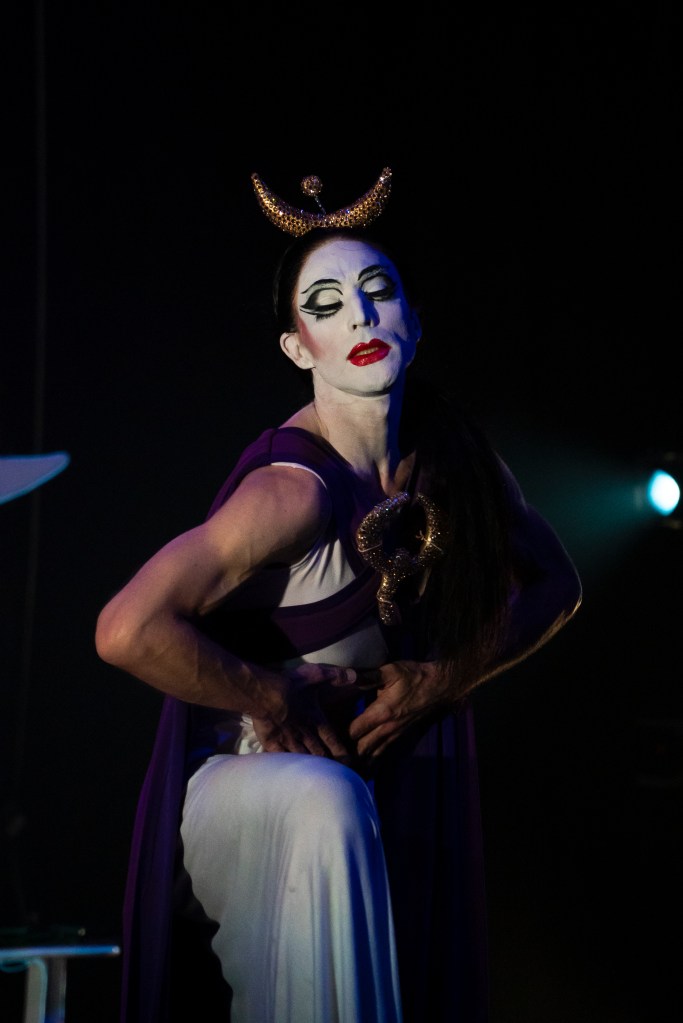
Night Club Journey, based on Graham’s 1947 dance Night Journey, injects humor and exuberant play into the piece’s eroticism and pathos. Part of Graham’s Greek Cycle, Night Journey dances the Oedipus myth by centering Queen Jocasta. Factor preserves the gestural patterns of the original dance to communicate Jocasta’s erotic pleasure, maternal love, and mortal confusion, while replacing William Schuman’s score with the Queen of Pop’s most iconic songs: “Material Girl,” “Like a Virgin,” and “Papa Don’t Preach.” Tucker Topel’s set design riffs on Isamu Noguchi’s sculptural furniture—a lyre, a phallic throne—to create club-chic décor outlined in neon lighting. It’s glam and fun with a touch of camp but is also true to both Graham’s sense of the mythic and pop’s primal universalism. Madonna’s sense of the symbolic has never been clearer to me.
As Factor’s Jocasta lifts the golden rope that will become her noose (in the original, the rope is also umbilical cord and wedding band), a gesture of arms firmly straightened and uplifted softens to a gentle waving. Suddenly, from the audience, this gesture is repeated by dozens of people who erupt from their seats, into the aisles, and onto the stage. The cued dancers (students in Factor’s contemporary repertory class at Point Park University) begin a Graham Vogue Line with Madonna’s iconic song and pose procession taking over the theater. Suicide is diverted to dance. Ball culture undoes the tragic.
For the encore, the curtain opens on Factor as Graham in her 1932 Satyric Festival Song gown—off the shoulders, banded in purple and gray tones, stopping just above the delicate ankle bones, exposing their fragility against those muscular feet. She is grounded, braced, powerfully extended down through the stage and up through the flies to atmosphere. With back to the audience, far upstage, the jumps begin. Again and again, rising and falling from and to the same position. Pure image of a leaping silhouette against the light of the projection screen. I am transfixed with wonder. The jubilant jumps still me in awe at the raw strength to contract and release, the leap toward freedom and joy rooted in discipline, power, and nerve.
While dance notation exists, it is through bodily imitation and direct contact that the tradition continues. Each unique body that expresses the movement witnesses to the source and speaks of that particular dancer. Marthaodyssey is an elegant portmanteau pointing to this journey of tradition as it passes in glory from one body to another.
Drag certainly makes this all gay and fun, a delectable spectacle, but it also shows itself to be a profound extension of Graham’s philosophy of dance as the creation of image. Like the backstage mirror that shows how a different angle reveals a hidden truth, Marthaodyssey shows the work and the werk it takes to be Graham, to dance Graham, to lip sync Madonna, to tease the crowd, to allow another character into your character. There is a “regality of order” (a phrase from St. Augustine, quoted in the show) to the performance and to the tradition it creates by merging Graham’s dance vocabulary, pop’s ebullience, and drag’s performativity into a body shaped for extreme emotional expression.
During the post-show Q&A, Kelly-Strayhorn Theater announced that Marthaodyssey will be going to New York City January 10-13 to perform at the Marjorie S. Deane Little Theater. KST will co-present the show with Live Artery / New York Live Arts. The performances coincide with GRAHAM 100. For more information and to purchase tickets: kelly-strayhorn.org
Elise Ryan is a Teaching Associate Professor at the University of Pittsburgh who sees herself as a thinker, writer, and reader excited by leaps between categories and atypical juxtapositions. She is currently being supported in the latter as a Fellow with Critical Insight, a 7-month Fellowship co-sponsored by Pittsburgh Public Theater and American Theater Magazine with the aim of supporting Pittsburgh-based arts criticism.

 PETRICHOR
Leave a comment