by Emma Riva
All images courtesy of the Frick Pittsburgh
In two seconds, anyone with access to the internet can find an image of “beautiful field.” The subjectivity of what makes the field beautiful doesn’t matter. In a quick cursory exercise, iStock presents a searcher with mountains tinged with lavender shadows, overlooking orange poppies and lush vegetation. But what does this mean, when beauty is a finger-click away? A paradox in modern life is that many in the western world, people are surrounded by excess—you can get anything you want at Walmart or Dollar General or Amazon—and yet feel dissatisfaction, disconnect, and numbness at record highs.
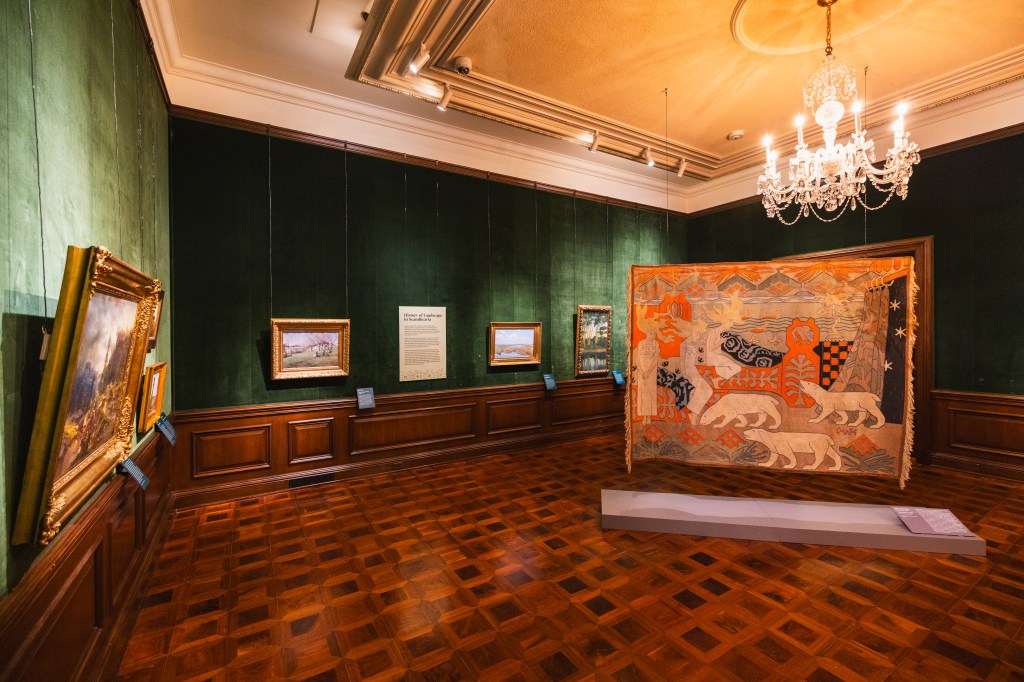
The Frick Pittsburgh’s newest exhibition, The Scandinavian Home: Landscape and Lore, shows the relationship between living in a harsh landscape and finding beauty in it. When people live more comfortable lives, how can they experience the sublime?
The headline image of The Scandinavian Home is Sunset in Värmland by Otto Hesselbom,glimmering bleu snow and a resplendent blaze of twilight sky against the soft darkness of pine trees. A ribbon of stream winding through the sno reflects a silvery, pale green, a color unfamiliar to warmer climate-dwellers. These’s a color palette at play in the works in The Scandinavian Home that’s hard even to describe. What seem like opposite colors that would dull each other out to a Pittsburgh viewer—orange and green or blue and brown—work in harmony under Nordic painters’ brushes. It’s easy to see why the Frick chose this as the header image. It’s spellbinding.

“That painting is just so incredibly eye-catching. There’s a way that the image is cropped that mimics the way that the sun is setting,” curator Dawn Reid Brean said. “It has a little cabin structure that references that idea of home, landscape, and importance and nature. It encapsulated everything the show is about. The set of footprints shows this sense of not being alone.”

The Scandinavian Home is the personal collection of David and Susan Werner, a married couple collecting art together for their State College home. Like the Carnegie Museum’s Milton and Sheila Fine Collection, The Scandinavian Home offers a glimpse into art that lived in collectors’ homes as part of their daily lives. Werner and Brean had known each other for over a decade, “It’s a huge honor for him to approach us and trust us with his collection,” Brean said. Susan Werner’s focus is more on ceramic art, and the couple continue to collect contemporary ceramics. The works in The Scandinavian Home were mostly on display in everyday life in the Werners’ home, too—few if any sat in a vault collecting tax write-off value.

Dr. David (left )and Susan Werner (right), the private collectors of the art featured in Th eScandinavian Home: Landscape and Lore exhibition now on display at The Frick Art Museum, stand in front of Otto Hesselbom’s “Sunset in Värmland.”
Seth Culp-Ressler/The Frick Pittsburgh.
Many of the objects were in their original owners’ homes, too, so they already had built up some resistance to everyday use. “But Sue will tell you, there are a number of things they would put away before their grandkids visited,” Brean said.
The artists’ ability to work with light is what makes many of the landscape paintings really pop. The milky moon in Full Moon in Early Summer by Harald Slott-Muller blazes off of the canvas. In Gustav Fjaestrad’s Winter Landscape with Hoar Frost, one single branch is painted gesturally in the foreground. It’s a master class in compositional technique—the harsher brushstrokes give the landscape depth, and pointillism-esque dots in the surface of a frozen lake add a shimmer and blur distinguishing the foreground and the background.

What distinguishes Scandinavian art from Western European art is its connection to folk art and craft. Gerhard Munthe’s tapestry The Suitors draws from folkloric images of polar bears, and Brean chose to hang it from the ceiling as it would really appear in a home, so viewers can see both sides of the work. Another highlight in the first room of the show is a very-early career Hilma af Klint, when the Swedish mystic was focusing more on realistic depictions of human figures than on theosophical premonitions. It’s a pleasant reminder that all great artists took detours within their careers, and viewers can see Klint’s interest in the surreal through the fact that even in a pastoral scene, Klint paints ghostly-looking figures without faces.
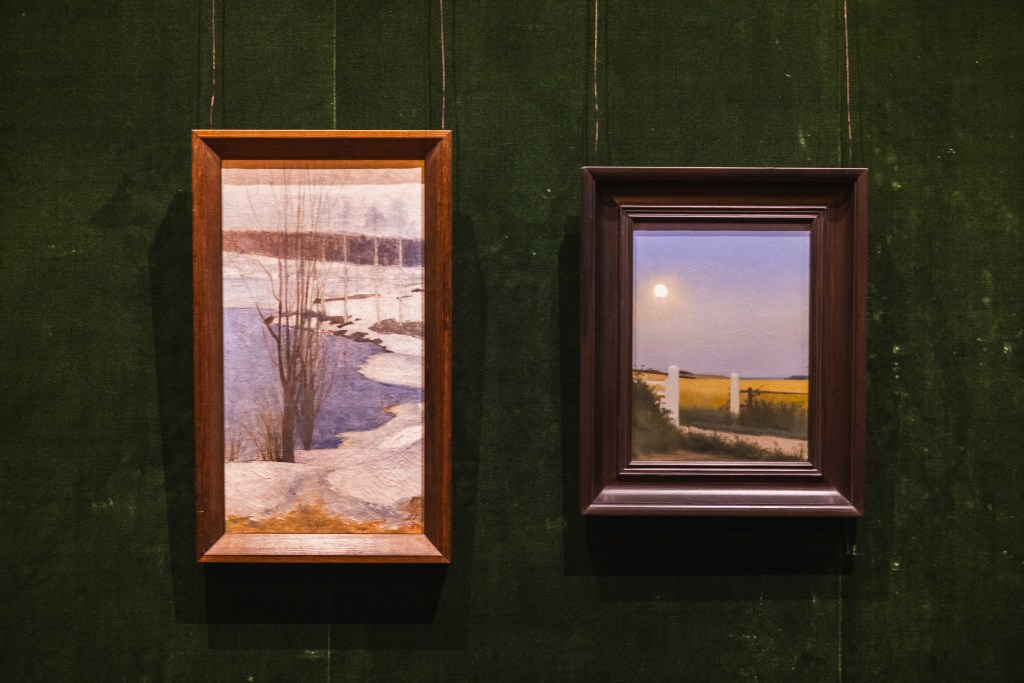
Right painting: Harald Slott-Møller (Danish, 1864-1937). Full Moon in Early Summer, 1894. Oil on canvas.
“[Scandinavian art] creates a sacred space within nature that epitomizes the way Scandinavian artists use light. They’re not only trying to depict the beauty of their homeland, but they’re trying to depict a feeling,” she said. “These artists are really trying to speak to a kind of communal experience of the Swedish wilderness. You get an emotional reaction to the landscape. A landscape is never just a landscape.”
The exhibition contextualizes Scandinavian art through regional history, including the nuances of Finnish and Icelandic identity as countries with both separate identities with commonalities to Denmark, Sweden, and Norway. At the turn of the 20th century, Finland and Norway were not their own countries and were developing their own national identities. “So much of the history of these countries is a revelation to our visitors. In thinking about a general public member, you say Scandinavia, where is that? I don’t know how many people could tell you. Where is Scandinavia in the turn of the century? Finland and Norway are not independent countries.”
Finnish is an isolate language related only to Hungarian and Estonian, and the country’s borders straddle Nordic and Slavic portions of Europe, including the disputed region of Karelia. Iceland sits in the middle of the ocean, culturally and geographically isolated with the claim of producing both the Vikings and Björk. If there is a place where the exhibition could have gone a little further, it might be in exploring how national identities have shifted in Nordic countries over the last century. But given that the show is a single collection, the curatorial team worked with what was there and packed an enormous amount of content into one show.

Seth Culp-Ressler/The Frick Pittsburgh
“Iceland is not well-represented in the Werners’ collection,” Brean said. “The history and trajectory of that country are different than Finland and Norway’s desire for political independence at the early twentieth century, from 1880-1920.” To add further context, Finland and Norway were under Swedish or Danish authority within that period. Another element of Scandinavian history not represented within this collection is Greenland, which Denmark occupied for many years, with the Arctic country still under de facto Danish rule to this day.

“While that doesn’t come up within Werners’ collection, what does come up is the indigenous population in Finland, the Sámi, whose place in the nation is still under discussion within Finnish national identity,” Brean said. The exhibition includes Helmer Oslund, a Sámi artist whose depictions of the landscape break light and color up into swirling, inter-connected blocks, again showing Scandinavian painters’ deft understanding of composition.
“There is a lot of comparison that can be drawn between this ‘romantic nationalism’ movement and the American Hudson River School, which romanticizes the American landscape but isn’t the entire story,” Brean said. But Scandinavian art is underrepresented in general in American museums, and part of Brean’s goal with The Scandinavian Home is to decentralize Paris as the be-all end-all of European art. Brean referenced that for most people, Scandinavia is “either IKEA or vikings,” nothing in between. Or, people know a dumbed-down version of deeply-held Nordic values like “hygge,” defined as “a quality of coziness, comfort, and contentedness through a feeling of well-being, simplicity, and community.”
“We talk about this Danish idea of ‘hygge,’ which has been Americanized as wearing cozy socks and a blanket and staying inside, but it runs a lot deeper. It’s also communing with nature and taking care of yourself,” Brean said. Hygge does not just mean being indoors, it’s the environment that you create around yourself, living in alignment with your values and feeling at ease with your decision. “Nordic countries’ commitment to their community through social democracy is a really foundational part of ‘hygge’ that gets brushed over,” Brean said.
In some sense, the work in The Scandinavian Home does feel from a different era before mass entertainment and media fundamentally changed human brain chemistry. But the exhibition concludes with paintings from “vitalism,” an art movement in turn-of-the-20th-century Scandinavia that focused on muscular portraits of young men. It was hard not to feel déja-vu in a parallel to the obsession with fitness, youth, and vitality that plagues modernity, too.
“Vitalism could be a whole other exhibition,” Brean said. Industrialization brought new diseases with it, tuberculosis, and the Spanish flu—now the second most-famous pandemic in recent history. Patricia G. Berman writes in a companion essay to The Scandinavian Home on vitalism that “Vitalist practice focused on the notion of individual and collective revitalization, the amelioration of what was widely perceived as the degenerative forces of modernity.” This will be familiar to anyone who’s spent time scrolling online through suggestions about natural menstrual cycle charting and calls to “reject modernity and embrace tradition” through moving out of cities and no longer eating seed oils—another form of the romantic nationalism.
The Scandinavian Home reveals one of art’s most powerful capabilities, to contextualize the past, ground viewers in the present, and expand their minds. There is truth to the idea, too, that when everything else falls away, a return to nature is all there is. The struggle to differentiate the human species from the cosmology of nature around it is universal and timeless. The work in The Scandinavian Home brings those who see it closer to understanding their own relationship to beauty in both the natural world and in the home.
The Frick Pittsburgh has generously supported this winter’s articles in Petrichor in conjunction with The Scandinavian Home. The exhibition is open through May 25, Tuesday – Sunday 10AM-4PM, tickets here. If you are an arts organization interested in a digital paid sponsorship, please reach out. We value our community partners that help us continue publishing while still allowing us to freely express our editorial thoughts.


Leave a Reply