by Emma Riva
This article is produced in partnership with the Frick Pittsburgh’s sponsorship of Petrichor. However, all views within the article are Petrichor’s own and do not represent the Frick either individually or institutionally.
Workers struggle with their relationships to technology that makes their job easier but is easily exploited by the powerful. Droves of immigrants flee suffering but are sometimes met with hostility. Though this describes 1905-1908 when Lewis Hine was photographing child labor and immigration, it could also describe 2026.
But unlike 1906, you can look at suffering anywhere in 2026. In fact, you can pull up an image of a starving child while you’re in line at the grocery store. Your brain goes “oh, that’s so sad,” and you move on to scanning cold cuts at the self-checkout. It’s easier than ever to see global suffering…so why are we in many ways less empathetic? The photography in Lewis Hine Pictures America at the Frick provokes questions like these.
Staging an exhibition like Lewis Hine, which shows images of steelworkers and coalminers who produced the product that made Frick himself rich, at the Frick is an intentionally thought-provoking choice. In the last few years, under the leadership of Chief Curator & Director of Collections Dawn Reid Brean and recently-appointed Executive Director Amanda Dunyak Gillen, the Frick has leaned more into social commentary through its exhibitions.
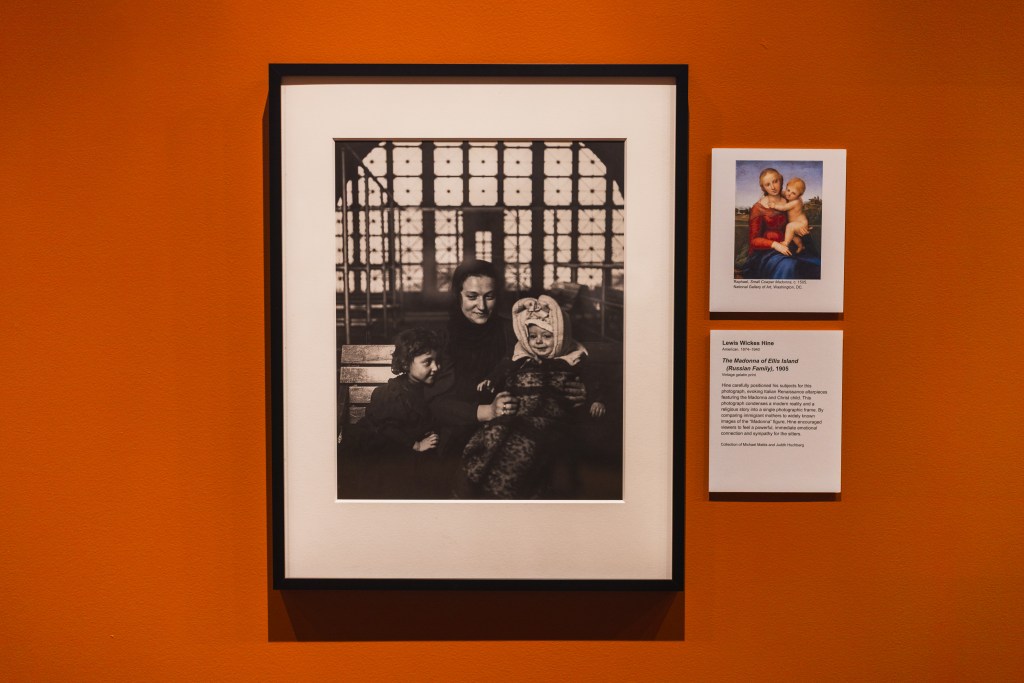
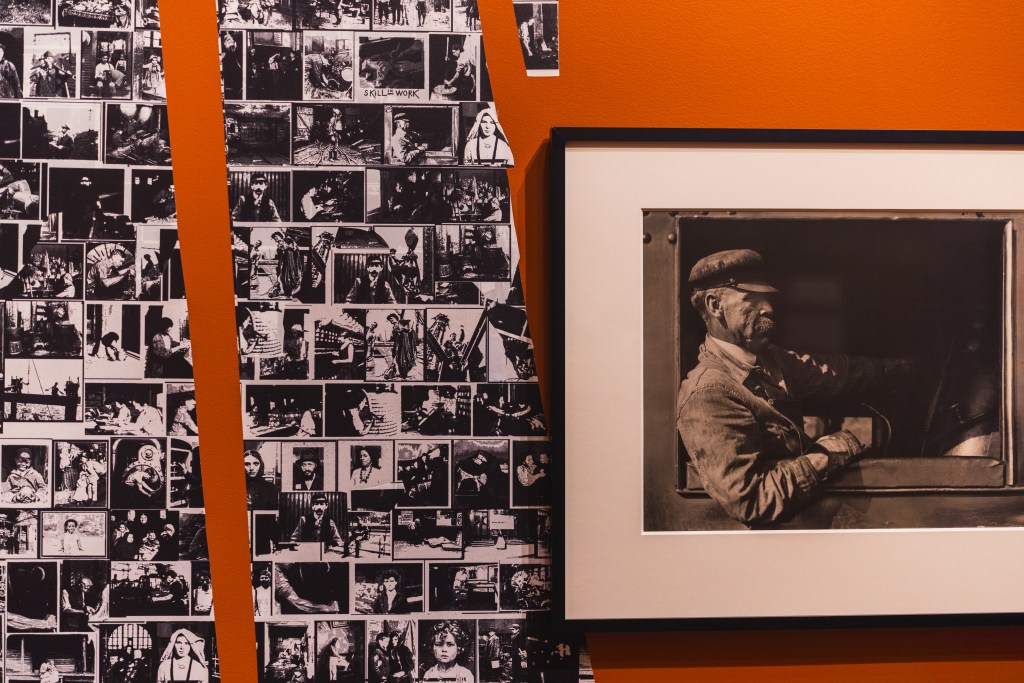
Hine’s photographs of Ellis Island feel particularly timely, and the exhibition design begins with that series, then goes to the Pittsburgh Survey and Hine’s photographs of labor, and ends with his images of the construction of the Empire State Building and a reflection space.
“The Frick family is part of such a larger ecosystem and our site tells their story. But we are not doing our job responsibly if we are not saying what made their wealth and their lives possible,” Brean said. “The photographs show people toiling in the mills that created Frick and his family’s wealth. We’ve had a couple of visitors say ‘I can’t believe you’re talking about labor at the Frick’ I hope a year or two from now that’s not surprising.”
For Lewis Hine Pictures America, a traveling exhibition organized through art2art and coming from the personal collection of Michael Mattis and Judith Hochberg, Brean and Lauryn Smith grounded it in a Pittsburgh connection.Hine photographed the Pittsburgh Survey, a sociological study attempting to understand the effects of industrialization.
“Museums have a lot of power in what they decide to put on the walls and whose stories we share,” Brean said. However, Hine might never have imagined his work in a museum space. “Hine didn’t consider himself an artist. He considered himself a social reformer,” curator Dawn Reid Brean said.
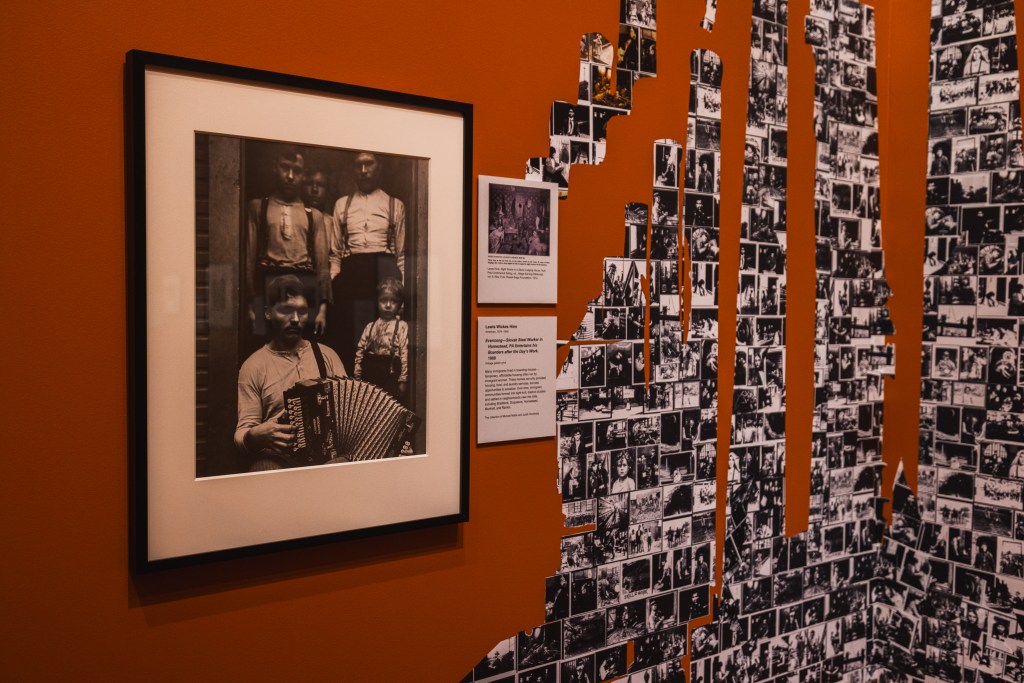
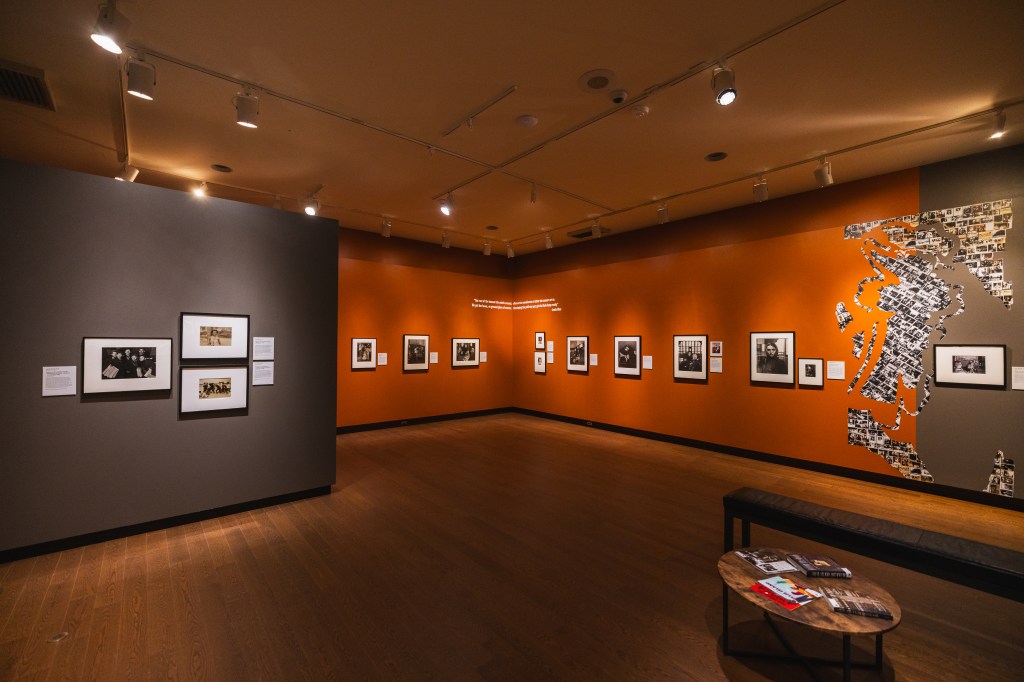
Though Hine himself didn’t identify as an artist, Quaishawn Whitlock, a local artist who provided exhibition design for the show, certainly does. Whitlock’s mural and exhibition design breathes life into the space. Whitlock was a guest labelist for Kara Walker: Harper’s Pictorial History of the Civil War, which has many parallels to Lewis Hine. Both show the Frick infusing its own identity and flair into an exhibition that could be cut-and-dry. Both encourage engagement with historical materials beyond just taking history on its face. Though Lewis Hine doesn’t use guest labelist, it still has thoughtful material written with intentionality.
Hine’s depictions of rest, such as in Group of Dockworkers Enjoying a Smoke at Lunch Hour, resonated with me more than his depictions of labor. As long as people have been working, they’ve needed respires from work. Though the images of children working and the brutality of the mines are provocative, it felt almost more radical to show the workers away from their vocations. The smoke break is still, today, one of the only ways someone working a demanding job has a moment to themselves.
But it’s also worth critically engaging with the photographs. “Documentary photography really begins at this particular moment,” Brean said. “There are questions about the ethics of photojournalism [at the turn of the century]. There’s been some research that shows Hine staged images, but they still represent truth.” The Paris Gamin, an iconic image used for campaigns against child labor, was later discovered to be staged with a model.
That phrasing from Brean, that something “represents truth” despite not being literally real, felt very 2026—what makes an image real? There are now images that were generated by unreal entities. There are images of images ad infinitum. If an image makes you feel something and it turns out not to be “real,” is the feeling you had real? Hine took a photograph of an orphan in Pittsburgh and titled it Little Orphan Annie in a Pittsburgh Institution, harnessing the power of the fictional to connect to the real. But, as the wall text notes, there is no way to know if the little girl pictured got the happy ending Annie did.
Hine’s work brings to mind Joan Didion’s documentary writing and her declaration that “We tell ourselves stories in order to live.” Each of Hine’s subjects had whole lives outside of the images and there is much viewers don’t know, yet they fit the subjects into whatever worldview they bring to the image.
Hine’s interest in photographing labor was a personal one, as he worked to support his family after his father’s death, and though he didn’t see his work as artistic, it’s clear it’s done with care.
The low lighting in the exhibition space protects the photographs but also gives it a more intimate feel. It asks viewers to reflect on what they lose when images of suffering become something they can access so easily. Images of suffering from the past might seem overly earnest or sentimental to a contemporary viewer, but Hine took these photos at great personal risk. One positive to the oversaturation of information is that it is much easier now to document injustice.
A charming moment in the exhibition is zines created by 5th grade students from Propel Charter School in McKeesport—though it proports to be in response to the exhibition most are about how much the students love the Steelers, showing that children resist easy sentimentality when you ask them to respond to a prompt.
At the exhibition’s conclusion, it allows visitors to write about what they’re thinking about after seeing it. Almost every one read that viewers saw parallels between Hine’s work and today’s world. The exhibit honors that every person seeing it brings something different to it.
“It’s a very personal exhibition, even though it’s a historical project,” Brean said. “A lot of our visitors see their families’ stories represented. We are seeing visitors write paragraphs and comments. I love that we are creating a space for that.”
This month’s articles are generously supported by Lewis Hine Pictures America at the Frick. Discover photography’s radical capacity through May 17. Tickets now on sale.



Leave a Reply