by Tara Fay FColeman
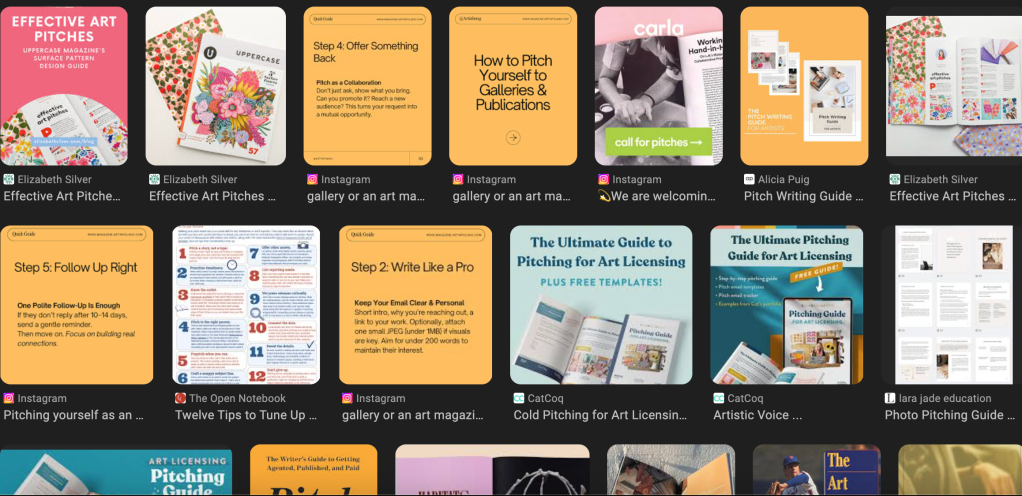
Cover image: Google results for “how to pitch to art magazines”
What I didn’t expect about being a writer is that most of my learning wouldn’t come from writing itself, it comes from pitching. Or more specifically, from trying to understand a process that isn’t really explained anywhere. People say all the same things: be concise, have a strong angle, know the publication, but none of that actually tells you why something gets picked up or ignored. There’s no baseline and often no real feedback. Most of the time, you send something out and hear nothing back. Not even a rejection, just radio silence.
So, you start adjusting without knowing what you’re adjusting for. You rewrite the same idea over and over. You second guess your tone, how direct you’re being, how much context to include. You try to match a voice that isn’t clearly defined in the first place. I’ve recently pitched the same publication at least six times. I’ve offered different ideas, different angles, sometimes reshaping something I thought was strong into something I thought they would want more. Nothing.
At a certain point, I got frustrated enough that I asked AI to generate a pitch for me, just to see if I was missing something structurally. I sent that too. Still nothing. Which is ironic, because AI is allegedly to flatten some of this and make access easier by giving you a model to follow. And in some ways, it does. It can produce something clean and legible that looks like a pitch, but it can’t get you inside. If anything, it risks making everything sound the same. And now people are paying attention to that. Editors are more attuned to AI tells, to a certain kind of polish that feels generic, even when it’s technically correct.
At the same time, I’m not interested in over-correcting to prove that something is human. I’m not going to abandon the rule of threes or short, direct sentences just because AI uses them too. Those are part of how I write. The issue isn’t the structure, it’s that the system can’t always tell the difference between a voice and a template.
At a certain point, it becomes obvious that it’s not just about how well the pitch is written, it’s about who is already in the room. Publications rely on people they already know. That part makes sense. Editors are busy. They need people they trust, people who can turn things around quickly, people who understand how the publication works without a lot of back and forth. It keeps things moving, but it also means the same people keep getting asked.
Even with freelancing, which is supposed to feel more open, it doesn’t really function that way. The same writers are given space over and over again, not always because they’re the only ones doing strong work, but because they’re already familiar. That creates a vacuum where the same voices keep circulating.
Art writing especially shouldn’t function that way. We’re already dealing with a lack of real critical writing, and this only narrows it further.The pool is small, and the same names circulate. And if you’re not already in that circle, you’re just sending things into it. Pitching starts to feel like unpaid labor you keep repeating. You research, write, revise, tailor everything to a specific publication, and most of it doesn’t go anywhere. There’s no compensation for that time, no response or feedback to build from. You just keep trying.
I was also asked by a platform to send a full draft instead of a pitch. Not an outline, not a short proposal, the ENTIRE piece. I wrote it, sent it, followed up. I “circled back” about 4 times. Nothing. That part actually feels worse than rejection. At least a rejection confirms that someone read it. Being asked to produce the full work and then getting no response makes it clear how little protection there is around a writer’s time.
All of this is happening within a field that is shrinking. There are fewer publications than there used to be, fewer places to send work, fewer editors, fewer budgets, fewer opportunities to build a relationship over time. Entire outlets have disappeared, or reduced what they publish, which means the remaining ones carry more weight and become even harder to access. So the competition increases, the pathways narrow, and the same dynamics intensify.
At the same time, publications depend on freelancers to produce a lot of their content, but keep that relationship at a distance. You’re contributing to the publication, but you’re not really part of it. There’s no stability, no guarantee of continued work, no investment in you beyond the piece they might take, so you end up in this position where you’re necessary, but not actually included. None of this is new, but it’s also not talked about that directly.
And I think that’s part of the frustration. It’s not just that pitching is difficult. It’s that it’s hard to even understand what you’re working within. There’s no clear entry point or consistent logic to follow, just a system you keep approaching without ever fully seeing how it operates.
I’m not expecting pitching to become easy. That’s not the point. But there should be some basic clarity and professional respect. A response, even if it’s a no. A boundary around what is being asked of writers, especially when full drafts are involved. Some acknowledgment that time is being spent, even when the work isn’t taken. Right now, there seems to be the expectation that you keep putting into a system that doesn’t consistently respond back. And eventually, that doesn’t just shape how you pitch, it shapes whether you keep trying at all.
I’m aware that writers who are more established than I am are dealing with this too. So, this isn’t just a matter of inexperience. Writing itself feels more unstable right now, and AI is a part of that, but it’s not the only factor. Opportunities are narrowing, books are being pulled from shelves over AI accusations, sometimes without clear proof, and decisions around what gets published or removed are starting to feel tied up with a broader culture of censorship.
There’s also a growing conversation about whether writers are even necessary in the long term. Whether that actually happens or not, the conditions already reflect a field that feels increasingly uncertain. So my only real advice, if I have any, is to write like your life depends on it. Not because the system makes space for you, but because it really doesn’t.
I think a lot about the writers who shaped how I even understand language: James Baldwin, Jesmyn Ward, Hanif Abdurraqib, Joan Didion, Zadie Smith, Zora Neale Hurston and COUNTLESS Black feminist writers, and Black art writers. My voice is an amalgamation of my lived experiences and everything I’ve read. That influence sits with me whether anything gets published or not.
My attachment to words shows up everywhere, even in the things I’ve chosen to put on my body. That part is never conditional, nor should it be for anyone with a genuine commitment to their craft. Even in a moment where everything around writing feels unstable, that should remain unchanged.
Tara Fay Coleman is an artist, independent curator, writer, and cultural worker from Buffalo, NY. Her practice aims to explore how power, race, and history shape what is seen, and what is systematically obscured. Working across art, writing, and curation, she centers Black cultural production that resists dominant narratives, and reclaims the right to self-representation. Rooted in lived experience, her work aims to challenge institutions to confront their exclusions, while creating space for stories long marginalized. Her goal is to always curate with a commitment to presence, complexity, and care, and she envisions cultural spaces where artists are not only visible, but central, and where art fosters joy, connection, and self-determination. Tara Fay currently lives and works in between Pittsburgh, PA, and New Haven, CT.
This month’s articles are generously supported by Lewis Hine Pictures America at the Frick. Discover photography’s radical capacity through May 17. Tickets now on sale.



Leave a comment