by Boen Wang
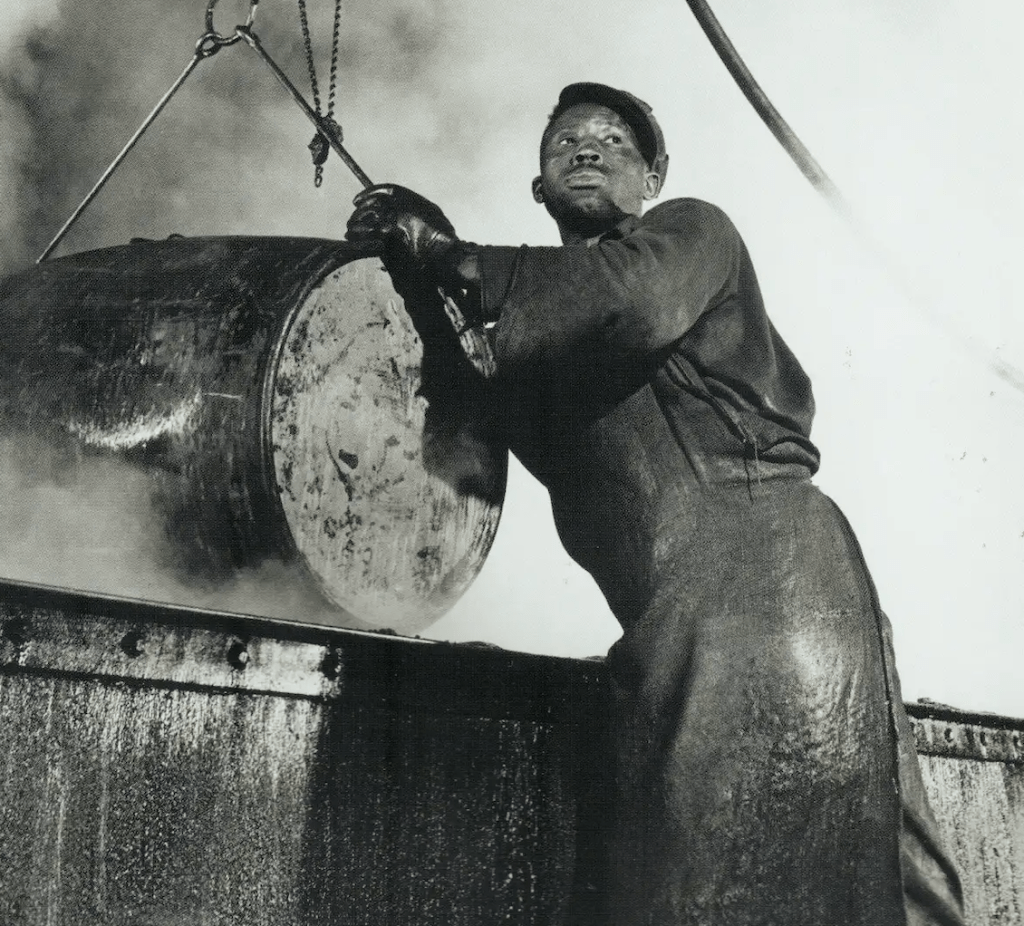
Cover image: The cooper’s room where the large drums and containers are reconditioned. Here a workman lifts a drum from a boiling lye solution which has cleaned from it grease and dust particles. Gordon Parks, 1944.
This essay was originally published in the Pittsburgh Review of Books, which has generously granted Petrichor permission to republish it.
If you ever see a box truck on the road, you might ask yourself: Does the driver receive any training? Do you have to take a series of lessons that cover basic functions and maneuvers, with an instructor in the passenger seat taking notes and dispensing sage advice, before taking the wheel of a six-ton, 400-horsepower monstrosity that has a completely useless rearview mirror (since the cargo container blocks the view) so that you have to back up a little bit, get out of the truck and check your position, back up a bit more, get out again, and so on just to park without hitting anyone or anything?
The answer is no. All I needed to drive an official City of Pittsburgh, Department of Parks and Recreation, Office of Special Events truck was a valid driver’s license—not even a background check of my driving history, which includes crashing my mom’s car at a four-way stop on the way home from the Trader Joe’s in Media, PA and crashing my wife’s car while performing the Sisyphean task of finding street parking in Brooklyn. The truck was emblazoned with a City seal on both sides and filled with AV equipment that I hauled to public parks throughout the East End, North Hills, and South Side. My coworkers and I would plug in a leaf blower, inflate a giant screen made of the same material as a bouncy house, and hook up the speaker and projector and DVD player, providing free screenings of The Minecraft Movie and Soul and Dog Man (where the head of a dead cop is surgically grafted onto the body of a dog, raising the question of whether Dog Cop would be a more accurate title) and other fine works of cinema to the children and parents of this great city.
The worst part was the late-night drive back to the CitiParks warehouse in the Strip District. I had to gingerly reverse the truck right up to the loading dock, which never got easier. The warehouse is right on the Allegheny River and somehow feels a world away from the wineries, Italian restaurants, and Chinese supermarkets just a few blocks south on Penn Ave. This sliver of the Strip is de-industrial, not post-industrial; nothing ever replaced the shuttered factories and mills. Pulling out of the warehouse one day and passing the countless graffiti-covered, disused buildings, I saw one of those historical markers out of the corner of my eye: “PITTSBURGH GREASE PLANT.”
Pittsburgh Grease Plant? I wasn’t about to cause my third car crash for the sake of Pennsylvania history, so I filed away the phrase, ignored Moana 2, backed up/got out/backed up the truck at the end of the night, and looked it up the next day. Founded in 1885 and owned for most of its history by Standard Oil, the Pittsburgh Grease Plant was best known for producing five million pounds of petroleum-based lubricant for the U.S. military during World War II. Tanks, trucks, jeeps, planes: anything that moved inevitably needed grease, whether for waterproofing, transport, or repairs.
The plant closed in 1999. The historical marker went up in 2000. In 2022, the Carnegie Museum of Art revisited the plant’s history with the exhibition Gordon Parks in Pittsburgh, 1944/1946, displaying the black and white photos that Gordon Parks—the prolific photographer, writer, civil rights activist, and filmmaker who directed Shaft—captured when the plant was at its peak.
Art books are for rich people. The accompanying exhibition book costs $65. Pro tip: the Carnegie Library carries almost every CMOA exhibition book, including a copy of Gordon Parks: Pittsburgh Grease Plant, 1944/46 tucked away in the stacks of the main branch, around the corner from the museum. The reason Parks even ended up in Pittsburgh is because of a PR crisis. In 1942, the Department of Justice accused Standard Oil of “anti-trust violations stemming from a long-term relationship with the German petrochemical company I.G. Farbenindustrie,” writes CMOA curator Dan Leers in his introductory essay. “Although [Standard Oil] was exonerated, the damage to its reputation had been done.”
Reading this, you might assume (as I did) that this was all a misunderstanding—just an innocent American oil company with a few business ties to a German counterpart. None of the contributing authors, including Leers, mention that the relationship between Standard Oil and I.G. Farben was so close that when it began in 1929, I.G. called it a “marriage.” At the time, I.G. was best known for developing and supplying the chlorine gas that Germany deployed during World War I. In the 30s, after partnering with Standard Oil, I.G. thoroughly enmeshed itself within the Nazi regime, manufacturing the oil, rubber, and explosives that Hitler used to wreak havoc across Europe. Standard Oil provided I.G. (and by extension, the Nazis) with patents for synthetic rubber, which the U.S. military desperately needed; instead, Standard deliberately hid the crucial technology from the American government. Standard owned factories in Hungary that the company sold to the Nazis. Standard even supplied gasoline to refuel Nazi aircraft.
“Standard Oil: Axis Ally,” read a headline in The New Republic on April 6, 1942, shortly after the DOJ presented evidence of Standard’s collusion with I.G. Farben. Standard was not in any way “exonerated,” as Leers writes. The reality is that the federal government definitively proved that Standard Oil, through its cartel-like arrangement with I.G. Farben, actively aided and abetted the Nazis from 1929 to 1942—an eventful time in German history. Harry Truman, at the time a U.S. Senator, declared that Standard’s actions constituted treason.
On April 7, 1942, just a few days after the end of the DOJ’s testimony, I.G. Farben announced an exciting new venture: I.G. Auschwitz. I.G. had invented and manufactured the Zyklon B that the Nazis used to gas Jews in Auschwitz. Now, I.G. would have a factory complex within the camp itself, powered by slave labor from the inmates. 300,000 concentration camp prisoners passed through I.G. Auschwitz; 25,000 of them were worked to death.
Why do none of the museum curators or foundation directors mention Standard Oil’s ties to the Nazis in Gordon Parks: Pittsburgh Grease Plant, 1944/46? I think it’s because if Standard Oil was complicit in the Holocaust, it raises an uncomfortable question: to what degree was Gordon Parks complicit?
Branded, rightly so, as a traitorous accomplice to the Nazis (“Standard Oil Aided Nazi Airlines,” read a New York Times headline), Standard scrambled to rebrand itself as a patriotic American company—in large part through photos of its American factories filled with American workers, captured by the most talented American photographers of the time. In other words, Standard Oil hired Gordon Parks to make propaganda. There’s no way around this fact. But here’s the thing: Parks’ photos are astonishing. They are breathtaking. They are precisely composed and dramatically staged and cinematically lit and bursting with warmth and humanity and love for labor and the laborers who painstakingly and painfully perform it. They are propaganda; they are art.
After all, how many opportunities did a Black photographer have in the 40s? Especially an opportunity where Parks was given complete creative control by Standard Oil—an essential prerequisite for any genuine work of art. Parks cut his teeth at the Farm Security Agency, the famed New Deal-era welfare agency that produced Migrant Mother, and he approached working for private industry with a public sector mindset. (The fact that Parks had to shift from taking photos for a federally funded relief program to a private petrochemical company foreshadows the larger reallocation of resources from the welfare state to the military-industrial complex: see LBJ diverting funds from his Great Society initiatives to fight the Vietnam War.) The photos have an educational quality that evokes Mister Rogers’ Neighborhood, patiently demonstrating each step of the grease making process: here’s an inspector scooping a ladle-full of piping hot grease into a cup for sampling, here’s a packer turning a spigot to fill a metal drum with strands of grease that look like vermicelli noodles, here’s an electrician checking the knobs and dials of hulking machinery, and so on.
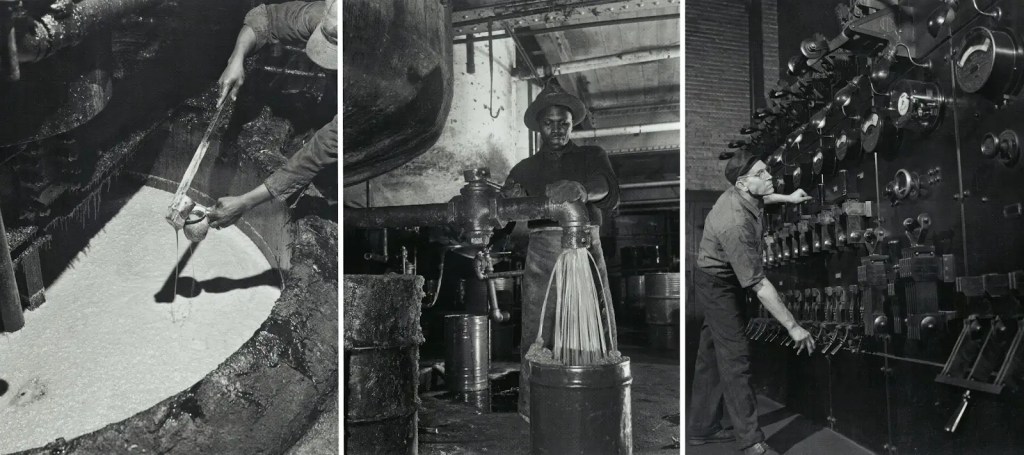
Photos of the grease making process by Gordon Parks, 1944.
Parks was interested in workers at work. We see the worker as both human and machine, as a full person and as a cog performing a specific task within a vast, interlocking industrial process. The photos feel spontaneous, as if Parks was a fly on the wall who just so happened to capture someone on the job. But camera equipment in the 1940s didn’t allow for vérité-esque verisimilitude; in addition to his tripod-mounted camera, Parks lugged around a set of flash bulbs that were the size of spotlights, which he carefully arranged both in front of and behind each subject. Parks must’ve interrupted people in the middle of their shifts, setting up lights and lenses and telling the subject where to stand and what to do, reducing the factory’s overall productivity for the sake of his art.
In addition to these non-spontaneous snapshots, Parks took more obviously posed portraits of workers as individuals and in small groups. In a book he published the year after he left the Pittsburgh Grease Plant, Parks called his approach “journalistic portraiture,” where a subject is photographed “within the subject’s environment. By defining the individual in relation to his everyday life, the portrait takes a new and greater meaning; be it of a farmer in his barn, an executive in his office, or a street urchin.”
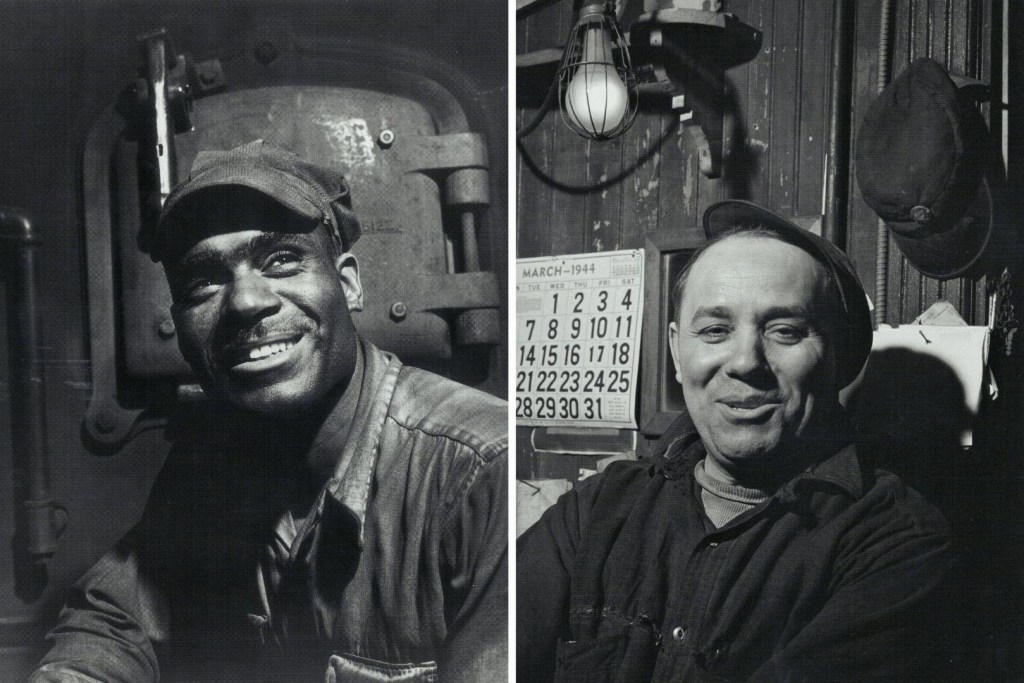
The portraits use the factory as a stage, the twisting pipes and cakes of grease acting as a studio backdrop. The faces of many workers are bright, open, and warm, with genuine smiles and crinkles around kind eyes. They look excited to have their picture taken; perhaps this was the first time they were ever photographed, that they were deemed important enough to be immortalized on celluloid.
One portrait in particular stands out to me. The photo is framed by a metal doorway. In the bottom half are two seated workers, and above them is a ring of flaming gas jets that evoke a hellish halo, the edges of the white-hot heat bleeding into a backdrop of primordial darkness. The workers’ clothes are tattered: frayed fabric hanging from a shirt pocket, torn overall straps held together by string. The worker on the right gazes upward and to his left with confident eyes and a determined expression, as if projecting his mastery over the flames. The one on the left wears wire-rim glasses that reflect Parks’ flashbulb, his mustachioed mouth slightly agape as if he’s astonished by what he’s witnessing, both awed and afraid. There’s something mythological about this photo, where two mortals encounter one of Earth’s foundational elements: fire, this force the gods blessed/cursed us with, that humans can wield to our own ends (in this case, manufacturing millions of pounds of grease) but can also destroy us, a force that we must face with respect and courage.
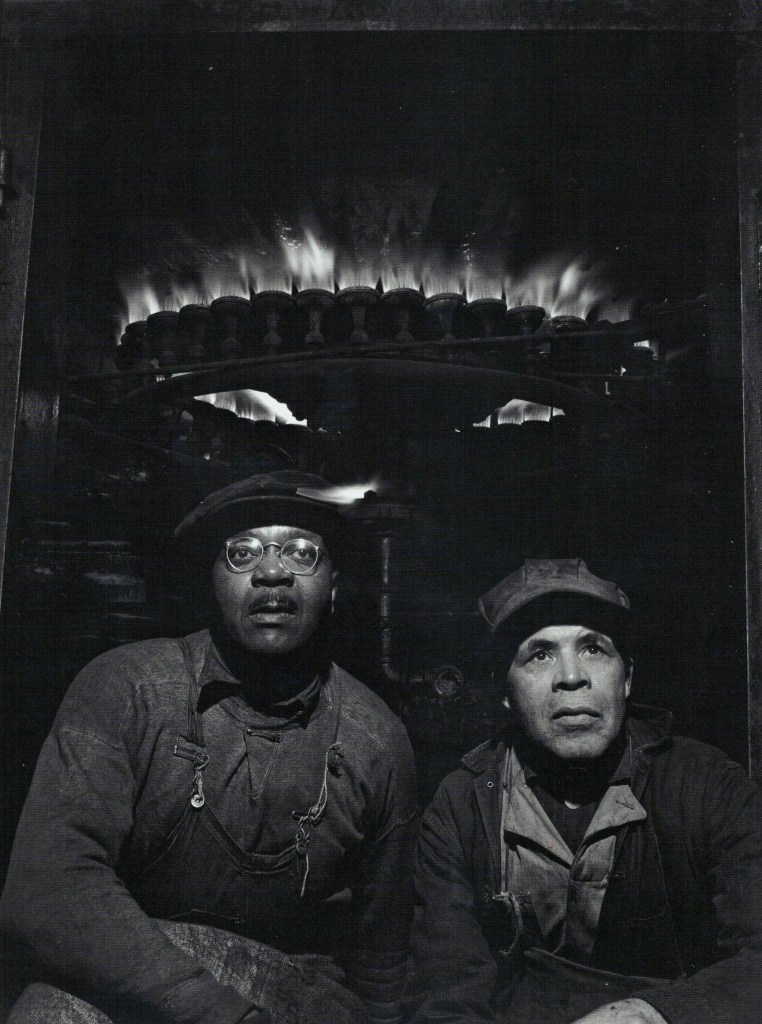
The most astonishing quality of this photo: the worker on the left is Black, and the one on the right is not. Pittsburgh didn’t have Jim Crow laws, but racial segregation and discrimination were absolutely alive and well. Black workers were the last hired and first fired, given the most dangerous and low-paying jobs, and initially barred from union membership. But here are two men of two races seated so close to one another that their arms touch, united across the color line by their shared class interest.
This is not to say that Parks promotes a kumbaya attitude of racial harmony in his photos. Parks grew up attending a segregated elementary school; he was keenly aware of how anti-Black racism affected every aspect of American life. By fully depicting the Pittsburgh Grease Plant, he also depicts the racial and economic stratification of the plant and industrial Pittsburgh as a whole. The rank-and-file workers, the ones actually making grease on the factory floor, are almost entirely Black. The “skilled” workers (as if manual labor doesn’t require skill), the plumbers and chemists and lab technicians, are mostly but not entirely white. There is also not a single living, breathing woman in any of the hundreds of photos Parks took; the only woman we see is a framed picture of a nude pin-up model on the wall. Were there absolutely no women in the three city blocks that the Pittsburgh Grease Plant occupied? Regardless, behind every male worker is the invisible, essential domestic labor that women performed and men literally survived on: someone had to make and pack all those lunches. Someone had to restitch those tattered overalls.
Only white men occupy the upper echelons of the plant, the well-appointed offices far from the shrieking, smoking machines. Chief engineer A. B. Knight is photographed in his private room, wearing a suit and tie with a crisp fedora on his head. Most of the photo is cut diagonally with stark, film noir shadows; we spy a calendar and a desk lamp lurking at the dim edges. Knight looks at us through a small square porthole, the sort of counter you prostrate yourself before at a DMV or hospital waiting room. He’s shrouded in darkness and photographed at a remove, unlike Parks’ proletariat close-ups, looking like a weary private eye. His eyebrows are slightly, ironically arched, and he gives us a side-eyed glance. He looks cold. He’s telling us: “Go away, don’t bother me.”
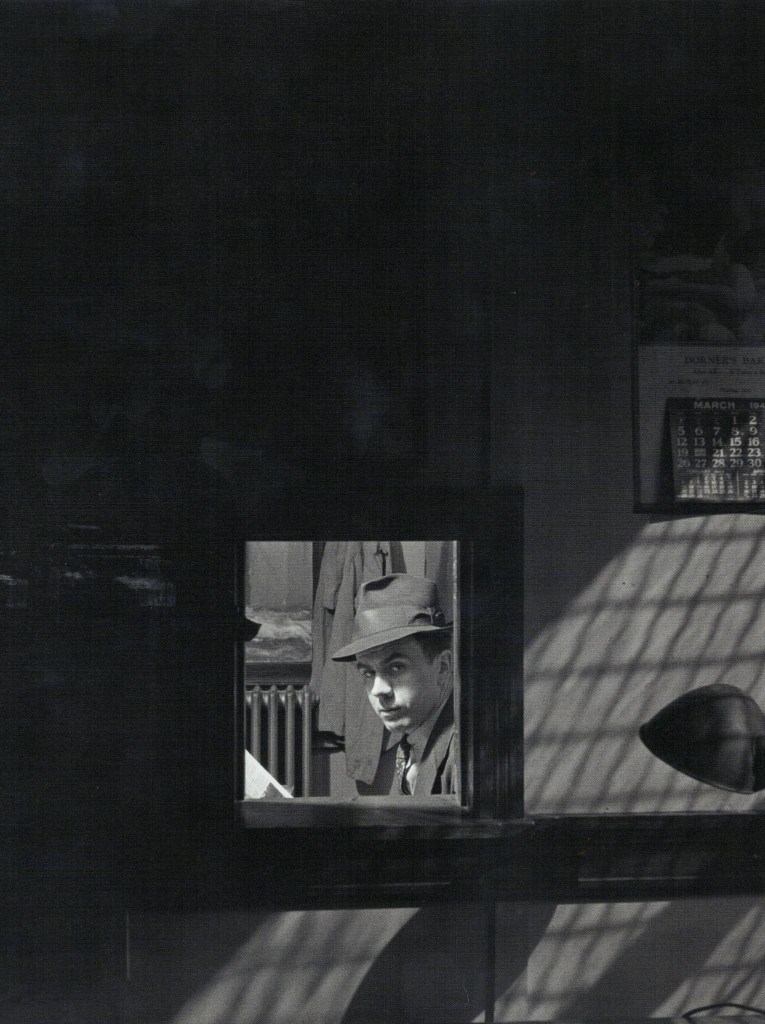
What is this man’s job? Parks clearly demonstrates the function of each worker through their actions: a labeler painting labels onto grease cans, a shipper loading those cans onto a railcar, etc. What action is this suited man performing—what is his function? His function is to sit in a comfortable chair in a private office and not be bothered.
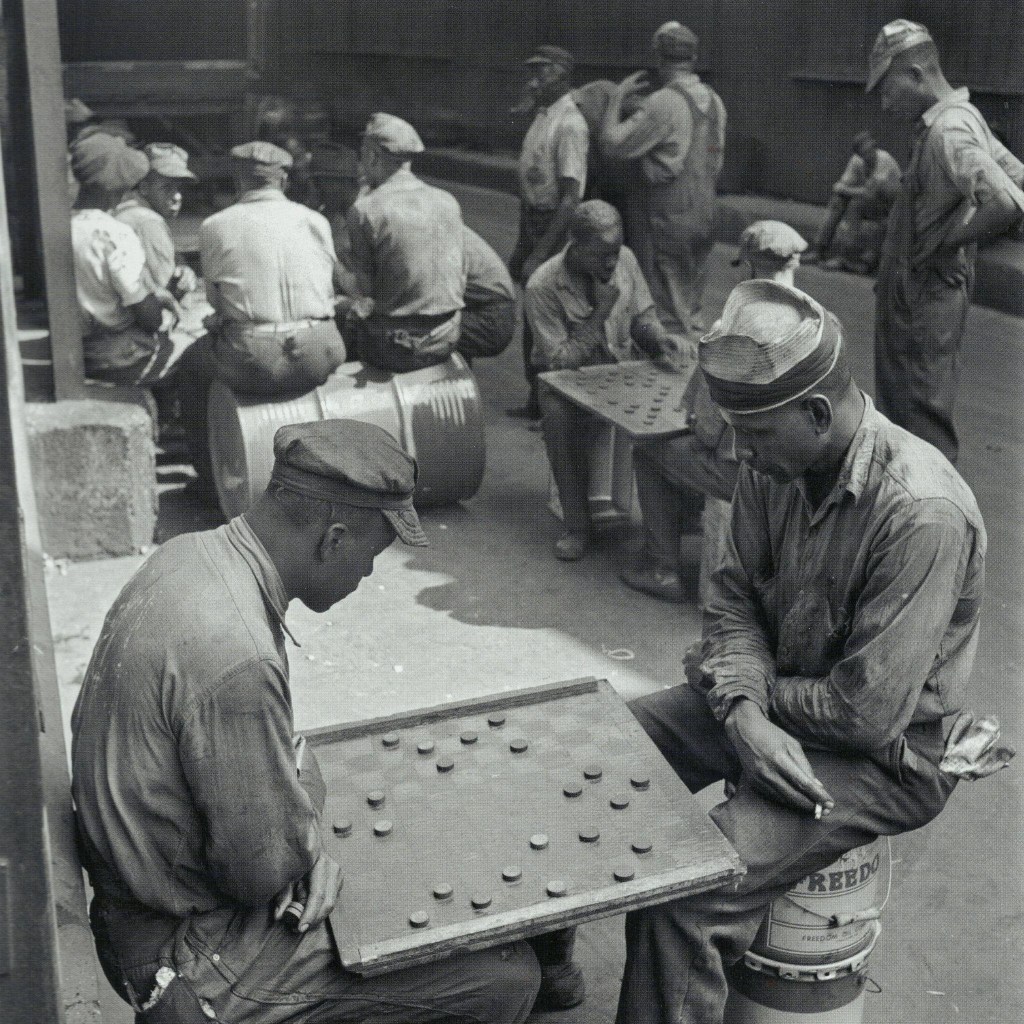
The workers don’t have comfortable chairs to rest in; they don’t have chairs at all. In Parks’ photos of workers on break, they congregate at a random patch of concrete outside the plant, sitting on wooden boxes and barrels and overturned oil drums. Some of them stand because they can’t find a seat at all. The workers play checkers with one another, and it took me a second to realize that the checkerboards aren’t placed on tables—because there aren’t any tables. A pair of workers face each other and rest the board on their knees, the rough wood digging into their trousers. These are the people who actually manufacture the material the company profits from, yet the company can’t even give them a few picnic tables to sit at.
At what point does an organization made up of humans supersede the needs and desires of the humans themselves? At what point does The Company become more important than the workers who actually create value for The Company? The great Latoya Ruby Frazier—one of the most prominent photographers of our era, born and raised in Braddock—writes in her introductory essay that Parks took these photos “behind enemy lines.” The enemy, by implication, is Standard Oil, which renamed itself to Exxon in 1973 and merged with Mobil to form ExxonMobil in 1999, as Frazier notes. This is a company that materially aided the Nazis, internally proved the existence of climate change while publicly promoting climate denialism, and is responsible for 3.2% of all global greenhouse gas emissions—a company that, historically and presently, is dragging humanity towards an ecological cliff that could end life on earth as we know it.
What does it mean to work and make art for a fundamentally exploitive institution? I teach at the University of Pittsburgh, which stopped providing gender-affirming care for trans youths and sicced cops on its own students for protesting the genocide in Gaza. The reason I learned about Parks’ photos in the first place is because Pitt, like most universities, doesn’t pay adjuncts over the summer, forcing us to string together gigs like (in my case) driving a box truck full of movie equipment past a historical marker for a grease plant. My deep antipathy for the chancellors and provosts and useless high-level administrators who bend to the will of a fascist regime is matched only by my respect and admiration for my students and fellow faculty, the people who create the university’s actual value. My wife was in my MFA cohort at Pitt; many of the guests we invited to our wedding are former classmates and professors.
As a grad student, I got free admission to the Carnegie Museums—named, of course, for a union-busting, strike-breaking robber baron responsible for the killings of dozens of his own workers who, after extracting the immense value generated by those workers, laundered his wealth and reputation by building libraries and museums and universities for the public. This month’s articles on Petrichor are supported by The Frick—name, of course, for Carnegie’s chief henchman, who dispatched Pinkerton militiamen to kill striking steelworkers in Homestead and later turned his private Point Breeze mansion into a museum, where today visitors can pay $15 to view another exhibition of black and white photos of the 20th century working-class (pro tip: RAD Pass is offering free tickets).
Listen: I love the Carnegie Museums. I’d go there during breaks between classes just to kill time. I recently interviewed a native Pittsburgher named Shirley Yee; her family once lived in Chinatown, which the City largely demolished in 1921 to build the Boulevard of the Allies. Her grandmother moved to Oakland, to a house on Forbes Ave right next to the museum. In 1974, the museum demolished her grandmother’s home—along with her neighbors—to build an expansion that, nearly half a century later, hosted the Gordon Parks exhibition. Whenever Shirley visits the museum, she’ll stand by the fountains in the courtyard. She’ll think of memories of playing in her grandmother’s living room, which today is a shallow pool of water where nothing lives.
Capital, labor, forced displacement, private corporations, cultural and academic institutions, fine art: they’re all tangled up in a way that’s hard to unravel. A nonprofit museum named after and founded by a ruthless exploiter of labor, which razed the homes of working-class families to build white boxes where photos of the working-class are admired by visitors who can afford the $25 ticket; a private company that at the height of WWII—after supporting the Nazis—forced its grease makers to work round the clock, yet couldn’t even provide seats for the weary laborers to rest in, who instead slept on empty stacks; a publicly-funded university that year-after-year increases tuition while overenrolling students—shoving a third bed into a double dorm, sticking students in hotels that are a 20 minute walk from campus—and increasing class sizes, making faculty do more work for the same amount of money. What do they all have in common? What allows these institutions to simultaneously extract value from yet hold in contempt the workers who make up and power the institution?
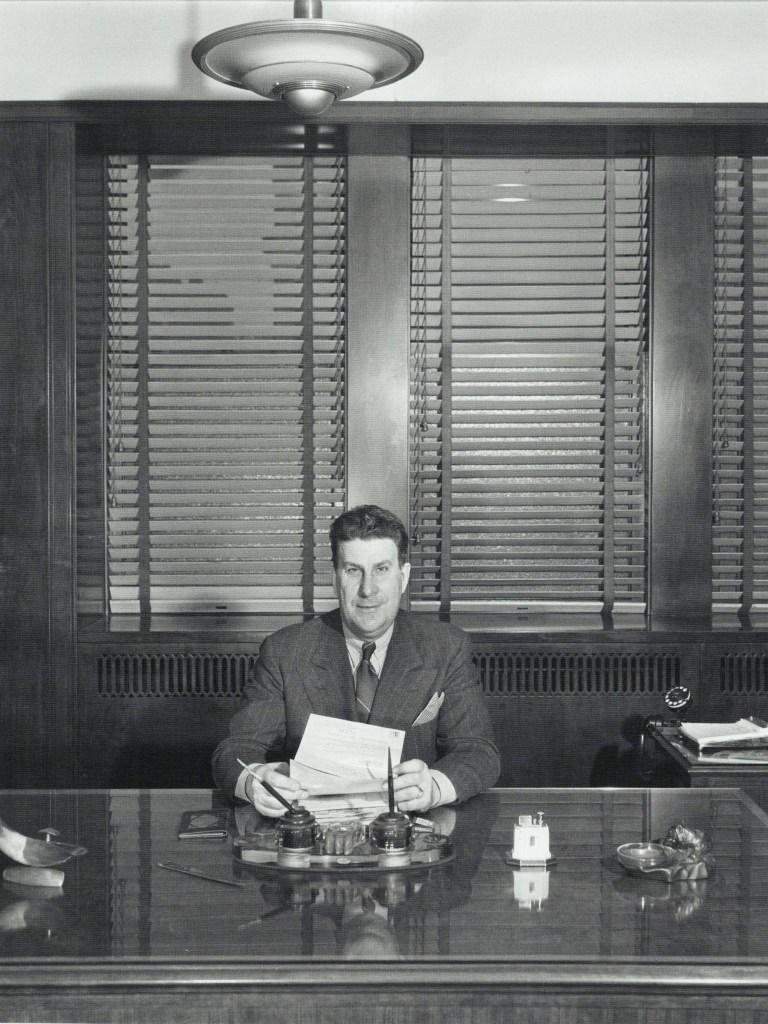
It’s hierarchy. It’s the vertical sliding scale of humanity, where some humans are simply more human than others, that structures our workplaces and schools and cities and society. Gordon Parks took a photo of the white man at the very top of this hierarchy at the Pittsburgh Grease Plant: C. B. Karns, the plant manager. The fact that he’s even named indicates his status; the identities of most of the workers are lost to history, although Parks commendably recorded some of their names. Karns wears a pinstripe suit with a pocket square and sits at a vast, polished desk. He’s surrounded by the accoutrements of the upper-class: fountain pen holders, a leather wallet, a bronze ashtray that for some reason has a lion carved into it. He gives a smile that I interpret as smug, although of course I’m biased. On his left hand is a wedding ring. He’s the only person in any of the photos to wear jewelry. He never got his hands dirty.
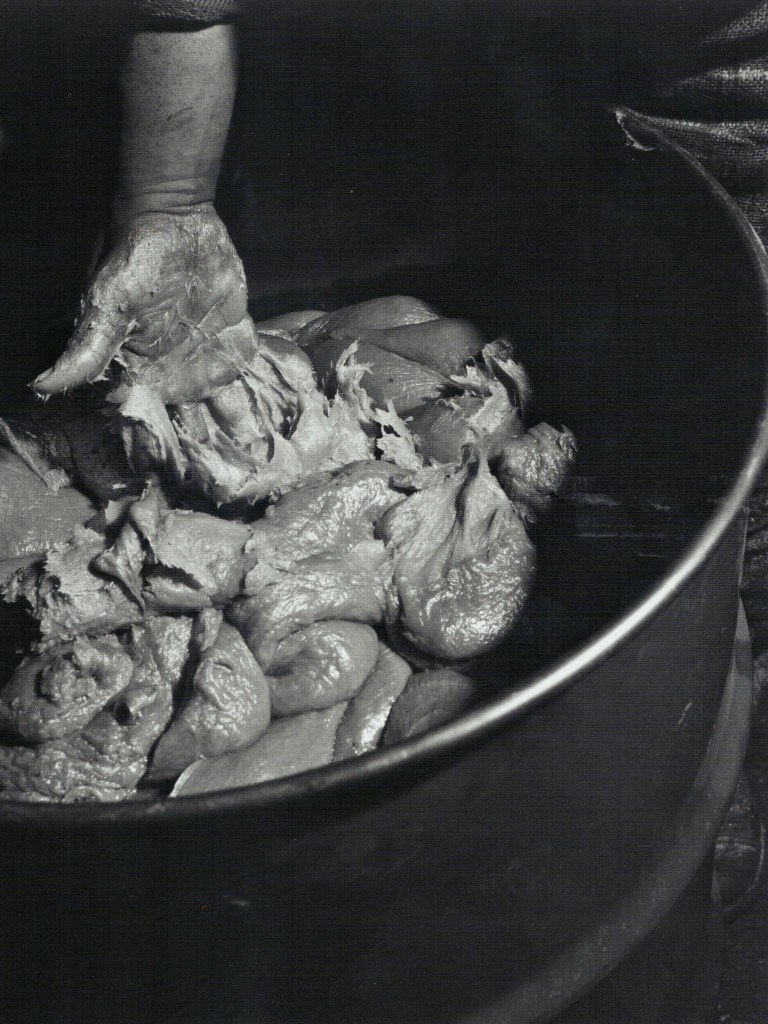
Gordon Parks did. He wrote in a letter that “in every building and on every floor grease was underfoot.” By the end of each day, his equipment was covered in grease, which he had to spend an hour scrubbing off. My favorite photo from the collection is a close-up of a hand dipped in a tub of grease. The grease contained asbestos; some of the workers wore gloves, but others handled it with their bare hands. Heating the grease to 450 degrees F would’ve released asbestos into the air, filling the workers’ lungs with invisible fibers. How long did the grease makers live? Did they develop the health conditions that continue to plague the residents of Clairton and Braddock, where U.S. Steel operates its remaining plants?
In the photo, the shiny folds of grease look like raw meat. The man’s palm is deeply lined, his fingers calloused, all of it caked in a thick layer of grease. It’s as if his hand is caught in a sinkhole, a swamp of petroleum-based lubricant that will swallow him whole. I imagine that no matter how many times he washed his hands, it never fully came off.
Boen Wang is a writer, audio producer, and adjunct instructor at the University of Pittsburgh, where he graduated in 2022 with an MFA in creative writing. His written work has appeared in The Sunday Long Read, The New Republic, and elsewhere. His audio work has appeared in This American Life, Radiolab, and elsewhere. Visit his website at boen.cool.
This month’s articles are generously supported by Lewis Hine Pictures America at the Frick. Discover photography’s radical capacity through May 17. Tickets now on sale.

 PETRICHOR

Leave a comment