by Tara Fay Coleman
Photo courtesy of the Carnegie Museum of Art
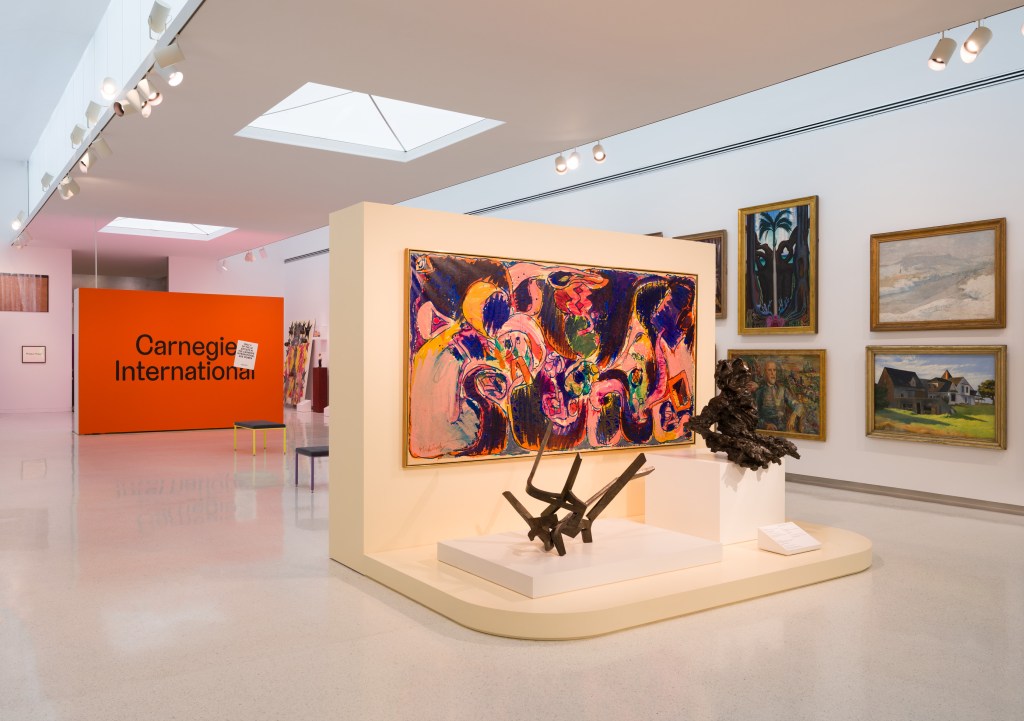
The 59th Carnegie International takes up the word “we” as its central proposition, positioning it as something shaped through acts of listening, understanding, translation, and exchange. It resists a fixed identity, moving instead toward something collective. But “we” is never neutral, it is structured by access, by who gets to speak, who is included, and who remains outside of its reach. Organized by Ryan Inouye, Danielle A. Jackson, and Liz Park, the exhibition extends beyond a single site, expanding across multiple institutions throughout Pittsburgh. In addition to its primary location at the Carnegie Museum of Art, works are presented in partnership with the Children’s Museum of Pittsburgh, the Carnegie Science Center, the Mattress Factory, and the Thelma Lovette YMCA in the Hill District. This dispersal suggests an attempt to move “we” outward, to situate the exhibition within a broader cultural landscape rather than contain it within a single institutional frame.
But expansion across sites does not undo the structures that hold it together. Each location carries its own history and its own relationship to the communities it inhabits. The Children’s Museum is a more accessible space that is less formally coded than traditional museums, and its focus on youth makes it an interesting expansion of the International, one that highlights how similar institutions are often excluded from conversations around contemporary art. The Kamin (formerly Carnegie) Science Center, part of the larger Carnegie Institutional network, suggests an extension of the idea of knowledge production, but also reinforces how institutions shape what qualifies as knowledge, and who gets to engage with it. The Mattress Factory, lauded as a more experimental and artist-focused museum, exists within the broader reality of development on the North Side of Pittsburgh, which creates a layered relationship to community in that it represents how a space can both support artists while contributing to rising costs and displacement.
The Thelma Lovette YMCA is the most unexpected of all of these site expansions, particularly because it’s situated in a neighborhood with a deep Black cultural history, as well as a long legacy of displacement through various urban renewal projects that dismantled core parts of the community. The YMCA functions as a direct community resource, which shifts the context of the exhibition by placing art within a site of community necessity rather than cultural consumption. This raises important questions about who the work is for, and how it’s encountered. These spaces do not have the same power or serve the same public, and moving across them makes that more visible, and reveals how unevenly the idea of ‘we’ is constructed, an unevenness which ultimately defines the exhibition itself.
The idea of “unbound borders” runs throughout the exhibition, bringing together artists working across geographies and engaging cultural and political conditions that exceed national frameworks. There is a clear investment in the movement of people, materials, and histories. But that movement is still organized, gathered, curated, and made legible within spaces that depend on coherence. The exhibition reaches toward borderlessness while making the idea’s limits quite visible. This tension is most pronounced in how collectivity is framed. “We” is offered as something that emerges through proximity and relation, but collectivity does not simply appear when works are placed in conversation.
I view the idea of collectivity as something that’s built and can fracture under difficult conditions. It requires negotiation, responsibility, and a willingness to stay present when things don’t align. Like past iterations of the International, the exhibition unfolds as a series of encounters rather than a unified whole. Artists are brought into proximity, their works resonating across differences. The parallels that surface across labor, migration, and memory remain uneven. They are shaped by specific histories that do not fully resolve into a shared identity, and materials carry much of that weight.
Across the exhibition, artists work through forms of making that carry knowledge – screenprinting, assembling, layering, working with found materials, and building through accumulation. Connections begin to form through the work itself, through methods that echo across distance without collapsing difference. The question of liberation runs underneath all of this.
As I moved through the exhibition, I kept reflecting on my own experience of collectivity in Pittsburgh, one that has often felt fragmented and disjointed. There is a tendency to treat community as something that forms naturally, as if presence alone is enough to sustain it. That has not been my experience. Community is truly shaped in moments of conflict, when things don’t align, when disagreement surfaces, and when remaining present becomes a choice rather than a given. I’ve been in spaces that call themselves communities where that work never happens. Conflict is avoided or redirected to preserve a sense of cohesion, and alignment is assumed rather than built. What’s being maintained in those moments is comfort, not care.
Over time, it becomes clear how often we continue to operate in ways that reproduce the systems we claim to resist. Not always directly, but through smaller decisions – who is protected, what is overlooked, when silence is easier. The benefits of that alignment are real, and they are not shared evenly. So when the exhibition gestures toward collectivity, I find myself thinking less about collectivity’s possibility and more about what it demands. It asks for a willingness to move through conflict, to recognize harm, and to give something up. It requires a sort of commitment that is often inconvenient.
Liberation does not come from being in the same room, or even from being in conversation. It comes from the work those conditions expose, and from continuing that work beyond the moment itself. The exhibition points toward collective life, and toward the necessity of being in relation. But it does not fully confront what that requires. If liberation is collective, it cannot be produced within the space of an institution. It cannot be installed or fully realized through partnerships, no matter how expansive they appear. Institutions can adopt the language of liberation. They can create visibility and open space for exchange. But they are not built to dismantle themselves.
Even as the exhibition extends across Pittsburgh into other museums and community spaces, it remains bound to the frameworks that make it possible. This does not negate the work, but it defines its limits. Survival, the kind the exhibition gestures toward, has never depended on institutions. It has depended on people, on networks of care and exchange that exist outside of formal recognition. In a moment this unstable, where so much feels at risk, the need for that kind of community is not theoretical, it is urgent.
We do not survive because we are included in an institution’s version of “we.” We survive because we build it ourselves. That is where the exhibition leaves us. Not with a resolved sense of collectivity, but with the recognition that “we” cannot be granted or staged. It has to be enacted, sustained, and protected, often in spite of the same structures that attempt to define it. What remains is not a cohesive whole, but a set of conditions, and a series of attempts to come together across differences. Proximity is not solidarity. Being placed in relation does not produce care. If “we” is anything, it is the understanding that without one another, there is nothing at all.
Tara Fay Coleman is an artist, independent curator, writer, and cultural worker from Buffalo, NY. Her practice aims to explore how power, race, and history shape what is seen, and what is systematically obscured. Working across art, writing, and curation, she centers Black cultural production that resists dominant narratives, and reclaims the right to self-representation. Rooted in lived experience, her work aims to challenge institutions to confront their exclusions, while creating space for stories long marginalized. Her goal is to always curate with a commitment to presence, complexity, and care, and she envisions cultural spaces where artists are not only visible, but central, and where art fosters joy, connection, and self-determination. Tara Fay currently lives and works in between Pittsburgh, PA, and New Haven, CT.
This month’s articles are generously supported by Lewis Hine Pictures America at the Frick. Discover photography’s radical capacity through May 17. Tickets now on sale.



Leave a Reply