by Zara Yost
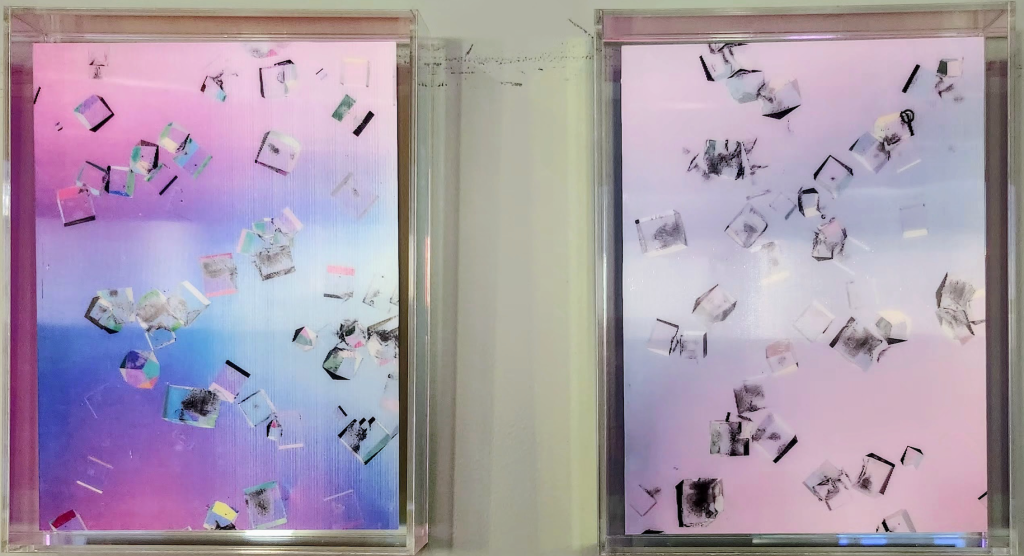
Cover image: Christine Lorenz, Halophilic 2-1525-1425, 2023
I got the call on Thursday. “You’re going to need to head to the hospital as soon as possible. You need to have an induction,” the nurse told me kindly but firmly. To my dismay and chagrin, I developed ICP (Intrahepatic Cholestasis of Pregnancy) a condition of the liver that creates a build up of bile acids in the bloodstream that could result in stillbirth, a condition that The Midwife Center considers out of their jurisdiction, along with a list of other complications, ICP could not be accommodated. I was being transferred. My dreams of a holistic, warm environment vanished as I bounced helplessly on my exercise ball while the nurse explained my labs, and asked which hospital I preferred. When I got off the phone, I stared out my window for a long time. The sky was a beautiful blue, the sun hot and high. I called my partner, I ate lunch, packed a hospital bag and waited.
My child was born a couple days later, early Saturday morning at 4:56 AM. It’s easy to say it was life changing. It’s harder to say that I died that day. No, I didn’t flatline during surgery, and no, I didn’t lose so much blood that I left this world for a few minutes. No, my birth was as good as I could have hoped for—no meds aside from a prostaglandin insert—and yet, who I was before, died. The woman I was before was gone. I left her behind on the hospital bed as soon as I pushed my child out, reached down, grabbed them and put them on my breast. My soul split and now there was me, and this tiny human wriggling in front of me.
I owe a lot of my resilience to The Midwife Center (TMC). Even though I was transferred, the care leading up to my delivery is what made my birth experience so positive. Through perinatal therapy, prenatal visits, connecting me with a doula, to postpartum group therapy, TMC was my champion and an invaluable resource.
It’s not a surprise then that Flock Artist Collective, a diverse group of artists focused on supporting one another through different stages of motherhood and mothering, would do a show at TMC and have it center around mother/artists.
The exhibition of thirteen artists spans across the three floors of Western PA’s first and only licensed freestanding birth center, The Midwife Center. You can find the works throughout the Strip District building—on the staircase, in the lobby, in the hallways leading to the birth rooms and in the spaces used for birthing classes and meetings.
Collages that range from magazine cutouts to cotton and quilting fabrics from Sophia Cardillo, to poem prints from Amy Bornman, to Stefanie Zito’s “Molt”, a sculpture of postpartum hair loss on a wooden spool. The art is as eclectic as Flock Artist Collective.
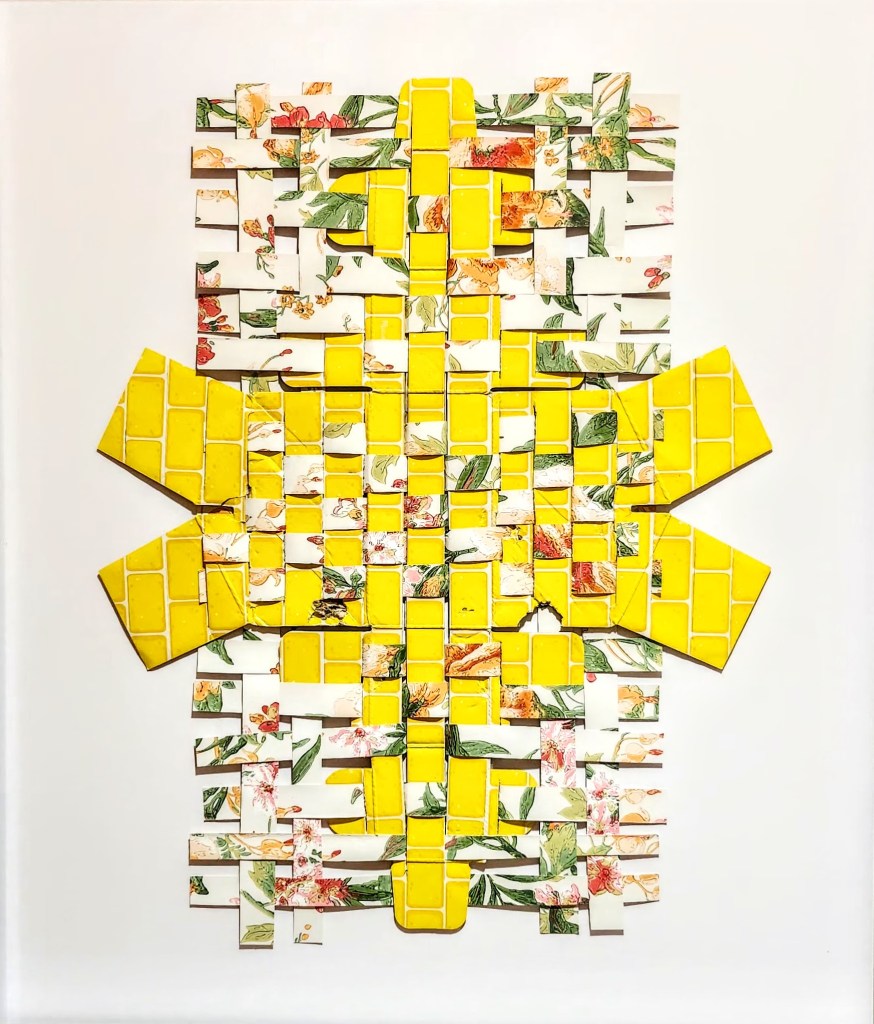
Carrie Smith Libman’s piece, “How to grow a garden,” weaves a Melissa and Doug block with wallpaper. Melissa and Doug, for anyone who is not a parent or somehow has not come across it, is a toy company catered to early childhood and some school-age kids. The brand offers everything from play food, blocks, push toys to interactive stations. Libman takes a jumbo cardboard building block and plaits it in with a piece of wallpaper. Like Libman is entwining themes of childhood and adulthood. Like building a home; it’s a space that is both hers and her family’s.
Sophia Cardillo’s, “The Glider” is in two parts. One part is a wooden glider, ready-made and backed with cotton fabric. In between the glider spools are magazine cutouts of patterns, flowers, and scenes of nature. The wood offers a hard, tactile frame to the softer fabric and images. Below the wooden-glider piece is a woven, eight-point star textile made up of postpartum disposable underwear, yarn, thread, and filled with unmatched baby socks, hospital socks and hair lost after birth.
Cardillo’s work ranges from performance film, to collage and textiles. In “The Glider” Cardillo takes something “disposable” like the postpartum underwear, and the mismatched baby socks and hair, and turns it into reverence. That underwear that held you after giving birth? Honor it. That hair that you grew for months and months? Respect it. Those baby socks that held warmth and safety but got misplaced or lost? Observe them.
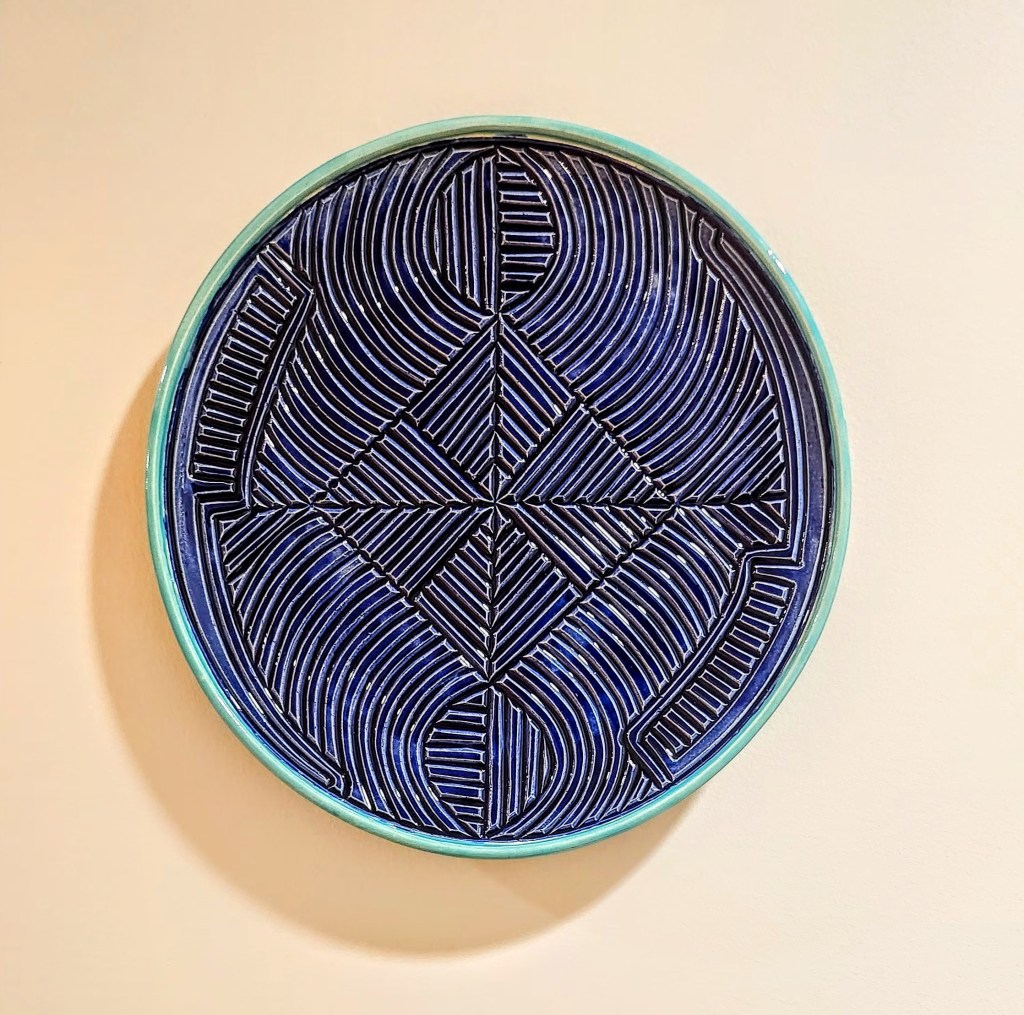
Alecia Dawn Young’s ceramic work is also on display. Young, a public artist deeply ingrained in Black cultural traditions, uses clay to study and consider the connection between material culture, the earth and the body. For Young, clay is a living medium that is embedded with transmissible knowledge of the past and a vessel for future makers. Her work, “two braiders, one head,” is an example of highlighting the cultural tradition of hair braiding and solidifying the practice into something tangible, celebratory and carved into time by the artist. The plates become more than status and decor, but markers of history, Black culture, and existence.
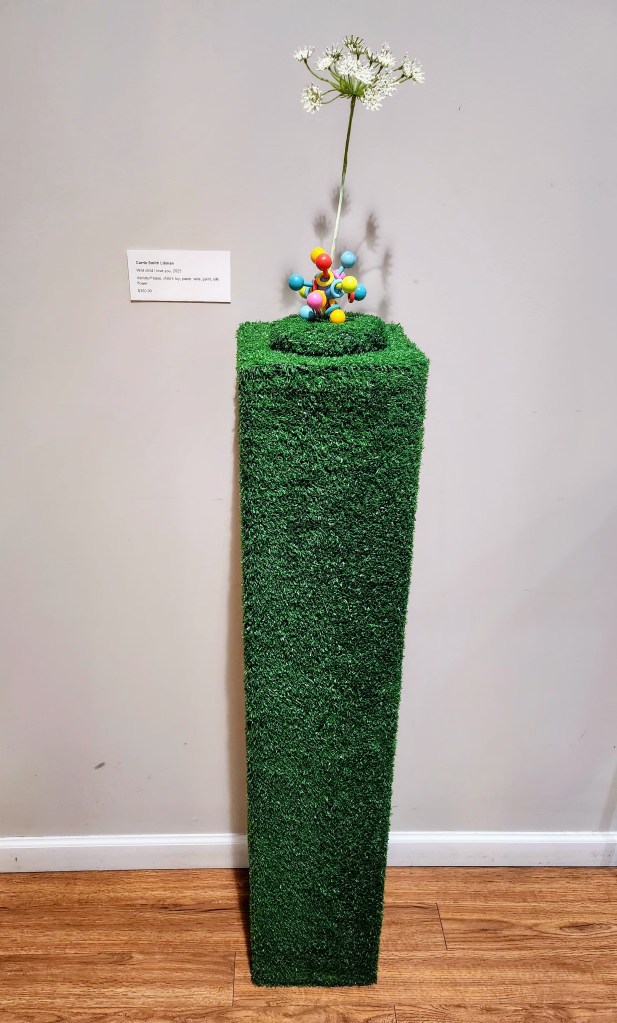
In the exhibition the artworks range in intensity, from Amiee Bungard’s acrylic painting, “Placentary,” Megan Shope’s, soft sculpture, “Excavation,” and Maggie Bjorklund’s “Placenta for Silas” which are more visceral and evoke tissue imagery of the birthing process, to more playful works like Carrie Smith Libman’s “Wild Child I love you,” and “Fragile and full of potential” sculptures of astroturf, a child’s toy, paper, wire, paint and silk flowers. While the scope of materials and the potency of imagery varies, parenting, motherhood, and identity punctuate throughout the works.
Flock Artist Collective: An Art Exhibition of Artist | Mothers at The Midwife Center will be on display until June 26, 2026.
Zara Yost is an interdisciplinary artist, curator, and writer living in Pittsburgh. Her career is heavily influenced by her time in Chicago’s music and art scene. She has written for publications such as Newcity, the Chicago Reader, and Fnewsmagazine. Zara is best known for her work with organizations such as the Museum of Contemporary Art Chicago, United States Artists, Boston Society for Architecture, and The Roberto Clemente Museum.


Leave a Reply