by Emma Riva
To an insect or a bird, flowers and blades of grass are eye-level. In Jannick Wildberg’s paintings, she places objects from nature at the level of the human gaze, both decentering human beings and reminding us that we are part of a larger system. It’s easy in a time when anyone can snap a photo of the natural world on their phone to discount the value of painting nature. Many contemporary exhibits have tried to reinvent the landscape or make the case for it being connected to social issues to prove its value. But Wildberg’s studies show the power of letting nature breathe as it is, while also imbuing it with stylized symbols and personal meaning.
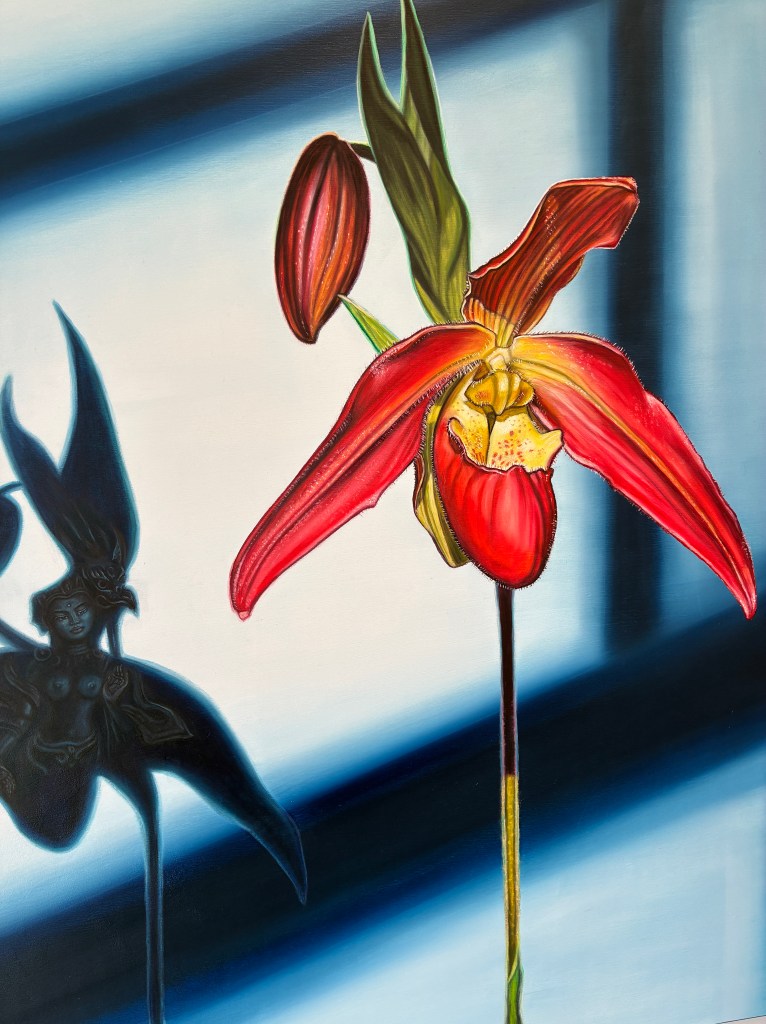
Wildberg, who is originally from Rennes, France, has been painting all her adult life. She only makes ten or eleven works a year, and the attention to process shows. The lines of each painting are at once both bold and gentle, and what seems to be a painting of a lady slipper or a bird’s nest can in fact be something else entirely.
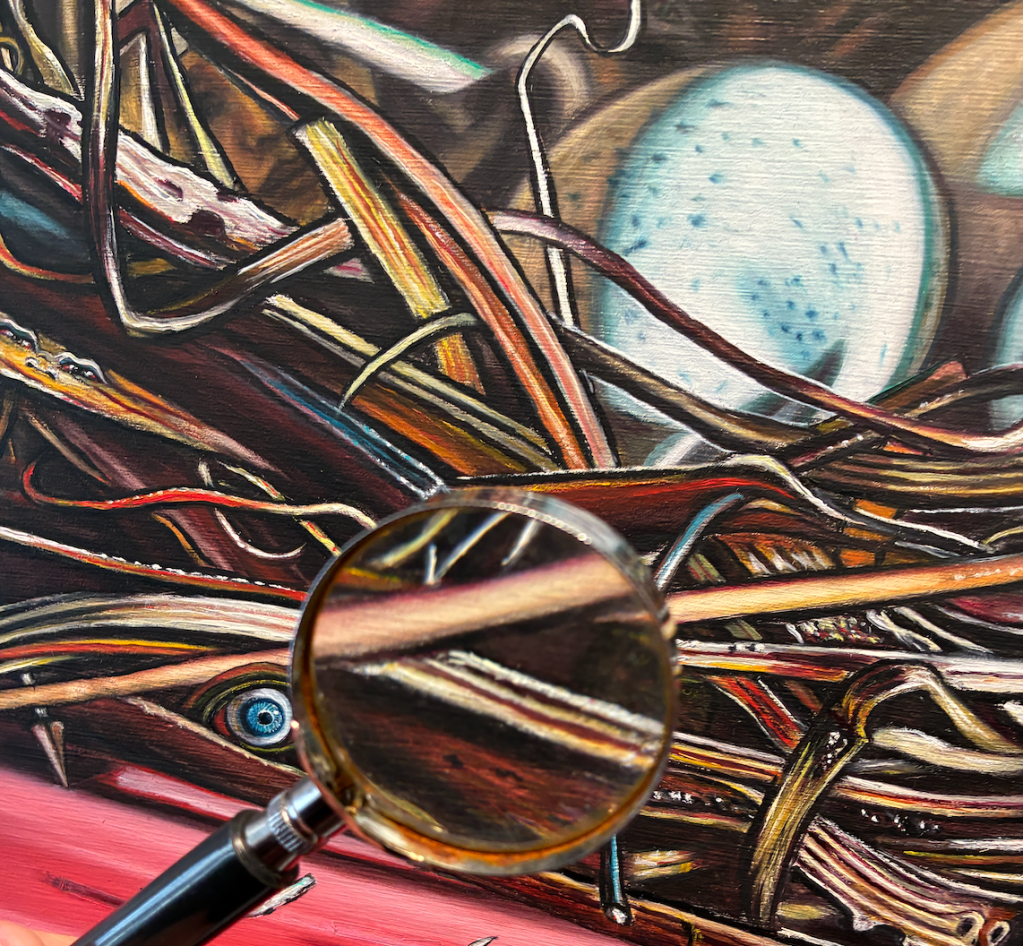
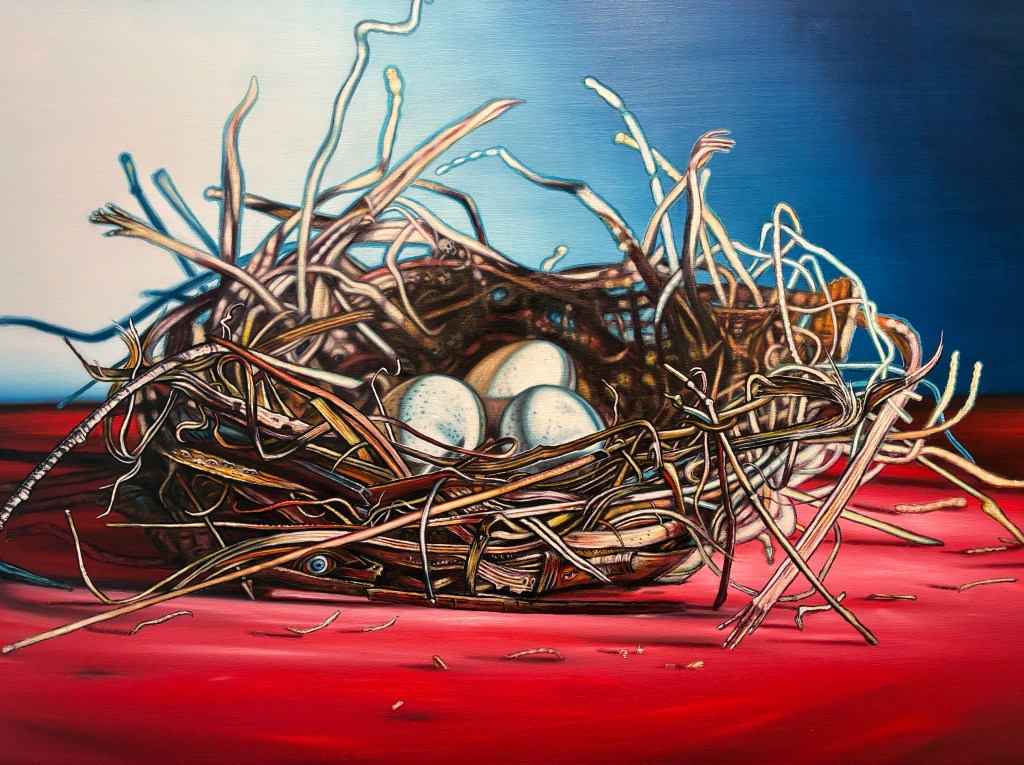
In Cradle of Life X, which from far away is a bird’s nest, eyes, faces, the shape of an angel, a hand, and a Christlike figure are woven into the twigs of the nest. There’s a surrealist edge to how Wildberg depicts the natural world, and part of what drives her intuition is her Buddhist spiritual practice. Her mother was from Vietnam, where Buddhism is one of the dominant religions, and her French father also practiced Buddhism. In her paintings, you can see the Buddhist goddess Tara or the Tibetan Buddhist protection symbol of the Garuda.
“I love nests, I think they are masterpieces themselves. The birds create all these breathtaking structures.”
“I love nests, I think they are masterpieces themselves. The birds create all these breathtaking structures. The nest and the eggs are symbolic of shelter, family, protection, the unity of all things. As a mother, maybe I associate with these things, but also men buy them, too,” she said. But for her, the nests also represent loss. Her mother lost her own mother at a young age, so the nest fallen to the ground as an image may have resonated with her.
Ultimately, though, she wants the work to speak for itself and have universal appeal beyond her individual identity. Someone who knows nothing about Buddhism or nothing about Wildberg’s life can still be mesmerized by her paintings. Earlier in her career, she painted portraits, and while she still makes figurative work of her friends, she tries more to capture the person’s essence than to capture their literal, photorealistic image. She noted that in a way, viewers relate more to the images of nature than to the portrait of someone they don’t know. “A flower just is,” she said. “It emanates radiance.”
When Wildberg had children was when she really began to feel the inter-connectedness of all things. “When my kids were born, something shifted and it fueled this determination to dedicate my professional life to art,” she said, diverging from the stereotype of mutual exclusivity about making art and motherhood. “I felt this sense of urgency.”
“When my kids were born, something shifted and it fueled this determination to dedicate my professional life to art. I felt this sense of urgency.”
And while many parents roll their eyes at their children’s interests, Wildberg allowed her children’s personalities and lives to inform her work. “I take my children very seriously and I learn from them,” she added. Both her children are now adults, and her daughter works for the Mount Cuba Botanical Garden outside of Philadelphia. Her daughter’s job helped Wildberg learn more specificity about plants and flowers. “Younger people have a higher consciousness,” she said. “They have much more respect and empathy for each other. I have a lot of hope for them.”
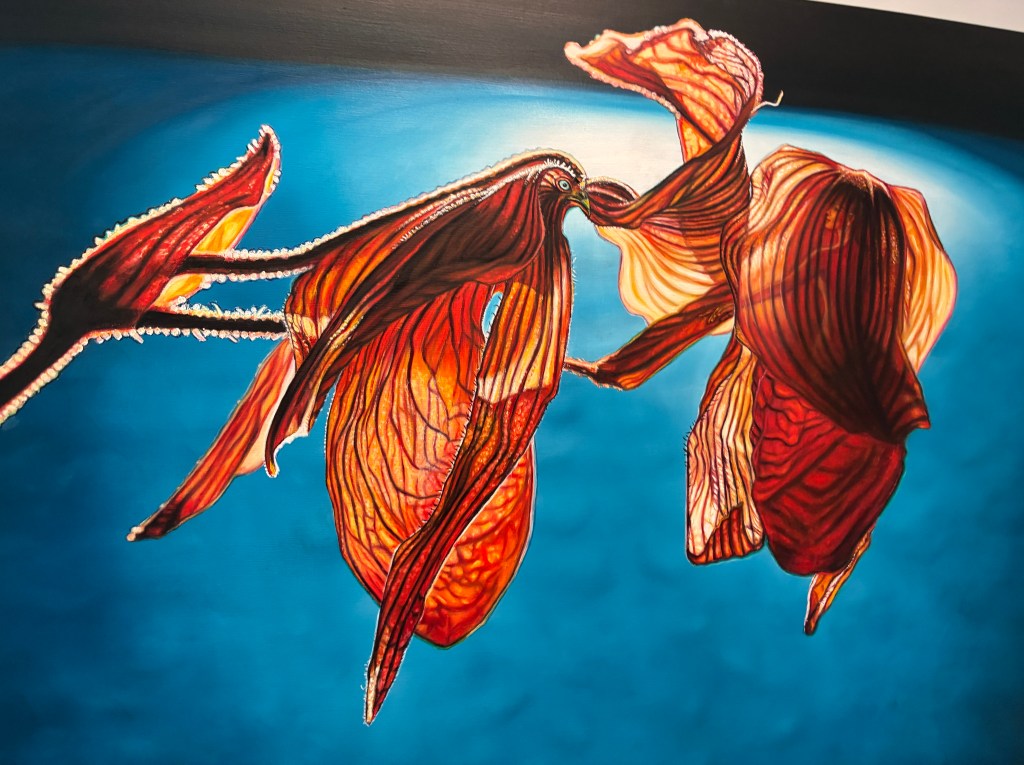
“A flower just is. It emanates radiance.”
At one point, Wildberg took out a magnifying glass to show me how granular some of the hidden symbols in her paintings on view at ZYNKA Gallery as part of the recent show emBodyment are. The paintings command slow looking and ask us to remember that everything we look at has more to it than we initially see. But Wildberg also considers her paintings meditations on impermanence. The lady slipper blossom, which can be the entire world to a bee searching for pollen, can be gone in an instant with too much wind or too little rain.
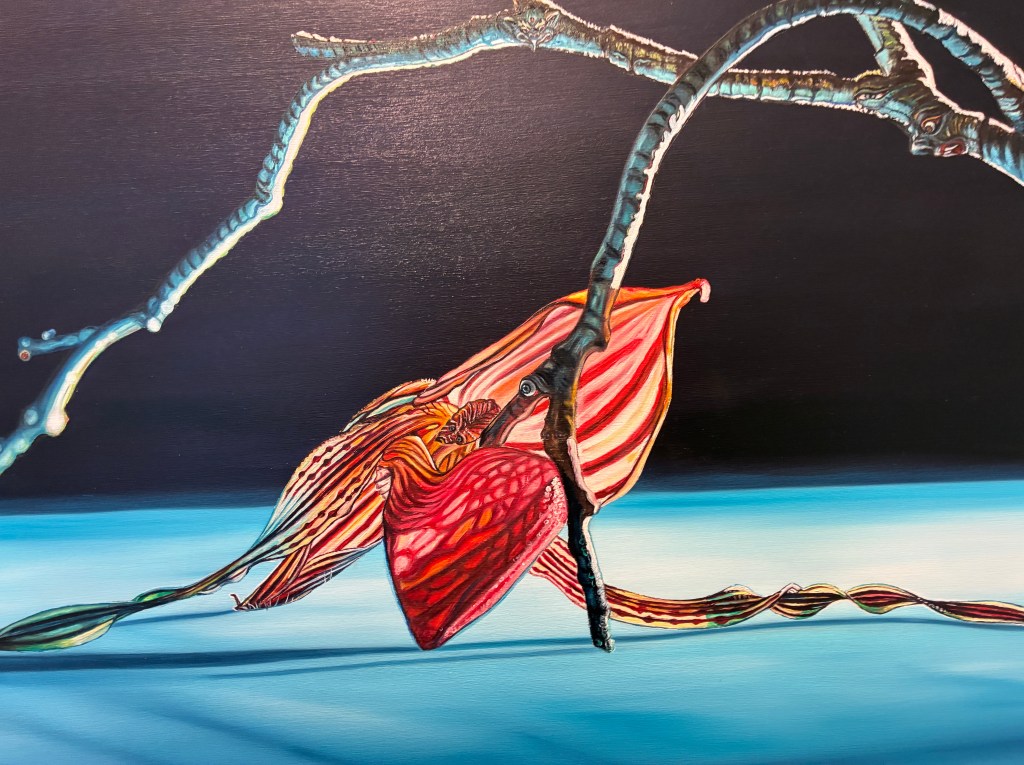
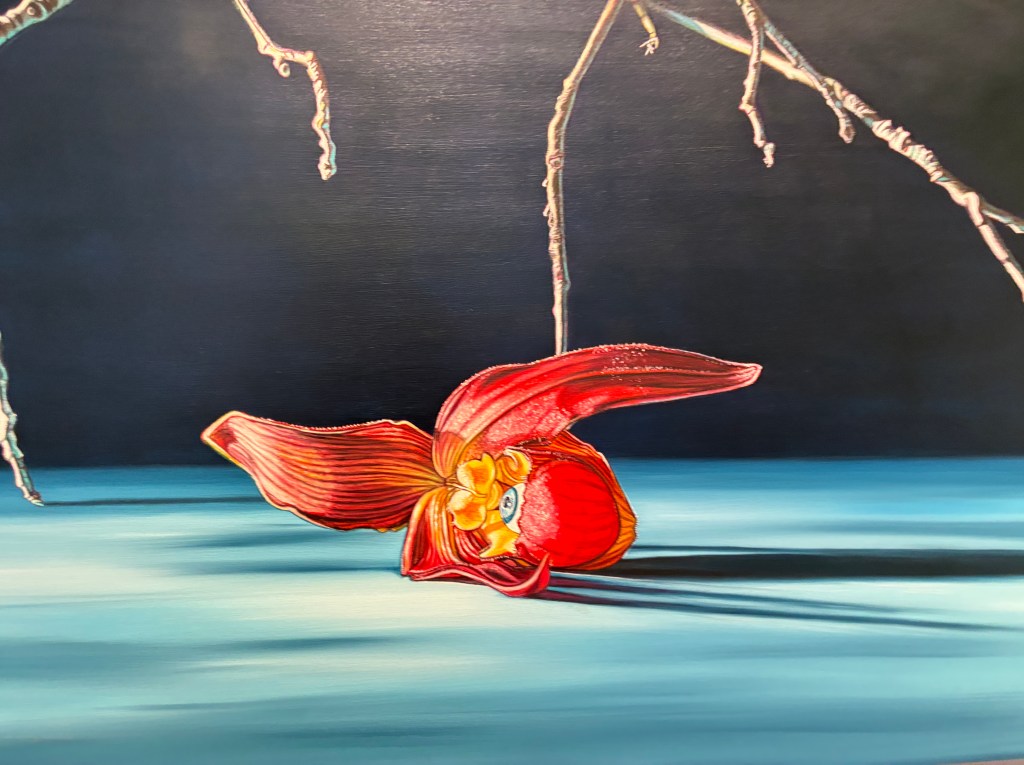
Through the process of making art, Wildberg finds healing and an ability to be at peace with loss and personal strife. Nature’s compassion is an antidote to the inevitability of suffering. In a painting titled Must I Go?, a flower sags away from the sun, bisected by long shadows from the branch above it. The paintings play with what we, as human beings, see of as happy or sad. The faces and eyes in Must I Go? seem sorrowful to us, but to trees and flowers, they are part of a natural cycle of life. Where human beings fall short is our desire for permanence, in line with the Buddhist noble truth that desire is what produces suffering.
“There is nothing wrong with love, positive desire to get to know someone, but what creates suffering and dissatisfaction is you are never satisfied,” Wildberg said. “Ultimately, the satisfaction has to come from within.” Her work asks viewers not to fight suffering or sadness, but to see it as a source of oneness. Each person looking at Wildberg’s paintings has, inside of them, everything she paints—desire, loss, suffering, nests both empty and full.
Jannick Wildberg’s work is on display at ZYNKA Gallery along with Linda Price-Sneddon, Carolyn Frischling, and Peggy Habets through 5/31. You can find her at jannickwildberg.com or @jannickwildberg on Instagram.


Leave a comment